

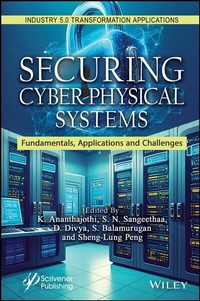
Securing Cyber-Physical Systems
Description

Protect critical infrastructure from emerging threats with this essential guide, providing an in-depth exploration of innovative defense strategies and practical solutions for securing cyber-physical systems.
As industries increasingly rely on the convergence of digital and physical infrastructures, the need for robust cybersecurity solutions has grown. This book addresses the key challenges posed by integrating digital technologies into critical physical systems across various sectors, including energy, healthcare, and manufacturing. Focusing on innovative defence strategies and practical solutions, this book provides an in-depth exploration of the vulnerabilities and defence mechanisms essential to securing cyber-physical systems. The book is designed to equip researchers, cybersecurity professionals, and industry leaders with the knowledge to protect critical infrastructure from emerging digital threats. From understanding complex vulnerabilities to implementing secure system designs, this volume offers a comprehensive guide to fortifying and securing the systems that shape our modern, interconnected world.
Readers will find the volume:
- Explores the evolving threat landscape, encompassing potential attacks on critical infrastructure, industrial systems, and interconnected devices;
- Examines vulnerabilities inherent in cyber-physical systems, such as weak access controls, insecure communication channels, and the susceptibility of physical components to digital manipulation;
- Uses real-world case studies to introduce strategies for assessing and quantifying the cybersecurity risks associated with cyber-physical systems, considering the potential consequences of system breaches;
- Provides an overview of cybersecurity measures and defense mechanisms designed to fortify cyber-physical systems against digital threats, including intrusion detection systems, encryption, and security best practices;
- Discusses existing and emerging regulatory frameworks aimed at enhancing cybersecurity in critical infrastructure and physical systems.
Audience
Researchers, cybersecurity professionals, information technologists and industry leaders innovating infrastructure to protect against digital threats.
More details
Other editions
Additional editions
Persons
K. Ananthajothi, PhD is a Professor in the Department of Computer Science and Engineering at Rajalakshmi Engineering College, Chennai, India. He has published one book, two patents, and several research papers in international journals and conferences. His research focuses on machine learning and deep learning.
S. N. Sangeethaa, PhD is a Professor in the Department of Computer Science and Engineering at the Bannari Amman Institute of Technology, Sathyamangalam, Tamil Nadu, India. She has published seven books, more than 25 research articles in reputable journals, and more than 50 papers in national and international conferences. Her research interests include artificial intelligence, machine learning, and image processing.
D. Divya, PhD is an Assistant Professor in the Department of Computer Science and Engineering at Misrimal Navajee Munoth Jain Engineering College, Chennai, India. She has published several papers in international journals. Her research focuses on data mining and machine learning.
S. Balamurugan, PhD is the Director of Albert Einstein Engineering and Research Labs and the Vice-Chairman of the Renewable Energy Society of India. He has published more than 60 books, 300 articles in national and international journals and conferences, and 200 patents. His research interests include artificial intelligence, augmented reality, Internet of Things, big data analytics, cloud computing, and wearable computing.
Sheng-Lung Peng, PhD is a Professor and the Director of the Department of Creative Technologies and Product Design at the National Taipei University of Business, Taiwan. He has published more than 100 research papers in addition to his role as a visiting professor and board member for several international universities and academic groups. His research interests include designing and analyzing algorithms for bioinformatics, combinatorics, data mining, and networks.
Content
Preface xvii
1 Enhancing Safety and Security in Autonomous Connected Vehicles: Fusion of Optimal Control With Multi-Armed Bandit Learning 1
K.T. Meena Abarna, A. Punitha and S. Sathiya
1.1 Background 2
1.1.1 Problem Statement 4
1.1.2 Motivation 4
1.2 Related Works 5
1.2.1 Contributions 7
1.2.2 Centralized CRN Scheduling 8
1.2.3 Multi-Armed Bandit (MAB) 9
1.2.4 Bandit Learning with Switching Costs 11
1.3 System Model 12
1.3.1 Resource Spectrum 12
1.3.2 CRs' Spectrum Utilization Schemes 13
1.3.3 CBS Scheduling 13
1.3.4 PUs' Activity 13
1.4 Outcomes 15
1.4.1 Scenario I: Fallen Traffic Signs 15
1.4.2 Scenario II: Traffic Signs Alert by the Road Workers 16
1.4.3 Scenario III: Back/Rotated Traffic Sign Across the Road 17
1.4.4 Scenario IV: Hacking of a Stop Sign at a Four-Way Stop Intersection 18
1.5 Conclusions and Future Enhancement 19
1.5.1 Conclusions 19
1.5.2 Future Directions 21
References 23
2 Secure Data Handling in AI and Proactive Response Network: Create a Physical Layer-Proposed Cognitive Cyber-Physical Security 25
A. Sivasundari, P. Kumar, S. Vinodhkumar and N. Duraimurugan
2.1 Introduction 26
2.1.1 The Role of AI in Cybersecurity 27
2.1.2 Usage of CCPS in IoT 27
2.2 Challenges and Mechanisms 28
2.2.1 Brief Account of Challenges Faced 28
2.2.2 Innovative Mechanisms 30
2.3 Using AI to Support Cognitive Cybersecurity 30
2.3.1 Cognitive Systems 30
2.3.2 AI in IoT 30
2.4 Create a Physical Layer-Proposed CCPS 31
2.4.1 Create a Physical Layer-Proposed CCPS in Healthcare Application 33
2.4.1.1 Privacy-Aware Collaboration 33
2.4.1.2 Cycle Model of CCPS 36
2.4.1.3 Dynamic Security Knowledge Base 36
2.4.2 Method for Secure Data Handling 36
2.5 Road Map of Implementation 38
2.5.1 AI for CCPS-IoT 38
2.5.2 AI-Enabled Wireless CCPS-IoT to Provide Security 39
2.6 Conclusions and Future Enhancement 40
Future Directions 41
References 43
3 Intelligent Cognitive Cyber-Physical System-Based Intrusion Detection for AI-Enabled Security in Industry 4.0 45
V. Mahavaishnavi, R. Saminathan and G. Ramachandran
3.1 Introduction 46
3.1.1 Cyber-Physical Systems 46
3.1.2 Intelligent Cyber-Physical Systems (ISPS) 47
3.1.3 Cognitive Cyber-Physical Systems (CCPS) 48
3.1.4 IDS in Industry 4.0 Using iCCPS 49
3.1.5 AI in iCCPS-IDS 49
3.2 Problem Statement 50
3.3 Motivation 51
3.4 Research Gap 52
3.5 Methodology 53
3.5.1 Training Dataset 54
3.5.2 Information for Assessment and Instruction 54
3.5.3 Model 54
3.5.4 CPS Determined by Cognition Agents 56
3.5.5 Useful Implementation of the Actual Device 57
3.6 Importance and Impact of AI-Based Intrusion Detection in iCCPS in Industry 4.0 59
3.6.1 Need 59
3.6.2 Challenges 60
3.7 Conclusions and Future Directions 60
Future Directions 61
References 63
4 Resilient Cognitive Cyber-Physical Systems: Conceptual Frameworks, Models, and Implementation Strategies 65
R. Manivannan and M.P. Vaishnnave
4.1 Introduction 66
4.1.1 Problem Statement 70
4.1.2 Motivation 71
4.2 Materials and Methods 72
4.3 CCPS Design Challenges 74
4.4 Cyber-Physical Systems Principles and Paradigms 77
4.4.1 CCPS Conceptual Framework 79
4.4.2 CCPS Modeling 81
4.4.3 Other Modeling Issues in CCPS 82
4.5 Conclusions and Future Enhancements 83
4.5.1 Future Enhancements 83
References 85
5 Cognitive Cyber-Physical Security Challenges, Issues, and Recent Trends Over IoT 87
Chinnaraj Govindasamy
5.1 Introduction 88
5.1.1 From IoT to CCPS-IoT 93
5.1.2 Fundamental Cognitive Tasks 94
5.2 Motivation and Challenges 94
5.2.1 Motivation 94
5.2.2 Challenges 95
5.3 Security 96
5.3.1 Physical Layer Attacks 98
5.3.2 Physical Layer Security 99
5.3.3 Main Constituents 100
5.4 Research Gap 102
5.5 An Automatic Security Manager for CCPS Using IoT 103
5.5.1 Combatting Erroneous Estimations 103
5.5.2 Detection and Classification 104
5.6 Conclusions and Future Enhancement 104
Future Enhancement 105
References 106
6 Cognitive Cyber-Physical Security With IoT: A Solution to Smart Healthcare System 109
P. Shanmugam, Mohamed Iqbal M. and M. Amanullah
6.1 Introduction 110
6.1.1 Motivation 112
6.1.2 Need and Contribution 113
6.1.2.1 Need 113
6.1.2.2 Contribution 114
6.2 Medical CCPS with IoT 116
6.2.1 IoT Device for AI Solution 118
6.2.2 Traditional Bio-Modality Spoofing Detection 119
6.2.3 MCPS Using AI Device 119
6.3 Functional and Behavioral Perspectives 120
6.4 Modeling and Verification Methods of MCPS 123
6.4.1 MCPS Modeling Based on ICE 124
6.4.2 MCPS Modeling Based on Component 125
6.5 Artificial Intelligence for Cognitive Cybersecurity 125
6.5.1 Privacy-Aware Collaboration 127
6.5.2 Cognitive Security Cycle Model 127
6.6 Conclusions and Future Direction 128
6.6.1 Conclusions 128
6.6.2 Future Directions 129
References 130
7 Cognitive Cyber-Physical Security with IoT and ML: Role of Cybersecurity, Threats, and Benefits to Modern Economies and Industries 133
P. Anbalagan, A. Kanthimathinathan and S. Saravanan
7.1 Introduction 134
7.1.1 Key Contributions 136
7.1.2 Problem Statement 137
7.1.3 Motivation 138
7.2 CCPS Associated with IoT 139
7.2.1 Reasons in Favor of Cognitive Analytics 140
7.2.2 Analyses of Current Cyber Risk Data 141
7.3 Materials and Methods 143
7.3.1 Role of Cybersecurity in CCPS with IoT and ml 143
7.3.2 ml in Cognitive Cyber-Physical Security with IoT 144
7.3.3 Threats to Modern Economies and Industries 144
7.3.4 Benefits to Modern Economies and Industries 147
7.4 Outcomes 148
7.4.1 AI-Enabled Management Technology and Approach Taxonomy 151
7.4.2 Essential Self-Adapting System Technologies 151
7.4.3 Attack Malware Classifier 151
7.5 Conclusions and Future Direction 152
Future Directions 152
References 154
8 A Safety Analysis Framework for Medical Cyber-Physical Systems Using Systems Theory 157
K. Ananthajothi, K. Balamurugan, D. Divya and T.P. Latchoumi
8.1 Introduction 158
8.2 Background 160
8.2.1 Cyber-Physical Systems 160
8.2.2 Quality-of-Service Issues in CPS 161
8.2.3 Medical Cyber-Physical Systems 161
8.3 The Systems-Based Safety Analysis Observation for MCPS 162
8.3.1 Identification of Critical Requirements in MCPS 162
8.3.2 A Systems Theory-Based Method for Safety Analysis in Medical Cyber-Physical Systems 163
8.3.3 MCPS in Patient-Controlled Analgesia 165
8.4 Improved Wireless Medical Cyber-Physical System (IWMCPS) 166
8.4.1 Level: Data Acquisition 166
8.4.2 Layer: Data Aggregating 167
8.4.3 Level: Storing 167
8.4.4 Level: Action 168
8.4.5 IWMCPS Architectural Research 168
8.4.6 Core of Communications and Sensors 168
8.5 Hazard Analysis on PCA-MCPS 169
8.5.1 System Safety Constraint 170
8.5.2 System Safety Control Structure 170
8.5.3 Identify Unsafe Control Actions 170
8.5.4 Specifying Causes 171
8.6 Conclusions and Future Directions 172
Future Directions 172
References 174
9 Cognitive Cybersecurity and Reinforcement Learning: Enhancing Security in CPS-IoT Enabled Healthcare 177
A. Arokiaraj Jovith, M. Sangeetha, D. Saveetha and S. Antelin Vijila
9.1 Introduction 178
9.2 Methodology 182
9.2.1 Device AI Solutions 182
9.2.2 Detect the Spoofing of Bio-Modality 182
9.2.3 Detect the Spoofing of Bio-Modality Using Machine Learning 183
9.3 Challenges and Mechanisms 183
9.3.1 Challenges 183
9.3.2 Innovative Mechanisms 185
9.4 Cognitive Cyber-Physical Systems and Reinforcement Learning 185
9.4.1 Model Formulation 188
9.4.2 AI in CCPS 189
9.4.2.1 Privacy-Aware Collaboration 192
9.4.2.2 Cognitive Security Cycle Model 192
9.4.2.3 Need 193
9.4.2.4 Cross-Sectoral Techniques 193
9.4.2.5 Actuation and Data Collection 194
9.5 Conclusions and Future Directions 194
9.6 Future Directions 195
References 196
10 Navigating the Digital Landscape: Understanding, Detecting, and Mitigating Cyber Threats in an Evolving Technological Era 199
Manikandan J., Hemalatha P., Jayashree K. and Rajeswari P.
10.1 The Digital Transformation: Shaping Modern Business Dynamics 200
10.2 Impact of COVID-19: Accelerating the Digital Shift 201
10.3 Online Safety Concerns: Navigating the Digital Landscape 202
10.4 Interplay of Digital Technologies: Vulnerabilities and Threats 204
10.4.1 Introduction to Digital Technologies 204
10.4.2 Case Studies and Examples 206
10.5 Rise of Cyber Assaults as a Service: Automating Criminal Activities 207
10.6 Evolving Threat Landscape: Understanding Modern Cyber Attacks 210
10.7 Beyond Conventional Security Measures: The Need for Advanced Defense 211
10.8 Rise of Cyber Assaults as a Service: Automating Criminal Activities 213
10.8.1 Introduction to Cyber Assaults as a Service 213
10.8.2 Automation of Criminal Activities 213
10.8.3 Impact and Implications 214
10.9 Evolving Threat Landscape: Understanding Modern Cyber Attacks 215
10.9.1 Types of Modern Cyber Attacks 215
10.9.2 Implications for Cybersecurity Defense 216
10.10 Beyond Conventional Security Measures: The Need for Advanced Defense 217
10.10.1 Challenges with Conventional Security Measures 217
10.10.2 The Evolution of Advanced Defense 218
10.11 Uncovering Cyber Threats: Patterns, Trends, and Detection Methods 218
10.11.1 Patterns of Cyber Threats 218
10.12 Addressing Advanced Persistent Threats: Challenges and Solutions 220
10.12.1 Introduction to Advanced Persistent Threats (APTs) 220
10.12.2 Challenges Posed by APTs 220
10.12.3 Solutions for Addressing APTs 221
References 222
11 Defense Strategies for Cyber-Physical Systems 225
Rajendran Thanikachalam, T. Nithya, Balaji Sampathkumar and J. Mangayarkarasi
11.1 Introduction 226
11.2 Threat Landscape in CPS 228
11.3 Advanced Defense Strategies 231
11.3.1 Anomaly Detection in CPS 231
11.3.2 Secure Communication Protocols 232
11.3.3 Machine Learning-Driven Defenses 235
11.3.4 Zero Trust Model for CPS 237
11.3.5 Resilience Techniques for CPS 240
11.3.6 Intensive Training and Awareness 241
11.3.7 Conclusion and Future Directions 245
References 245
12 Cybersecurity in the Era of Artificial Intelligence: Challenges and Innovations 249
Ashwini A., H. Sehina and Banu Priya Prathaban
12.1 Introduction to Cybersecurity Analysis 250
12.2 Need for AI in Cybersecurity 252
12.3 Current Cybersecurity Techniques 253
12.4 Role of AI in Cybersecurity 255
12.5 Challenges in AI Enhanced Cybersecurity 256
12.6 Quantum Computing and Post Quantum Computing in Cybersecurity 257
12.7 AI Powered Encryption Analysis 259
12.8 Adaptive Cybersecurity 261
12.9 Overall Analysis of AI in Cybersecurity 262
12.10 Privacy Preserving AI and Cybersecurity 263
12.11 Future Directions and Research Challenges 264
12.12 Conclusion 266
References 266
13 Safeguarding the Virtual Realm: Assessing Cyber Security Challenges and Innovations in Today's World 269
Rajaram P., Rajasekar Rangasamy, R. C. Karpagalakshmi, J. Lenin and S. Muthulingam
13.1 Introduction 270
13.2 Understanding the Motivations Behind Cyber Attacks: Financial, Political, and Military Goals 272
13.3 Types of Cyber Threats: From Viruses to Data Breaches 276
13.4 Impact of Cyber Attacks on Businesses and Governments: Financial and Operational Consequences 278
13.5 Strategies for Cyber Security: Prevention, Detection, and Response 281
13.6 Evolving Threat Landscape: Keeping Pace with Emerging Cyber Threats 283
13.7 Exploring Global Cyber Security Initiatives: Collaborative Efforts and Best Practices 285
13.8 Cyber Security Frameworks: Origins, Evolution, and Effectiveness 286
13.9 Emerging Trends in Cyber Security: AI, Blockchain, and IoT Solutions 288
13.10 Challenges and Limitations of Current Cyber Security Approaches 289
13.11 Future Directions in Cyber Security Research and Development 291
13.12 Conclusion 293
References 293
14 Predicting Android Ransomware Attacks Using Categorical Classification 295
A. Pandiaraj, N. Ramshankar, Mathan Kumar Mounagurusamy, Karakanapati Mrudhula, P. Lahari Sai and Lekkala Likhitha
14.1 Introduction 296
14.2 Background Study 297
14.3 Scope 300
14.4 Experimentation 300
14.5 Methodology 303
14.6 Conclusion 306
References 306
15 Defense Strategies for Cognitive Cyber-Physical Systems in Machine Learning Domain 309
M. Karthiga, N. Sangavi, V. R. Kiruthika, S. N. Sangeethaa, P. Ananthi and S. Vaanathi
15.1 Introduction 310
15.1.1 Background and Motivation 313
15.1.2 Challenges in CPS Defense 314
15.1.2.1 Resource Constraints and Real-Time Demands: Security in a Tight Spot 314
15.1.2.2 Data Security and Privacy: Balancing Protection with User Rights 314
15.1.2.3 Human Factors and Insider Threats: The Weakest Link 315
15.1.2.4 Evolving Threats: A Never-Ending Battle 315
15.2 Literature Review 315
15.3 CPS Security Fears 318
15.3.1 Vulnerabilities Posed in CPS 319
15.4 Secure Approaches for CPS: In Terms of Technology and Attack Perspectives 320
15.4.1 Security Strategies for Various Aspects of Attacks 320
15.5 Issues and Concerns for Ml Protection for CPS 322
15.5.1 ml Model Attacks and the Relevant Measures for Prevention 323
15.5.1.1 Dataset Poisoning Attacks 325
15.5.1.2 Black-Box Attack 327
15.5.1.3 White Box Attack 328
15.5.1.4 Backdoor Attacks 328
15.6 Countermeasures Against Dataset Poisoning Attempts 328
15.6.1 Simulated Poisoning Incidents 329
15.6.2 Countermeasures Against Model Poisoning Incidents 330
15.7 Vulnerability to Privacy 330
15.7.1 Process of Reverse Engineering and API Calls Disclosing Sensitive Data 331
15.8 Membership Inference Assaults 333
15.9 Runtime Disruption Assault 335
15.10 Comparative Investigation 336
15.11 Conclusion and Future Research Directions 338
References 339
16 Cyber-Physical Systems: Challenges, Opportunities, Security Solutions 343
Gopinathan S., S. Babu and P. Shanmugam
16.1 Cyber-Physical Systems 344
16.1.1 Introduction 344
16.1.2 Present Issues on Cyber Security 345
16.1.2.1 Phishing Exploits 346
16.1.2.2 Internet of Things Ransomware 347
16.1.2.3 Strengthened Regulation of Data Privacy 347
16.1.2.4 Cyberattacks Using Mobile Technology 347
16.1.2.5 A Higher Allocation of Resources to Automation 347
16.1.3 CPS -Applications and Research Areas 348
16.2 Cyber Security Challenges 351
16.2.1 Social Media Role in Cyber-Security 352
16.2.2 Cyber-Security Methods 352
16.2.2.1 Access Management and Passphrase Protection 352
16.2.2.2 Verification of Data 352
16.2.2.3 Malicious Software Detectors 353
16.2.2.4 Network Security Barriers 353
16.2.2.5 Antimalware 353
16.3 Integration of Physical and Digital 353
16.3.1 Materials and Procedures 354
16.3.2 Applications 355
16.3.2.1 Financial Sector 355
16.3.2.2 Health Division 355
16.3.2.3 Business Sector 356
16.3.2.4 Industry Sector 356
16.4 Digital Threats to Physical Systems 357
16.4.1 Threats Prioritization 357
16.4.2 Selection of Security Requirements 358
16.5 Industry 4.0 Security 359
16.5.1 Classification of Cyber-Physical Systems and their Pertinent Themes within the Framework of Industry 4.0 360
16.5.2 The Digital Supply System 361
16.5.2.1 The Data Sharing Hazards Associated with the Digital Supply System 361
16.5.2.2 Data Sharing: Granted Access to Information for More Parties 362
16.5.3 Cybersecurity Challenges in Industry 4.0 363
16.6 Evaluation of Risk for CPS 364
16.6.1 Safety Risk Assessment Standards 364
16.6.2 Approaches for Safety Risk Evaluation in CPS 365
16.6.2.1 Analysis of Fault Trees 365
16.6.2.2 Failure Modes and Impacts Evaluation (fmie) 365
16.6.2.3 The Menace and Operability Approach 365
16.6.2.4 Model-Centred Engineering 366
16.6.2.5 Master Logic Illustration with Objective Tree - Accomplishment Tree 366
16.6.2.6 System Theoretical Accident Model and Procedures (STAMP) is the Foundation for System Theoretic Process Analysis, a Hazard Analysis Method 366
References 366
Index 369
1
Enhancing Safety and Security in Autonomous Connected Vehicles: Fusion of Optimal Control With Multi-Armed Bandit Learning
K.T. Meena Abarna*, A. Punitha and S. Sathiya
Department of Computer Science and Engineering, Annamalai University, Annamalainagar, Chidambaram, India
Abstract
Communication between vehicles as well as intra-vehicle sensors that include radar and cameras are some of the components that are necessary for autonomous connected vehicles (ACVs) to function properly. This paves ways for both physical as well as cyberattacks, where by an adversary can physically control the ACVs by manipulating the sensor readings. This study proposes a complete control and learning system to protect ACV networks from the physical and the cyberattacks. It has been established that the proposed controller is resistant to physical assaults meant to cause instability in ACV systems. As driverless vehicles become more common, it is crucial to make sure that safety procedures and security safeguards are resilient. The proposed framework makes use of the best control techniques to steer cars through challenging situations while maximizing efficiency and safety. Furthermore, adaptive decision-making in unpredictable and dynamic scenarios-taking into account safety and security restrictions-is made possible by multi-armed bandit learning. The framework attempts to create robust systems that can mitigate cyber-physical threats and guarantee the safe operation of ACVs in a variety of contexts by incorporating various strategies.
Keywords: Autonomous connected vehicles, cognitive cyber-physical systems, cybersecurity, adaptive control, network security, sensor fusion, vulnerability assessment, dynamic environments
1.1 Background
Traditional manual driving entails using the vehicle's pedals and steering, which can result in dangerous actions in a complex traffic environment and this leads to a variety of accidents related to driving. Reaction time, distractibility, and lack of experience are a few instances of these human flaws. Furthermore, a lot of drivers have a lots of bad driving habits, which adds to the unpredictable driving behaviors that cause traffic jams/congestions and thereby a decline in the traffic system's overall efficiency [1]. In contrast, it is expected that autonomous vehicles (AVs) would either increase the efficiency of roadways or completely reduce accidents that result from human actions or behavior or inactions. Simultaneously, the notion "internet of vehicles" since has gained support for improving the getting together of AVs. Automobiles can exchange a range of datasets through the internet of vehicles, such as sensory inputs, information on locations, and their sensing of their environmental surroundings [2].
Keeping the roads safe has always been of utmost importance. In area of AVs and human-driven vehicles adoption, determining the most effective strategy to lower vehicle-related traffic accidents in today's environment is one of the most actively researched issues. In situations where different factors (such the weather) are constantly changing, AVs are required to make necessary decisions [3]. To minimize the likelihood of collisions, an automobile needs to be able to predict adjacent cars' or objects' actions with sufficient accuracy. All vehicles in a typical traffic scenario are operated by people, and, because of their knowledge and expertise, the people are able to predict with accuracy what other vehicles or nearby objects are likely to do next. Based on this evaluation, everyone who drives instantly modifies their behavior to enhance safety and ensure a free traffic flow [4]. However, in a mixed traffic situation, AVs have to anticipate actions of the human driver upon their perspectives of the road. While driving, the vehicles are allowed through communications such as vehicle-to-infrastructure (V2I) and vehicle-to-vehicle (V2V) to get information regarding the objects that are present in the road. Additionally, by enabling information sharing between AVs and surrounding entities, vehicle-to-everything (V2X) communication contributes significantly to AV decision-making processes, resulting in more safer and more effective driving [5]. An AV's decision-making process could be improved by V2X communications and more specifically V2V communication, and that importance has been highlighted.
The authors have proposed a steering control method based on machine learning (ML) with urban settings coupled with V2X communications to enhance driving. The communication protocols used in vehicular networks, which enable safe communication between vehicles driven by humans and AVs, have been the subject of extensive research. An AV can predict the actions of other objects in the vicinity by exchanging information with other cars and learning about their present driving conditions [6].
These vehicles possess the capacity to precisely identify traffic signs (TSs) and categorize things that are present in the scenario according to their environmental function-a feat mostly made possible by sophisticated ML algorithms-is essential to how they operate. The integrity of these algorithms is a very crucial factor, though. Serious road accidents might result from malicious acts or misinterpretations. Anomalies do exist in most of advanced technology. These flaws could be used by hostile actors to trick autonomous driving systems, which could have a disastrous result. Therefore, to promote AVs' safe incorporation into our transportation system network, a thorough understanding of cyber-physical security is vital, with a particular emphasis on traffic sign recognition (TSR) and object classification (OC) algorithms [7].
In the future, AVs (ACVs) will need to handle a lot of data that is gathered through communication links and sensors. Maintaining the accuracy of this information is essential for smooth flow of traffic and to ensure safe roads [8]. However, autonomous connected vehicles (ACVs) are very much susceptible to cyber-physical attacks because of their reliance on data processing and connectivity. Specifically, an attacker may introduce errors into the ACV at data processing stage, which might lead to accidents or negatively impact traffic flow on the roads [9]. As shown by a practical experiment conducted on a Jeep Cherokee in [10], ACVs are mostly susceptible to cyberattacks that can take over some of its vital functions, such as acceleration and braking. Naturally, an unauthorized person gaining control of an ACV might not only affect the compromised ACV but also hinder other vehicles' flow and result in subpar intelligent transportation system (ITS) performance. This, in turn, encourages an in-depth study into the combined physical and cyber effects of assaults on ACV systems. Cognitive radio networks (CRNs) have emerged as an intriguing model to change the efficiency of spectrum utilization and offer ubiquitous connections for an increasing number of applications [11].
For the purpose of creating and executing effective spectrum sharing mechanisms in CRNs, an essential building piece is the knowledge regarding primary user (PU) activity, or whether the channels are ON/OFF or busy/idle. When assigning a fixed spectrum, the cognitive base station (CBS) queries an external white space database to obtain complete information about the spectrum occupancy of each PU [12]. However, this approach assumes that the data held in the database is always accurate and has not been compromised, which results in increased communication overhead between the database and the CBS.
1.1.1 Problem Statement
The challenge of ACVs is to balance societal integration with technology growth. Many issues need to be resolved as we move toward a time when automobiles are more interconnected and autonomous, in order to guarantee the safe and widespread use of these AVs.
Ensuring the safety of self-driving vehicles in a range of intricate and dynamic contexts is one of the main concerns. Unpredictable situations such as bad weather, construction zones, and encounters with humandriven vehicles, pedestrians, and cyclists are some of the challenges that ACVs must navigate efficiently. Achieving comprehensive safety assurance systems is essential to fostering confidence in autonomous systems' dependability and averting further mishaps or accidents.
Furthermore, it becomes clear that cybersecurity is an important cog in the wheel of deployment of ACV. Vehicles, nowadays, are more susceptible to cyber threats including malware, hacking, and illegal access, owing to their increased connectivity via wireless networks and communication systems. Preventing hostile assaults that could jeopardize vehicle's functionality, passenger safety, or data privacy requires ensuring the integrity and security of ACV systems.
Moreover, there are ethical, legal, and regulatory issues with integrating ACVs into the present transportation system. It becomes essential to set up thorough frameworks that regulate AV operations, accident responsibility, and moral decision-making in dire circumstances. To encourage public acceptance and governmental support for ACVs, it is crucial to strike a balance between innovation and safety, privacy, and societal issues.
To put the safety and well-being of all road users in priority, developing strong safety mechanisms, bolstering cybersecurity, and navigating ethical and regulatory landscapes are all necessary to address the problem statement of ACVs and to ensure...
