

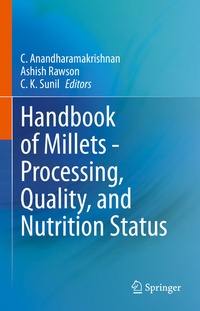
Handbook of Millets - Processing, Quality, and Nutrition Status
Description

The book offers an updated perspective on the unique characteristics of millets. Millets are consumed for their health/nutritional benefits, and in the preparation of specialty foods for target groups - from pediatrics to geriatrics. Recent trends suggest the importance of millet in the human diet due to their nutritional importance, ability to grow in high temperatures and drought conditions, and their resistance to pests and diseases. This book highlights different types of millet and discusses their properties as well as nutritional and anti-nutritional values. In addition, the book also provides information on the physiochemical properties, future prospects, current methodologies, and agricultural practices. The last few parts cover the emerging technologies in millet processing, by-products utilization, quality standards, and the current millet industry scenario. The book provides a comprehensive overview of the status of millet processing, quality, and nutraceutical product manufacture.
The book is a resourceful read for students and researchers in food sciences, as well as industry experts.
More details
Other editions
Additional editions
Persons
Dr. C. Anandharamakrishnan has more than two decades of experience in research and development and administration at the CSIR-Central Food Technological Research Institute (CFTRI). He was principal scientist and coordinator for the Academy of Scientific and Innovative Research at CSIR-CFTRI, before appointment as the director of the Indian Institute of Food Processing Technology (IIFPT), Thanjavur. His areas of research include design of engineered nano- and microscale delivery systems for the controlled and targeted release of food bioactive compounds, spray drying and spray-freeze-drying of food products, and computational modeling of food processing operations. Till date he has published more than 150 articles in peer reviewed international journals and 08 books. He serves as editor/editorial board member in various journals which includes Journal of Food Science and Technology, Drying Technology, Journal of Food Process Engineering, PLOS One, International Journal of Food Engineering etc.
Ashish Rawson, MTech, PhD, is an Associate Professor at the Indian Institute of Food Processing Technology, India. He obtained his PhD from the National University of Ireland Galway in collaboration with Teagasc Food Research Centre Ashtown Dublin, Ireland. He has over 17 years of experience in teaching and research. His area of research includes thermal and non-thermal processing technologies, food by-product valorization, and food safety. He serves as associate editor for Frontiers in Sustainable Food Systems and as guest editor for the Journal of Food Process Engineering , Wiley, further he serves as reviewer in almost all the leading food research journals.
Sunil. C. K, PhD, is an Assistant Professor at the Indian Institute of Food Processing Technology, India. He obtained his PhD in food process engineering from the Indian Institute of Food Processing Technology, India. He has over 17 years of teaching, research, and industry experience. Hehas published scientific papers and book chapters in peer-reviewed journals and books. His areas of research include processing of millet, design and development of processing machineries, application of novel thermal and non-thermal technologies, and valorization of processing waste. He serves as review editor for Frontiers in Sustainable Food Systems. He also serves as a reviewer for different international journals.
