

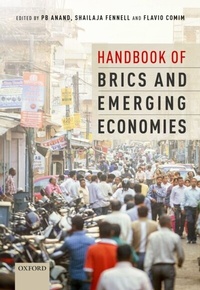
Handbook of BRICS and Emerging Economies
1st Edition
Published on 16. December 2020
1104 pages
978-0-19-256255-5 (ISBN)
Description

Ever since Jim O'Neill at Goldman Sachs coined the term BRICS in 2001 there have been many different assessments of these major emerging economies, with some even proclaiming that the promise of the BRICS (comprising Brazil, Russia, India, China, and South Africa) is over. However, the so called 'arranged marriage' still seems to be working well, with the club having become a formal international forum, with summit declarations, ministerial meetings, and numerous BRICS-wide fora. Is this euphoria misplaced? Is there a BRICS model of economic and human development? Are inequalities increasing and is this the denouncement of the economic successes? Are geo-political tensions rising between these nations?
During the post COVID-19 situation, the importance of bilateral and multilateral co-operation mechanisms and institutions is becoming clear. This book focuses on one such emerging co-operation mechanism of BRICS but also more widely on those five countries and other similar economies. As a global depression looms large, global economic recovery depends on the performance of not only its largest economies but also many other important and significant economies within the so called G20 group. Even prior to the COVID-19 outbreak multilateral institutions have been under considerable strain, as with the relationship between the United States of America and China, and risks to global economic recovery appear very real. This book brings together multi-disciplinary perspectives from over sixty scholars and it presents a comprehensive and deep dive into the BRICS and emerging economies and into an understanding the political, economic, and social contexts that can help in designing approaches for recovery and regaining the last momentum in the journey towards the Sustainable Development Goals.
More details
Other editions
Additional editions
Pb Anand | Shailaja Fennell | Flavio Comim
Handbook of BRICS and Emerging Economies
Book
12/2020
Oxford University Press
€242.50
Shipment within 15-20 days
Persons
P.B. Anand is Professor of Public Policy and Sustainable Development and Head of Peace Studies and International Development at the University of Bradford. He is a member of the Council of the Development Studies Association and a Fellow of the Human Development and Capability Association. He previously worked in a development bank in India and managed an executive education programme portfolio at Bradford for the staff of China Development Bank (2007-13) and the Aga Khan Foundation (2013-15). He was the principal author and team leader of the Mongolia Human Development Report 2011 and contributed to UNDP studies on climate change, extractive economies, and sustainable development. He is the author of Scarcity, Entitlements and the Economics of Water in Developing Countries (2007) and many papers on global public goods, access to water and smart cities. With Flavio Comim and Shailaja Fennell, he edited New Frontiers of the Capability Approach (Cambridge University Press, 2018).
Shailaja Fennell is Reader in Regional Transformation and Economic Security at the Department of Land Economy, University of Cambridge. She is a Fellow of the Human Development and Capability Association and a member of the governing council of the Development Studies Association (UK). She has undertaken more than two decades of research in both Asian and African countries, and has been a consultant with the World Bank, DFID, Oxfam and ASEAN. Her previous publications include Rules, Rubrics and Riches: The Interrelations between Legal Reform and International Development (2010), and she has published papers in the fields of comparative regional development to examine how the lives of rural and urban communities have been affected by the nature and directives of development policy.
Flavio Comim is a Development Economist and an Associate Professor of Economics at the IQS School of Management, Ramon Llull University in Spain and an Affiliated Lecturer at Land Economy University of Cambridge. He has worked for the United Nations Development Programme (UNDP) and has been a consultant for UNESCO, WHO, UNEP (UN Environment Programme), and ILO in several development projects. He has co-edited several books, including The Capability Approach: Concepts, Measures and Applications (2008), with Mozaffar Qizilbash and Sabina Alkire; Capabilities and Happiness (2008), with Luigino Bruni and Maurizio Pugno; Capabilities, Gender, Equality (2014), with Martha Nussbaum; and New Frontiers of Human Development with Shailaja Fennell and P.B. Anand (2018).
Content
- Section I: Introduction
- 1: PB Anand, Shailaja Fennell, and Flavio Comim: BRICS and emerging economies: an assessment
- Section II: Economic Perspectives, Resources, and Development
- 2: Martin Daunton: WTO and the BRICS: a historical perspective
- 3: Deepak Nayyar: BRICS and other emerging economies
- 4: Moazam Mahmood and Florence Bonnett: Growth, employment, and social protection in BRICS
- 5: John Weiss: Development banks in BRICS with a focus on Brazil
- 6: Vinode Ramgopal and Ashish Kalra: Capitalizing the world
- 7: Rashmi Arora: Financial inclusion and financial stability in India
- 8: Mario Biggieri: Informal sector in China and India
- 9: Dan Meng, Yan Gao, and Xioayang Li: Rural-urban migration and its multi-dimensional impacts in China
- 10: PB Anand: Extractive economies, institutions, and development: Implications for BRICS and emerging economies
- 11: Degol Hailu: Africa's extractive economies
- 12: Padraig Carmody: Building BRICS in Africa
- 13: Richard Sidebottom: Cotton production and trade in West Africa
- Section III: Social Development Challenges and Perspectives
- 14: Flavio Comim: Publicness and human development: an illustration from BRICs
- 15: David Clark: Reason, argument, and agitation: can South Africa follow in the footsteps of the BRICS countries?
- 16: A Dalcin, T Kang, Daiane Zanon, Felipe Bellé, Luana Betti, , Fabio Rasche Jr, Daiane Zanon, and F Comim: Education in BRICS
- 17: G Garibotto: Early childhood and human development
- 18: C. Raj Kumar: Building world class universities in BRICS: reflections
- 19: Kenia Parsons: Hijacking of social protection by cash transfers- the case of Bolsa Familia
- 20: Miguel Nino Zarazua: Social protection in Mexico
- 21: Alice Krozer, Stephanie Garry, and Juan-Carlos Moreno Brid: Minimum wages and inequality in Mexico: an example (not) to follow
- 22: S Chatterjee: The illegal trade in organs and poverty in India: a comparative analysis with Brazil and China
- Section IV: Inequality and Political Economies
- 23: Prabir Bhattacharya and Vibhor Saxena: Demography and roots of gender inequality in BRICS
- 24: Sabino da Silva Porto Junior, Bernardo Frederes Kramwr Alcalde, and Izete Pengo Bagolin: Equality of opportunity in Brazil and India: an empirical exercise for the 1993-2013 period.
- 25: Shailaja Fennell: Women and identity: negotiating institutional pathways to claim rights in China and India
- 26: Lucy McMahon: Violence and the BRICS
- 27: Catalina Droppelmann Roepke and Nicolas Trajenberg: Inequality and crime in Latin America
- 28: Javier Gonzalez-Diaz: The political economy of inequality in Chile: the role of institutions and power
- 29: David Potts: Development and inequality in the African lions
- Section V: Sustainable Development Issues
- 30: Tadashi Hirai: Happiness in BRICS
- 31: Franklin Obeng-Odoom: Cities, oil, and national development
- 32: Nicholay Kolev and Yue Xu: Institutional changes in the oil industry: China versus Russia
- 33: Olga Ulybina: Is Russia going green?
- 34: Terry van Gevelt: Indigenous communities, ICT and rural development: case studies in Tanzania and Sarawak, Malaysia
- 35: Suresh Babu and Kamiljon Akramov: Food security in Central Asia and implications for BRICS
- Section VI: Governance Issues
- 36: Richard Jolly: Humane global governance: an area for the future where progress inches forward
- 37: Haider Khan: Governing a complex global financial system in the age of global instabilities and BRICs
- 38: Deepanshu Mohan: Governing dynamics of a changing global order: case for the developing countries
- 39: Paul Jackson: United Nations? The BRICS and international peace keeping
- 40: Cassandra Sweet: Emerging powers coalitions: India and Brazil examined
- 41: Sunil Tankha: Economic, political, and social transformation in Brazil: a study in disorderly progress
- 42: Vsevolod Samokhlov: Reshaping Eurasia: Russian and Chinese regional approaches
- 43: Utku Teksoz: Turkey: always at crossroads, never quite there
