

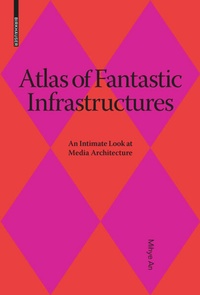
Atlas of Fantastic Infrastructures
Description

Der Atlas erforscht die Charakteristiken von Architektur, Medien und digitaler Infrastruktur. Anders ausgedrückt, handelt er von der Materialität von Gebäuden und der Immaterialität von Daten. Während die technischen und funktionalen Untersuchungen medialer Architektur dazu neigen, die Vielschichtigkeit der Phänomene zwischen abstrakter Virtualität und konkreter Realität zu verflachen, schlägt die Autorin spekulativ vier abstrakte Prismen vor: 1) AFFAIR WITH PHANTOMS - Wen wollen wir in einem digital vermittelten Raum antreffen und welche Art von Unterhaltung/Aktivitäten werden wir haben? 2) PARA-DESIRE - Wo leben unsere surrealen Wünsche und was sind die Strategien der Umsetzung? 3) MEDIATED SPACE CATALOGUE - Welche Daten, Informationen, Dinge, Räume und Orte stehen uns in der Welt zur Verfügung und wie überlagern wir sie durch unsere Aktivitäten? 4) GIFTS OF THE GARDENS - Wie kann eine Idee in die physische Realität eindringen und was sind die Pfade, auf welchen dies geschehen kann?
Die Autorin untersucht dabei Bauten und Projekte von Toyo Ito, Werner Sobek, Philippe Rahm, Usman Haque, Electroland, Troika, NOX sowie Rafael Lozano-Hemmer, Ben Rubin und Olafur Eliasson.
More details
Other editions
Additional editions
Persons
Content
- Intro
- Contents
- Foreword: Mastering the Generic by Ludger Hovestadt
- Preface
- Atlas I - Affair With Phantoms
- Accepting Obscurity
- Accepting Affection
- Having Fictitious Affairs
- Scheherazade
- Dracula
- Orlando
- The Last Leaf
- Morel's Machine
- God
- Atlas II - Para-Desire
- Infrastructure of Para-Functionality
- Para-Desire
- Infra-Natural
- Infra-Ordinary
- Infra-Speculative
- Atlas III - Mediated Space Catalogue
- 1001 Days on Earth
- At Home
- Outside
- Something Special
- Atlas IV - Gifts of the Gardens
- A Field Trip to Gardens
- Fourfold Analysis and Speculation
- Baroque
- English
- Zen
- Monastic
- Folly
- Footnotes
- Image Credits
- Acknowledgements
- Imprint
