

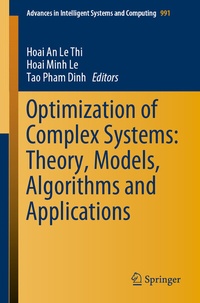
Optimization of Complex Systems: Theory, Models, Algorithms and Applications
1st Edition
Published on 15. June 2019
XXII, 1152 pages
978-3-030-21803-4 (ISBN)
Description

This book contains 112 papers selected from about 250 submissions to the 6th World Congress on Global Optimization (WCGO 2019) which takes place on July 8-10, 2019 at University of Lorraine, Metz, France. The book covers both theoretical and algorithmic aspects of Nonconvex Optimization, as well as its applications to modeling and solving decision problems in various domains. It is composed of 10 parts, each of them deals with either the theory and/or methods in a branch of optimization such as Continuous optimization, DC Programming and DCA, Discrete optimization & Network optimization, Multiobjective programming, Optimization under uncertainty, or models and optimization methods in a specific application area including Data science, Economics & Finance, Energy & Water management, Engineering systems, Transportation, Logistics, Resource allocation & Production management. The researchers and practitioners working in Nonconvex Optimization and several application areas can find here many inspiring ideas and useful tools & techniques for their works.
More details
Series
Language
English
Place of publication
Cham
Switzerland
Publishing group
Springer International Publishing
Target group
Professional and scholarly
Product notice
Reflowable
Illustrations
XXII, 1152 p. 252 illus., 168 illus. in color.
File size
59,31 MB
ISBN-13
978-3-030-21803-4 (9783030218034)
DOI
10.1007/978-3-030-21803-4
Schweitzer Classification
Other editions
Additional editions
Hoai An Le Thi | Hoai Minh Le | Tao Pham Dinh
Optimization of Complex Systems: Theory, Models, Algorithms and Applications
Book
06/2019
Springer
€160.49
Shipment within 7-9 days
Content
- Intro
- Preface
- Organization
- Conference Chair
- Program Chairs
- Publicity Chair
- International Program Committee Members
- External Reviewers
- Plenary Lecturers
- Special Session Organizers
- Organizing Committee Members
- Sponsoring Institutions
- Contents
- Continuous Optimization
- A Hybrid Simplex Search for Global Optimization with Representation Formula and Genetic Algorithm
- 1 Introduction
- 2 Hybrid Simplex Search with Representation Formula and Genetic Algorithm
- 2.1 Representation Formula
- 3 Test Bed
- 4 Numerical Results
- 4.1 Influence of the Pincus Function
- 4.2 Influence of the Population Size Used in GA
- 4.3 Influence of the Sample Size for RF
- 4.4 Comparison Between Methods
- 4.5 Comparison with Other Methods
- 5 Conclusion
- References
- A Population-Based Stochastic Coordinate Descent Method
- 1 Introduction
- 2 Coordinate Descent Method
- 3 A Population-Based Stochastic Coordinate Descent Method
- 4 Numerical Experiments
- 5 Conclusions
- References
- A Sequential Linear Programming Algorithm for Continuous and Mixed-Integer Nonconvex Quadratic Programming
- 1 Introduction
- 2 Presentation of the Problem and Definitions
- 3 Steps of the SLP Algorithm
- 4 Numerical Experiments
- 5 Conclusion
- References
- A Survey of Surrogate Approaches for Expensive Constrained Black-Box Optimization
- 1 Introduction
- 2 General Structure of Surrogate Methods for Constrained Optimization
- 3 Surrogates for Constrained Black-Box Optimization
- 3.1 Radial Basis Function Model
- 3.2 Kriging Model
- 4 Infill Strategies for Constrained Optimization
- 4.1 Radial Basis Function Methods
- 4.2 Kriging-Based Methods
- 4.3 Surrogate-Assisted Methods for Constrained Optimization
- 4.4 Parallelization and Handling High Dimensions
- 5 Summary and Future Directions
- References
- Adaptive Global Optimization Based on Nested Dimensionality Reduction
- 1 Introduction
- 2 The Global Search Algorithm
- 3 Dimensionality Reduction
- 3.1 Dimensionality Reduction Using Peano-Type Space-Filling Curves
- 3.2 Nested Optimization Scheme
- 3.3 Block Adaptive Optimization Scheme
- 4 Results of Numerical Experiments
- 5 Conclusion
- References
- A B-Spline Global Optimization Algorithm for Optimal Power Flow Problem
- 1 Introduction
- 2 Background: Polynomial B-Spline Approach for Global Optimization
- 2.1 Univariate Case
- 2.2 Multivariate Case
- 2.3 Main B-Spline Global Optimization Algorithm
- 3 Case Study: 3-Bus Power System
- 4 Conclusions
- References
- Concurrent Topological Optimization of a Multi-component Arm for a Tube Bending Machine
- 1 Introduction
- 2 Problem Formulation
- 3 Two Dimensional Problem
- 4 Concurrent Topological Optimization of a Tool Support Swing Arm
- 5 Conclusion
- References
- Discrete Interval Adjoints in Unconstrained Global Optimization
- 1 Introduction
- 2 Methodology
- 2.1 Interval Arithmetic
- 2.2 Algorithmic Differentiation
- 2.3 Interval Adjoint Algorithmic Differentiation
- 3 Branch and Bound with Interval Adjoints
- 4 Case Studies
- 4.1 Ambiguous Control-Flow Branches
- 4.2 Minimum Bound Update
- 4.3 Interval Derivative Conditions
- 5 Conclusion and Outlook
- References
- Diving for Sparse Partially-Reflexive Generalized Inverses
- 1 Introduction
- 2 Relaxing P2
- 3 Diving
- 4 Preliminary Experiments
- References
- Filtering Domains of Factorable Functions Using Interval Contractors
- 1 Introduction
- 2 Interval Computations
- 2.1 Interval Arithmetic
- 2.2 Interval Contractors
- 3 Filtering Domains of Functions
- 3.1 Domain Constraints
- 3.2 Branch-and-Contract-Algorithm
- 4 Experimental Results
- 5 Discussion and Perspectives
- References
- Leveraging Local Optima Network Properties for Memetic Differential Evolution
- 1 Introduction
- 2 Definitions
- 2.1 Strategies
- 2.2 Local Optima Network
- 2.3 Network Measures
- 3 Benchmarking the Classic Variants
- 3.1 Test Functions
- 3.2 Performance Metrics
- 3.3 Stop Conditions
- 3.4 Results
- 4 MDE Supported by Network Analysis
- 4.1 Above-Below Rule
- 4.2 Numerical Experiment
- 5 Conclusions
- References
- Maximization of a Convex Quadratic Form on a Polytope: Factorization and the Chebyshev Norm Bounds
- 1 Introduction
- 2 Methods
- 3 Comparison and Numerical Experiments
- 4 Conclusion
- References
- New Dynamic Programming Approach to Global Optimization
- 1 Introduction
- 2 The Optimization Problem
- 3 Dual Approach to Rc
- 4 Sufficient Optimality Conditions for the Problem (8)
- 5 Feedback Control for the Problem Rc
- References
- On Chebyshev Center of the Intersection of Two Ellipsoids
- 1 Introduction
- 2 SDP Relaxation and Its Approximation Bound
- 3 Globally Solve (CC) in Polynomial Time
- 4 Generate CDT Subproblem with Positive Duality Gap
- References
- On Conic Relaxations of Generalization of the Extended Trust Region Subproblem
- 1 Introduction
- 2 Optimality Conditions
- 3 Conclusions
- References
- On Constrained Optimization Problems Solved Using the Canonical Duality Theory
- 1 Preliminaries
- 2 The Main Result
- References
- On Controlled Variational Inequalities Involving Convex Functionals
- 1 Introduction
- 2 Notations, Working Hypotheses and Problem Formulation
- 3 Preliminary Results
- 4 Main Results
- References
- On Lagrange Duality for Several Classes of Nonconvex Optimization Problems
- 1 Introduction
- 2 -Convexity
- 3 Subgradients
- 3.1 Minimax Theorem for -Convex Functions
- 4 Lagrange Duality for -Convex Functions
- 5 Conclusions
- References
- On Monotone Maps: Semidifferentiable Case
- 1 Introduction
- 2 Preliminaries
- 2.1 Semidifferentials
- 2.2 Convexity in Semidifferentible Case
- 2.3 Pseudoconvexity and Quasiconvexity
- 2.4 Monotonicity and Geneneralized Monotonicity
- 3 Main Results
- References
- Parallel Multi-memetic Global Optimization Algorithm for Optimal Control of Polyarylenephthalide's Thermally-Stimulated Luminescence
- Abstract
- 1 Introduction
- 2 Problem Statement and the SMEC Algorithm
- 3 Parallel M3MEC Algorithm
- 4 Optimal Control of Polyarylenephthalide's Thermally-Stimulated Luminescence
- 4.1 Thermally-Stimulated Luminescence of Polyarylenephthalides
- 4.2 Optimal Control Problem and Numerical Experiments
- 5 Conclusions
- Acknowledgments
- References
- Proper Choice of Control Parameters for CoDE Algorithm
- 1 Introduction
- 2 Adaptive Variant of CoDE
- 3 Efficiency of DE Control Parameters
- 4 Proposed Variants of CoDE Algorithm
- 4.1 CoDEFCR1: Better Average Performing Setting
- 4.2 CoDEFCR2: Worse Average Performing Setting
- 5 Experimental Settings
- 6 Results
- 7 Conclusion
- References
- Semidefinite Programming Based Convex Relaxation for Nonconvex Quadratically Constrained Quadratic Programming
- 1 Introduction
- 2 Convex Relaxations Based only on Constraints
- 3 Concluding Remark
- References
- Solving a Type of the Tikhonov Regularization of the Total Least Squares by a New S-Lemma
- 1 Introduction
- 2 Proof for the New Version of the S-Lemma
- 2.1 Optimizing a Class of Polynomials of Degree 4 (PoD4)
- 3 Dinkelbach Method for Solving (TRTLI)
- 4 Discussion
- References
- Solving Mathematical Programs with Complementarity Constraints with a Penalization Approach
- 1 Introduction
- 2 Preliminaries
- 3 A Penalization Approach
- 4 Numerical Results
- 5 Conclusion
- References
- Stochastic Tunneling for Improving the Efficiency of Stochastic Efficient Global Optimization
- 1 Introduction
- 2 Problem Statement
- 3 The Adaptive Variance Target sEGO Approach
- 3.1 Stochastic Kriging (SK)
- 4 Adaptive Target Selection
- 5 The Proposed Normalization Scheme
- 6 Numerical Examples
- 7 Conclusion
- References
- The Bernstein Polynomials Based Globally Optimal Nonlinear Model Predictive Control
- 1 Introduction
- 2 NMPC Formulation
- 3 Bernstein Polynomial Approach for Global Optimization
- 3.1 Newton-Based Box Trim Operator
- 3.2 Bernstein Bound-trim-branch Global Optimization Algorithm
- 3.3 Simulation Results
- 4 Conclusions
- References
- Towards the Biconjugate of Bivariate Piecewise Quadratic Functions
- 1 Introduction
- 2 Preliminaries and Notations
- 3 The Domain of the Conjugate
- 4 Conjugate Expressions
- 5 Conclusion and Future Work
- References
- Tractable Relaxations for the Cubic One-Spherical Optimization Problem
- 1 Introduction
- 2 Notation and Preliminaries
- 3 Relaxations for the CSP
- 3.1 Lower Bound by Decomposition - Approach 1
- 3.2 Lower Bound by Duality - Approach 2
- 4 Numerical Results
- 4.1 Discretization - Approach 3
- 4.2 Small Instances from the Literature
- 4.3 Random Instances
- References
- DC Programming and DCA
- A DC Algorithm for Solving Multiobjective Stochatic Problem via Exponential Utility Functions
- 1 Introduction
- 2 Problem Statement
- 3 Transformations and Reformulation
- 4 Review of DC Programming and DCA
- 5 DCA Applied to Problem (8)
- 6 Experimental Results
- 7 Conclusion
- References
- A DCA-Based Approach for Outage Constrained Robust Secure Power-Splitting SWIPT MISO System
- 1 Introduction
- 2 System Model
- 3 Solution Method Based on DC Programming and DCA
- 3.1 DC Programming and DCA
- 3.2 DC Programming and DCA for Solving the Problem (1)
- 4 Numerical Experiments
- 5 Conclusions
- References
- DCA-Like, GA and MBO: A Novel Hybrid Approach for Binary Quadratic Programs
- 1 Introduction
- 2 DCA-Like, GA and MBO for Solving BQP
- 2.1 DC Programming and DCA
- 2.2 DC Reformulation of BQP
- 2.3 Genetic Algorithms and Its Application to BQP
- 2.4 Migrating Bird Optimization
- 3 COP-DCAl-Meta: The Cooperative Approach
- 4 Numerical Results
- 5 Conclusion
- References
- Low-Rank Matrix Recovery with Ky Fan 2-k-Norm
- 1 Introduction
- 2 Ky Fan 2-k-Norm-Based Models
- 3 Numerical Algorithm
- 3.1 Difference of Convex Algorithms
- 3.2 Numerical Results
- 4 Conclusion
- References
- Online DCA for Times Series Forecasting Using Artificial Neural Network
- 1 Introduction
- 2 Online Learning and Online DCA
- 2.1 Online Learning
- 2.2 DCA and Online DCA
- 3 Autoregressive Neural Network for Online Forecasting Problem
- 4 Solving the Problem (2) by Online DCA
- 4.1 DC Decomposition and Subproblems of Online DCA
- 4.2 Learning Rule: min { ft(): S } (Case t0 = t)
- 4.3 Learning Rule: min { i=1 } t fi(): S (Case t0 = 1)
- 5 Numerical Experiments
- 6 Conclusion
- References
- Parallel DC Cutting Plane Algorithms for Mixed Binary Linear Program
- 1 Introduction
- 2 DC Programming Formulation and DCA for MBLP
- 3 DC Cutting Planes
- 3.1 Valid Inequalities Based on DC Programming
- 3.2 DC Cut from Infeasible Solution
- 3.3 DC Cut from Feasible Solution
- 4 DC-CUT Algorithms
- 4.1 DC-CUT Algorithm Without Parallelism
- 4.2 Parallel-DC-CUT Algorithm
- 4.3 Variant DC-CUT and Parallel-DC-CUT Algorithms
- 5 Experimental Results
- 6 Conclusion and Perspectives
- References
- Sentence Compression via DC Programming Approach
- 1 Introduction
- 2 Hybrid Sentence Compression Model
- 2.1 ILP Probability Model
- 2.2 Parse Tree Model
- 2.3 New Hybrid Model: ILP-Parse Tree Model
- 3 DC Programming Approach for Solving ILP
- 4 Experimental Results
- 4.1 F-score Evaluation
- 4.2 Numerical Results
- 5 Conclusion and Perspectives
- References
- Discrete Optimization and Network Optimization
- A Horizontal Method of Localizing Values of a Linear Function in Permutation-Based Optimization
- 1 Introduction
- 2 The Combinatorial Optimization Problem: Statement and Properties
- 3 The Horizontal Method for PB-COP2
- 4 BP.COP2 Example
- 5 Conclusion
- References
- An Experimental Comparison of Heuristic Coloring Algorithms in Terms of Found Color Classes on Random Graphs
- Abstract
- 1 Introduction
- 2 Coloring Algorithms
- 2.1 Sequential Algorithms
- 2.2 Mixed/Combined Algorithms
- 2.3 Parallel Algorithms
- 3 Tests and Results
- 3.1 Sequential Algorithms
- 3.2 Combined Algorithms
- 3.3 Parallel Algorithms
- 4 Conclusion
- References
- Cliques for Multi-Term Linearization of 0-1 Multilinear Program for Boolean Logical Pattern Generation
- 1 Introduction and Background
- 2 Main Results
- 3 A Preliminary Experiment
- References
- Gaining or Losing Perspective
- 1 Definitions
- 2 Our Results
- 2.1 Volumes
- 2.2 Asymptotics: The Case of p equals 2
- 2.3 Branching-Point Selection: The Case of p equals 2
- 3 Computational Experiments: The Case of p equals 2
- 3.1 Separable Quadratic-Cost Knapsack Covering
- 3.2 Mean-Variance Optimization
- References
- Game Equilibria and Transition Dynamics with Networks Unification
- Abstract
- 1 Introduction
- 2 Model Description
- 3 Unification of Innovative Nets
- 4 Adjusting Dynamics in Networks and Dynamic Stability of Equilibria
- 5 Network Dynamics Model of Net Unification
- 6 Conclusion
- Acknowledgement
- References
- Local Search Approaches with Different Problem-Specific Steps for Sensor Network Coverage Optimization
- 1 Introduction
- 2 Related Work
- 3 Maximum Lifetime Coverage Problem (MLCP)
- 4 General Scheme of the Local Search
- 5 Experiments
- 5.1 Benchmark SCP1
- 5.2 Overall Mean Percentage Quality
- 5.3 Lengths of Schedules
- 6 Conclusions
- References
- Modelling Dynamic Programming-Based Global Constraints in Constraint Programming
- 1 Introduction
- 2 Method
- 3 Computational Results
- 3.1 Shortest Path in MiniZinc
- 3.2 Knapsack Problem
- 4 Conclusions
- References
- Modified Extended Cutting Plane Algorithm for Mixed Integer Nonlinear Programming
- 1 Introduction
- 2 The Extended Cutting Plane Algorithm
- 3 The Outer Approximation Algorithm
- 4 Our Modified Extended Cutting Plane Algorithm
- 5 Computational Results
- References
- On Proximity for k-Regular Mixed-Integer Linear Optimization
- 1 Introduction
- 1.1 Literature Review and Outline
- 1.2 Fundamentals
- 2 Proximity for k-Regular MILO
- 2.1 k-Regular Mixed-Integer Linear Optimization
- 2.2 2-Regular Pure-Integer Linear Optimization
- 3 Special Case: The Incidence Matrix of a Mixed Graph
- References
- On Solving Nonconvex MINLP Problems with SHOT
- 1 Introduction
- 2 The SHOT Solver
- 3 SHOT as a Local Solver for Nonconvex MINLP Problems
- 3.1 Repairing Infeasibilities in the Dual Problems
- 3.2 Forcing Primal Updates Using a Cutoff Constraint
- 4 Automated Reformulations for Linearizing Special Terms
- 5 Some Numerical Tests
- 6 Conclusions
- References
- Reversed Search Maximum Clique Algorithm Based on Recoloring
- Abstract
- 1 Introduction
- 2 Maximum Clique Algorithms Review
- 3 New Algorithm
- 3.1 Description
- 3.2 Coloring Choice Based on Density
- 3.3 Algorithm
- 4 Results
- 4.1 Generated Test Results/Random Graphs
- 4.2 DIMACS Test Results
- 5 Summary
- References
- Sifting Edges to Accelerate the Computation of Absolute 1-Center in Graphs
- 1 Introduction
- 1.1 Previous Results
- 1.2 Our Results
- 2 Definitions and Notations
- 3 Fundamental Properties
- 4 A Faster Algorithm for A1CP
- 4.1 Sifting Edges
- 4.2 The Algorithm
- 4.3 Application
- 5 Conclusions
- References
- Solving an MINLP with Chance Constraint Using a Zhang's Copula Family
- 1 Introduction
- 2 Copulae: A Bird's Eye View
- 3 Outer Approximation
- 4 A Power System Management Problem
- 4.1 Problem's Description
- 4.2 Problem's Data
- 5 Numerical Experiments
- 6 Conclusion
- References
- Stochastic Greedy Algorithm Is Still Good: Maximizing Submodular + Supermodular Functions
- 1 Introduction
- 2 Preliminaries
- 3 Algorithms
- 3.1 SG Algorithm
- 3.2 SSG Algorithm
- 3.3 RG Algorithm
- 4 Numerical Experiments
- 5 Conclusion
- References
- Towards Multi-tree Methods for Large-Scale Global Optimization
- 1 Introduction
- 2 Polyhedral Outer-Approximation
- 2.1 Piecewise DC Outer Approximation
- 3 DECOA
- 3.1 Cut and Breakpoint Generation
- 3.2 OA-Start Heuristic
- 3.3 Solving OA Sub-problems
- 3.4 Fix-and-Refine
- 3.5 OA-Based Local Search
- 3.6 Bound Tightening
- 4 Numerical Experiments Using Decogo
- 5 Conclusions
- References
- Optimization under Uncertainty
- Fuzzy Pareto Solutions in Fully Fuzzy Multiobjective Linear Programming
- 1 Introduction
- 2 Preliminaries on Arithmetic and Partial Order on Fuzzy Numbers
- 3 Fully Fuzzy Multiobjective Linear Problem
- 4 Conclusions
- References
- Minimax Inequalities and Variational Equations
- 1 Introduction
- 2 Variational Equations for Reflexive Spaces
- 3 Minimax Inequality Under Weak Conditions
- 4 Conclusions
- References
- Optimization of Real-Life Integrated Solar Desalination Water Supply System with Probability Functions
- Abstract
- 1 Introduction
- 2 General Formulation of SPP-PF
- 3 A Model of System
- 3.1 Simulation Model of Integrated Solar Desalination Water Supply System
- 3.2 Financial-Economic Model of System
- 4 The Optimization Problems
- 4.1 Case 1: Objective Function Is Mathematical Expectation
- 4.2 Case 2: Combined Chance Constrained Programming Problem
- 4.3 Case 3: Joint Chance Constrained Programming Problem
- 5 Conclusions
- Appendix
- References
- Social Strategy of Particles in Optimization Problems
- Abstract
- 1 Introduction
- 2 The Standard PSO Model
- 3 SoPSO Method
- 4 Test Results
- 5 Conclusion
- References
- Statistics of Pareto Fronts
- Abstract
- 1 Introduction
- 2 Statistics of Families of Curves
- 2.1 Problem Position
- 2.2 An Approach Independent from the Representation
- 2.3 Application to Pareto Fronts
- 3 Statistics of Pareto Fronts by Using Generalized Fourier Series
- 4 Concluding Remarks
- Appendix A: Generalized Fourier Series
- References
- Uncertainty Quantification in Optimization
- Abstract
- 1 Introduction
- 2 UQ Methods for the Determination of the Unknown Coefficients
- 2.1 Collocation
- 2.2 Variational Approximation
- 2.3 Moment Matching
- 2.4 Adaptation of an Iterative Method
- 2.5 Optimality Equations
- 3 Concluding Remarks
- References
- Uncertainty Quantification in Serviceability of Impacted Steel Pipe
- 1 Introduction
- 2 Numerical Model of a Pipe Under Variable Impactors
- 2.1 Pipe Modeling
- 2.2 Limit State Criterion
- 2.3 Impactor Modeling
- 3 Sensitivity Analysis of Impactor and Pipe Characteristic
- 3.1 Obtained Results
- 4 Uncertainty Analysis of a Model
- 4.1 Stresses Variability Under Multiple Impacts
- 5 Conclusion
- References
- Multiobjective Programming
- A Global Optimization Algorithm for the Solution of Tri-Level Mixed-Integer Quadratic Programming Problems
- 1 Introduction
- 1.1 Previous Work
- 2 Tri-Level Mixed-Integer Quadratic Optimization Algorithm
- 2.1 Numerical Example
- 3 Computational Studies
- 4 Conclusions
- References
- A Method for Solving Some Class of Multilevel Multi-leader Multi-follower Programming Problems
- 1 Introduction
- 2 Problem Formulation
- 3 Equivalent Formulation
- 4 Solution Approach For Special Problems
- 5 Example
- 6 Conclusion
- References
- A Mixture Design of Experiments Approach for Genetic Algorithm Tuning Applied to Multi-objective Optimization
- 1 Introduction
- 2 Theoretical Fundamentals
- 2.1 Global Criterion Method
- 2.2 Genetic Algorithms
- 2.3 Mixture Design of Experiments
- 3 Experimental Method
- 4 Case Study-The FCAW Process Optimization
- 5 Conclusion
- References
- A Numerical Study on MIP Approaches over the Efficient Set
- 1 Introduction
- 2 Mixed Integer Programming Approaches
- 3 Preliminary Computational Experiments
- 4 Conclusion
- References
- Analytics-Based Decomposition of a Class of Bilevel Problems
- 1 A New Class of Bilevel Problems
- 2 An Analytics-Based Decomposition for the BPMSIF
- 3 Numerical Examples
- 3.1 A Benchmark Problem
- 3.2 A Large-Scale Problem
- 4 Conclusions
- References
- KMCGO: Kriging-Assisted Multi-objective Constrained Global Optimization
- Abstract
- 1 Introduction
- 2 Kriging Model
- 3 KMCGO Method
- 3.1 The Construction of Three Optimization Objectives
- 3.2 Selection of New Expensive-Evaluation Points
- 3.3 Exploration on Promising Area
- 3.4 The Specific Implementation Flows
- 4 Test
- 4.1 Numerical Test
- 4.2 Speed Reducer Design Problem
- 4.3 Comparison
- 5 Conclusions
- Acknowledgements
- References
- Multistage Global Search Using Various Scalarization Schemes in Multicriteria Optimization Problems
- 1 Introduction
- 2 Multistage Multicriteria Optimization Problem Statement
- 3 Reduction of the Multistage Multicriteria Search to the Scalar One-Dimensional Global Optimization Problems
- 4 Computational Complexity Reduction of the Multistage Multicriteria Search on the Basis of the Reuse of the Search Information
- 5 Efficient Solving the Multistage Multicriteria Optimization Problems with Nonlinear Constraints
- 6 Results of Numerical Experiments
- 7 Conclusion
- References
- Necessary Optimality Condition for Nonlinear Interval Vector Programming Problem Under B-Arcwise Connected Functions
- 1 Introduction
- 2 Preliminaries
- 3 Optimality Conditions
- 4 Conclusions
- References
- On the Applications of Nonsmooth Vector Optimization Problems to Solve Generalized Vector Variational Inequalities Using Convexificators
- 1 Introduction
- 2 Definitions and Preliminaries
- 3 Relationships Between Vector Variational Inequality Problems and Nonsmooth Vector Optimization Problem
- References
- SOP-Hybrid: A Parallel Surrogate-Based Candidate Search Algorithm for Expensive Optimization on Large Parallel Clusters
- 1 Introduction
- 2 The SOP Algorithm
- 2.1 Synchronous Model-Based Optimization Framework
- 2.2 A Multi-objective View of the Exploration-Exploitation Tradeoff
- 2.3 Candidate Search - DYCORS
- 3 SOP-Hybrid Framework
- 3.1 Selection - Acquisition Functions
- 4 Computer Experiments
- 4.1 Experimental Setup
- 4.2 Results
- 5 Conclusion
- References
- Surrogate Many Objective Optimization: Combining Evolutionary Search, -Dominance and Connected Restarts
- 1 Introduction
- 2 The -GOMORS Algorithm
- 2.1 The Iterative Surrogate Optimization Framework
- 2.2 The GOMORS Algorithm
- 2.3 The -GOMORS Framework
- 2.4 -Non-Dominance Archiving and -NSGA-II
- 2.5 Connected Restarts
- 3 Experiments and Results
- 3.1 Experimental Setup
- 3.2 Results
- 4 Conclusion
- References
- Tropical Analogues of a Dempe-Franke Bilevel Optimization Problem
- 1 Introduction
- 2 The Min-Min and Max-Min Problem
- 2.1 The Max-Max and Min-Max Problems
- 3 Conclusions and Acknowledgement
- References
- -Weak Slater Constraint Qualification in Nonsmooth Multiobjective Semi-infinite Programming
- 1 Introduction
- 2 Notations
- 3 Main Results
- References
- Data science: Machine Learning, Data Analysis, Big Data and Computer Vision
- A Discretization Algorithm for k-Means with Capacity Constraints
- 1 Introduction
- 2 The Centroid Set and -Approximate Centroid Set
- 3 After the -Approximate Centroid Set
- 4 The Construction of -Approximate Centroid Set
- 4.1 Well-Separated Instances
- 4.2 General Instances
- 5 Naive FPT(k,d) PTAS: A Simple Application
- References
- A Gray-Box Approach for Curriculum Learning
- 1 Introduction
- 2 Reinforcement Learning Background
- 3 The Curriculum Learning Problem
- 4 The Scheduling Problem to Minimize Regret
- 5 Numerical Methods for the Gray-Box
- 6 Experimental Evaluation
- 6.1 GridWorld
- 6.2 Algorithms and Implementation Details
- 6.3 Numerical Results
- References
- A Study on Graph-Structured Recurrent Neural Networks and Sparsification with Application to Epidemic Forecasting
- 1 Introduction
- 2 A Short Review of Recurrent Neural Network
- 3 Graph-Strutured RNN Model
- 4 Graph Description of Spatial Correlation
- 5 Sparsity Promoting Penalties
- 6 Experimental Results
- 7 Concluding Remarks
- References
- Automatic Identification of Intracranial Hemorrhage on CT/MRI Image Using Meta-Architectures Improved from Region-Based CNN
- 1 Introduction
- 2 Background
- 2.1 Meta-Architectures Improved from the Strategy of R-CNN
- 2.2 Transfer Learning
- 2.3 Hounsfield Unit (HU) of Brain Hemorrhage
- 3 Proposed Method
- 3.1 Converting DICOM to PNG Based on Window Technique
- 3.2 Retraining Faster R-CNN and R-FCN on ICH Dataset
- 4 Experiments
- 4.1 Data Preprocessing
- 4.2 Retraining COCO-Trained Faster R-CNN and R-FCN Models
- 5 Conclusion
- References
- Bayesian Optimization for Recommender System
- 1 Introduction
- 2 The Problem Definition
- 3 Bayesian Optimization for Hyper-parameter Optimization
- 3.1 Hyper-parameter Optimization
- 3.2 Bayesian Optimization
- 4 BO on a Benchmark Test Function
- 5 Application
- 6 Conclusions
- References
- Creation of Data Classification System for Local Administration
- Abstract
- 1 Introduction
- 2 Text Classification Methods
- 3 The Architecture of the Data Classification System for the Local Administration
- 4 Conclusion
- Acknowledgment
- References
- Face Recognition Using Gabor Wavelet in MapReduce and Spark
- 1 Introduction
- 2 Related Works
- 3 Background
- 3.1 Feature Extraction
- 3.2 K-Nearest Neighbors (KNN)
- 3.3 Spark and Hadoop MapReduce
- 4 Our Proposed Method
- 4.1 An Overview of Our Approach
- 4.2 Feature Extraction Model of Facial Image
- 4.3 Face Recognition Model with MapReduce in Spark Environment
- 5 Experimental and Results
- 5.1 Testing and Result
- 6 Conclusion
- References
- Globally Optimal Parsimoniously Lifting a Fuzzy Query Set Over a Taxonomy Tree
- 1 Introduction
- 2 Parsimoniously Lifting a Fuzzy Thematic Subset in Taxonomy: Model and Method
- 3 Structuring and Generalizing a Collection of Research Papers
- 3.1 Scholarly Text Collection
- 3.2 DST Taxonomy
- 3.3 Scoring the Relevance Between Texts and Key Phrases
- 3.4 Deriving Fuzzy Clusters of Taxonomy Topics
- 3.5 Results of Lifting Clusters L, R, and C
- References
- K-Medoids Clustering Is Solvable in Polynomial Time for a 2d Pareto Front
- 1 Introduction
- 2 Problem Statement and Notation
- 3 Optimal Property of Interval Clustering
- 4 Computing the Costs of Interval Clustering
- 5 Dynamic Programming Algorithm
- 6 Bi-Objective Clustering, How to Choose K?
- 7 Conclusion and Perspectives
- References
- Learning Sparse Neural Networks via 0 and T1 by a Relaxed Variable Splitting Method with Application to Multi-scale Curve Classification
- 1 Introduction
- 2 Sparse Neural Network Training Algorithm
- 3 Experimental Results
- 4 Conclusions
- References
- Pattern Recognition with Using Effective Algorithms and Methods of Computer Vision Library
- Abstract
- 1 Introduction
- 2 Binarization, Segmentation and Machine Learning
- 2.1 Harris Corner Detection
- 3 Experimental Results
- 3.1 Algorithms SIFT, FAST and SURF
- 4 Contour Analysis
- 5 Conclusion
- References
- The Practice of Moving to Big Data on the Case of the NoSQL Database, Clickhouse
- Abstract
- 1 Introduction
- 2 Main Part
- 2.1 Defining Big Data
- 3 Methodology
- 4 Results and Findings
- 5 Conclusion
- References
- Economics and Finance
- Asymptotically Exact Minimizations for Optimal Management of Public Finances
- 1 Introduction
- 2 Main Results
- 2.1 Theoretical Results
- 2.2 Numerical Experiments
- 3 Conclusion
- References
- Features of Administrative and Management Processes Modeling
- Abstract
- 1 Introduction
- 2 Modeling of Administrative and Management Processes on the Example of University Business Processes
- 2.1 Tools for Business Modeling and Analysis
- 2.2 Description of the Process Environment and Creation of the "As Is" Process Model
- 3 Conclusion
- Acknowledgments
- References
- Optimization Problems of Economic Structural Adjustment and Problem of Stability
- 1 Introduction
- 2 The Model
- 3 Evaluation of the Implementation of Transfer Conditions of Computational Experiments Results to the Practice
- 3.1 Estimates of the Stability of Smooth Mappings Defined by the Model
- 3.2 Estimates of the Stability Indicators of Smooth Mappings Defined by the Model
- 3.3 Implementation of the Counterfactual and Forecast Scenarios
- 4 The Solution of the Problem of Structural Adjustment
- 4.1 Selection of the Promising Industries
- 4.2 Setting and Solving the Parametric Control Problem
- References
- Research of the Relationship Between Business Processes in Production and Logistics Based on Local Models
- Abstract
- 1 Introduction
- 2 The Purpose of Creating a Basic Business Process Model
- 3 Local Business Process Models: Choice, Purpose and Operation
- 3.1 External Conceptual Model (CM1)
- 3.2 Internal Conceptual Model (CM2)
- 3.3 The Strategic Model (SM)
- 4 Logical Model of the J-th Specialized Process (LMJ)
- 5 Conclusion
- Acknowledgments
- References
- Sparsity and Performance Enhanced Markowitz Portfolios Using Second-Order Cone Programming
- 1 Background and Motivation
- 2 Formulations for Sparse Portfolios
- 3 Tightening the Perspective Relaxation
- 4 Our Data Driven Sparse Portfolio Methods
- 5 Computational Study and Experiments
- 5.1 Integer Programing Computational Experiments.
- 5.2 Predictive Performance Experiments
- 5.3 Experiments with Fama and French Factors
- 6 Conclusion
- References
- Managing Business Process Based on the Tonality of the Output Information
- Abstract
- 1 Introduction
- 2 Pre-project Analysis. Practical Examples
- 3 Algorithmization of the Analysis and Calculation of Tonality Indicators
- 4 Methods of Process Formalization and Management of the Company's Analytics Processes
- 5 Conclusion
- Acknowledgments
- References
- Energy and Water Management
- Customer Clustering of French Transmission System Operator (RTE) Based on Their Electricity Consumption
- 1 Introduction
- 2 The Proposed High-Dimensional Time-Series Data Clustering Approach
- 2.1 DTW Distance: A Suitable Similarity Measure for Time-Series Data
- 2.2 A Feature-Based Clustering Approach for High-Dimensional Time-Series Data
- 2.3 Description of the Main Algorithm
- 3 Numerical Experiments
- 4 Conclusion
- References
- Data-Driven Beetle Antennae Search Algorithm for Electrical Power Modeling of a Combined Cycle Power Plant
- Abstract
- 1 Introduction
- 1.1 Data-Driven Optimization
- 1.2 Combined Cycle Power Plant (CCPP)
- 2 Research Methodology
- 2.1 Cascade Feed-Forward Neural Network (CFNN)
- 2.2 Performance Measure
- 2.3 BAS Algorithm
- 3 Computational Results and Analysis
- 4 Conclusions
- References
- Finding Global-Optimal Gearbox Designs for Battery Electric Vehicles
- 1 Introduction
- 2 Related Work
- 3 Materials and Methods
- 3.1 Generation of Load Scenarios
- 3.2 Mathematical Gearbox Model
- 3.3 Mathematical Motor Model
- 4 Results
- 5 Conclusion and Outlook
- References
- Location Optimization of Gas Power Plants by a Z-Number Data Envelopment Analysis
- Abstract
- 1 Introduction
- 2 Literature Review
- 3 Description Model with the Z-DEA
- 4 Experimental Results and Discussion
- 4.1 Determining Effective and Important Criteria
- 4.2 Specifying Input and Output Variables
- 4.3 Determining the Efficiency of Each Index with F-DEA and Z-DEA Models
- 4.4 Determining the Optimum Alpha Using the Noise Analysis
- 4.5 Sensitivity Analysis
- 4.6 Factor Weighting
- 4.7 Identifying the Optimum Location for Establishing a Gas Power Plant
- 4.8 Comparing the Z-DEA and F-DEA Models
- 5 Conclusions
- References
- Optimization of Power Plant Operation via Stochastic Programming with Recourse
- Abstract
- 1 Introduction
- 2 Introduction Model for Photovoltaic Generation
- 3 Formulation of Photovoltaic Generation Introduction Model
- 4 Piecewise Linear Approximation of Nonlinear Constraint Equation
- 5 Evaluation of Solution by Stochastic Programming
- 6 Concluding Remarks
- References
- Randomized-Variants Lower Bounds for Gas Turbines Aircraft Engines
- 1 Introduction
- 2 Problem Description
- 3 Proposed Lower Bounds
- 3.1 Non-increasing Lifespan Order Heuristic (LPT)
- 3.2 Randomized Based Heuristics Rk
- 4 Experimental Results
- 5 Conclusion
- References
- Robust Design of Pumping Stations in Water Distribution Networks
- 1 Introduction
- 2 Optimal Design of a Pumping Station
- 2.1 Operation of a Branched Network
- 2.2 Robust Design and Relaxed Operation
- 2.3 Pump Investment Variables, Constraints and Costs
- 3 Benders' Decomposition
- 3.1 Stabilized Cutting-Plane Algorithm
- 4 Infeasibility, Dominance and Fault Tolerance
- 4.1 Dominance
- 4.2 Generation of Feasibility Cuts
- 4.3 Robustness to a Pump Outage
- 5 Numerical Assessments on a Real-Life Instance
- 5.1 Numerical Results
- 6 Conclusion
- References
- Engineering Systems
- Application of PLS Technique to Optimization of the Formulation of a Geo-Eco-Material
- Abstract
- 1 Introduction
- 2 Design of Experiment with PLS Technique
- 3 Eco-Geo-Materials
- 4 Raw Earth Concrete Mixture Design
- 5 Model Validation
- 6 Results and Discussion
- 6.1 Loading Plot of PLS Technique
- 6.2 Response Surface Plot of UCS-Optimization
- 7 Conclusions
- References
- Databases Coupling for Morphed-Mesh Simulations and Application on Fan Optimal Design
- 1 Introduction
- 2 Database Generation
- 3 Design Space Exploration with Assistant Information
- 3.1 Regression Model
- 3.2 Correlation Model
- 4 Multi-condition Optimal Design of Engine Cooling Fan
- References
- Kriging-Based Reliability-Based Design Optimization Using Single Loop Approach
- 1 Introduction
- 2 Theory of Kriging Metamodel
- 3 Kriging-Based Single Loop Approach (Kriging-SLA)
- 4 Examples and Results
- 4.1 First Mathematical Example
- 4.2 Second Mathematical Example
- 5 Conclusion
- References
- Sensitivity Analysis of Load Application Methods for Shell Finite Element Models
- 1 Introduction
- 2 Load Application Methods
- 2.1 Group 1: Application of Loads by Sections (LAM-RBE)
- 2.2 Group 2: Application of Loads by Sections but Physical Distribution (LAM-4NO)
- 3 Shell Finite Element Model
- 4 Sensitivity Analysis: Morris Method
- 5 Sensitivity Analysis of Load Application Methods
- 5.1 Case 1(a): Materials Properties and Loads as Inputs and Displacement as Output
- 5.2 Case 1(b): Materials and Loads as Inputs and Stress as Output Parameters
- 5.3 Case 2(a): Loads Only as Input Parameters and Displacement as Output Parameter
- 5.4 Case 2(b): Loads Only as Input Parameters and Stress as Output Parameter
- 6 Conclusion and Perspectives
- References
- Transportation, Logistics, Resource Allocation and Production Management
- A Continuous Competitive Facility Location and Design Problem for Firm Expansion
- 1 The Model
- 2 Solving the Location Model
- 2.1 An Exact Interval B&B Method
- 2.2 A Heuristic Evolutionary Algorithm
- 3 Computational Studies
- 4 Conclusions and Future Research
- References
- A Genetic Algorithm for Solving the Truck-Drone-ATV Routing Problem
- 1 Introduction
- 2 Problem Description
- 3 Solution Method
- 4 Computational Experiments
- 4.1 Test Setting
- 4.2 Numerical Results
- 5 Conclusion
- References
- A Planning Problem with Resource Constraints in Health Simulation Center
- 1 Introduction
- 2 SimUSanté: A Planning Problem with Resource Constraints
- 3 SimUG: A Greedy Algorithm
- 3.1 Function sessionChoice()
- 3.2 Function findBetterStart()
- 3.3 Function: eligibleActivities()
- 3.4 Function: activityChoice()
- 3.5 Function: updateAvailability
- 4 Instances and Computational Results
- 4.1 Description of Instances
- 4.2 Computational Results
- 5 Conclusion and Perspectives
- References
- Edges Elimination for Traveling Salesman Problem Based on Frequency K5s
- 1 Introduction
- 2 The Frequency K5s and a Probability Model
- 2.1 The Frequency K5s
- 2.2 A Probability Model
- 3 The Binomial Distribution Model
- 4 A Heuristic Algorithm
- 5 Examples and Analysis
- 6 Conclusions
- References
- Industrial Symbioses: Bi-objective Model and Solution Method
- Abstract
- 1 Introduction
- 2 Industrial Symbioses and Assumptions
- 3 Bi-Objective Maximization Problem
- 4 Reformulation of (4) and Solution Methods
- 5 Numerical Experiment
- 6 Conclusion
- References
- Intelligent Solution System Towards Parts Logistics Optimization
- 1 Introduction
- 2 Problem Formulation
- 2.1 Problem Scenario Description
- 2.2 Mathematical Model
- 3 Solution
- 3.1 Algorithm Architecture
- 3.2 2L-VRPTW Solver
- 3.3 Initialization
- 3.4 Optimization-Tabu Search
- 3.5 Post-optimization
- 4 Experiment and Result
- 5 Conclusion
- References
- Optimal Air Traffic Flow Management with Carbon Emissions Considerations
- Abstract
- 1 Introduction
- 2 Literature Review
- 3 Emissions-Delay Network Model
- 3.1 CO2 Emissions Approximation and Calculations
- 3.2 Sets
- 3.3 Parameters
- 3.4 Decision Variables
- 3.5 Bi-objective Mixed Integer Linear Programming Model
- 3.6 Solution Approach
- 4 Delay and CO2 Emissions Trade-Off
- 5 Conclusions
- Acknowledgement
- References
- Scheduling Three Identical Parallel Machines with Capacity Constraints
- 1 Introduction
- 2 Preliminaries
- 3 The Scheduling Algorithm and Our Main Result
- 4 Conclusions
- References
- Solving the Problem of Coordination and Control of Multiple UAVs by Using the Column Generation Method
- 1 Introduction
- 2 Problem Formulation
- 2.1 The Model of Aircraft Dynamics
- 2.2 Assignment and Dependency
- 3 A Column Generation Approach
- 3.1 Reformulate the Problem
- 3.2 The Sub-problem
- 4 Numerical Experiment
- 5 Conclusion
- References
- Spare Parts Management in the Automotive Industry Considering Sustainability
- Abstract
- 1 Introduction
- 2 Spare Parts Management in Automotive Industry
- 3 Mathematical Model
- 4 Resolution Method
- 4.1 Petri Net Approach
- 4.2 Proposed Algorithm
- 5 Numerical Results
- 6 Conclusion
- References
- The Method for Managing Inventory Accounting
- Abstract
- 1 Introduction
- 2 Objective
- 2.1 Creation of a Mathematical Model with the Application of New Methods
- 2.2 Relevance of the Topic
- 2.3 Concept and Evolution of Logistics, Efficiency of Use
- 2.4 Warehouse Accounting
- 3 Local Business Process Models: Choice, Purpose and Operation
- 3.1 External Conceptual Model (CM1)
- 3.2 Internal Conceptual Model (CM2)
- 3.3 The Strategic Model (SM)
- 4 Logical Model of the J-th Specialized Process (LMJ)
- 5 Conclusion
- Acknowledgments
- References
- The Traveling Salesman Drone Station Location Problem
- 1 Introduction
- 2 Problem Definition
- 2.1 Minimal Makespan TSDSLP
- 2.2 Minimal Operational Cost TSDSLP
- 3 Computational Experiments
- 4 Conclusion
- References
- Two-Machine Flow Shop with a Dynamic Storage Space and UET Operations
- 1 Introduction
- 2 NP-Hardness in the Strong Sense
- 3 Polynomial-Time Approximation Scheme
- 4 ILP Formulation
- 5 Heuristic Algorithms
- 6 Experimental Results
- 7 Conclusions
- References
- Correction to: The Practice of Moving to Big Data on the Case of the NoSQL Database, Clickhouse
- Correction to: Chapter "The Practice of Moving to Big Data on the Case of the NoSQL Database, Clickhouse" in: H. A. Le Thi et al. (Eds.): Optimization of Complex Systems: Theory, Models, Algorithms and Applications, AISC 991, https://doi.org/10.1007/978-3-030-21803-4_82
- Author Index
