

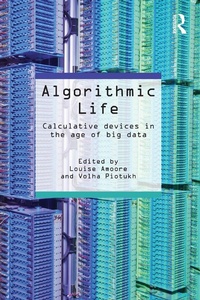
Algorithmic Life
Calculative Devices in the Age of Big Data
Published on 22. December 2015
212 pages
978-1-317-52737-4 (ISBN)
Description

This book critically explores forms and techniques of calculation that emerge with digital computation, and their implications. The contributors demonstrate that digital calculative devices matter beyond their specific functions as they progressively shape, transform and govern all areas of our life. In particular, it addresses such questions as:
How does the drive to make sense of, and productively use, large amounts of diverse data, inform the development of new calculative devices, logics and techniques?
How do these devices, logics and techniques affect our capacity to decide and to act?
How do mundane elements of our physical and virtual existence become data to be analysed and rearranged in complex ensembles of people and things?
In what ways are conventional notions of public and private, individual and population, certainty and probability, rule and exception transformed and what are the consequences?
How does the search for 'hidden' connections and patterns change our understanding of social relations and associative life?
Do contemporary modes of calculation produce new thresholds of calculability and computability, allowing for the improbable or the merely possible to be embraced and acted upon?
As contemporary approaches to governing uncertain futures seek to anticipate future events, how are calculation and decision engaged anew?
Drawing together different strands of cutting-edge research that is both theoretically sophisticated and empirically rich, this book makes an important contribution to several areas of scholarship, including the emerging social science field of software studies, and will be a vital resource for students and scholars alike.
How does the drive to make sense of, and productively use, large amounts of diverse data, inform the development of new calculative devices, logics and techniques?
How do these devices, logics and techniques affect our capacity to decide and to act?
How do mundane elements of our physical and virtual existence become data to be analysed and rearranged in complex ensembles of people and things?
In what ways are conventional notions of public and private, individual and population, certainty and probability, rule and exception transformed and what are the consequences?
How does the search for 'hidden' connections and patterns change our understanding of social relations and associative life?
Do contemporary modes of calculation produce new thresholds of calculability and computability, allowing for the improbable or the merely possible to be embraced and acted upon?
As contemporary approaches to governing uncertain futures seek to anticipate future events, how are calculation and decision engaged anew?
Drawing together different strands of cutting-edge research that is both theoretically sophisticated and empirically rich, this book makes an important contribution to several areas of scholarship, including the emerging social science field of software studies, and will be a vital resource for students and scholars alike.
Reviews / Votes
"Certainly, this is a lively volume. At times insightful, at times confusing and obscure, often experimental, at times still in a process of becoming, it seems to mirror the world that it begins to open up. Linking all the contributions, however, are the editors' and contributors' shared concerns about security, privacy, agency, and freedom, and we should take them seriously: the book is a fitting manifesto for a sociology of the unseen agents that increasingly shape our 'algorithmic life'." - Philip Roscoe, University of St Andrews, UKMore details
Language
English
Place of publication
London
United Kingdom
Publishing group
Taylor & Francis Ltd
Target group
College/higher education
Product notice
Reflowable
Illustrations
26 s/w Abbildungen, 4 s/w Tabellen, 2 s/w Zeichnungen
4 Tables, black and white; 7 Line drawings, black and white; 20 Halftones, black and white; 27 Illustrations, black and white
File size
10,45 MB
ISBN-13
978-1-317-52737-4 (9781317527374)
Copyright in bibliographic data and cover images is held by Nielsen Book Services Limited or by the publishers or by their respective licensors: all rights reserved.
Schweitzer Classification
Other editions
Additional editions
Book
12/2015
1st Edition
Routledge
€206.20
Shipment within 10-20 days
Book
11/2015
1st Edition
Routledge
€76.20
Shipment within 10-20 days
Persons
Louise Amoore is Professor of Political Geography at the University of Durham. She researches and teaches in the areas of global geopolitics and security, and is particularly interested in how contemporary forms of data, analytics and risk management are changing border management and security. Her latest book The Politics of Possibility: Risk and Security Beyond Probability was published in 2013 by Duke University Press. She is currently ESRC Global Uncertainties Leadership Fellow (2012-2015), and her project Securing against Future Events (SaFE): Pre-emption, Protocols and Publics (ES/K000276/1) examines how inferred futures become the basis for new forms of security risk calculus.
Volha Piotukh holds a PhD in Politics and International Studies from the University of Leeds and is currently Postdoctoctoral Research Associate at the Department of Geography of the University of Durham, where she works with Prof. Louise Amoore on Securing against Future Events (SaFE): Pre-emption, Protocols and Publics research project. Prior to that, she taught at the University of Leeds, the University of Westminster and UCL. She is the author of Biopolitics, Governmentality and Humanitarianism: 'Caring' for the Population in Afghanistan and Belarus (Routledge, 2015), which offers an interpretation of the post-Cold War changes in the nature of humanitarian action using Michel Foucault's theorising on biopolitics and governmentality, placed in a broader context of his thinking on power.
Volha Piotukh holds a PhD in Politics and International Studies from the University of Leeds and is currently Postdoctoctoral Research Associate at the Department of Geography of the University of Durham, where she works with Prof. Louise Amoore on Securing against Future Events (SaFE): Pre-emption, Protocols and Publics research project. Prior to that, she taught at the University of Leeds, the University of Westminster and UCL. She is the author of Biopolitics, Governmentality and Humanitarianism: 'Caring' for the Population in Afghanistan and Belarus (Routledge, 2015), which offers an interpretation of the post-Cold War changes in the nature of humanitarian action using Michel Foucault's theorising on biopolitics and governmentality, placed in a broader context of his thinking on power.
Content
Introduction Louise Amoore and Volha Piotukh Part 1. Algorithmic life Chapter 1. 'The public and its algorithms: Comparing and experimenting with calculated publics' Andreas Birkbak and Hjalmar Bang Carlsen Chapter 2. 'The libraryness of calculative devices: Artificially intelligent librarians and their impact on information consumption' Martijn van Otterlo Part 2. Calculation in the age of big data Chapter 3. 'Experiencing a personalised augmented reality: Users of Foursquare in urban space' Sarah Widmer Chapter 4. 'A politics of redeployment: Malleable technologies and the localisation of anticipatory governance' Nathaniel O'Grady Chapter 5. 'Seeing the invisible algorithm: The practical politics of tracking the credit trackers' Joe Deville and Lonneke van der Velden Part 3. Signal, visualise, calculate Chapter 6. 'Bodies of information: Data, distance and decision-making at the limits of the war prison' Richard Nisa Chapter 7. 'Data anxieties: Objectivity and difference in early Vietnam war computing' Oliver Belcher Chapter 8. 'Seeing futures' - Politics of visuality and affect' Matthias Leese Part 4. Affective devices Chapter 9. 'Love's algorithm: 'The perfect parts for my machine'' Lee Mackinnon Chapter 10. 'Calculating obesity, pre-emptive power and the politics of futurity: The case of Change4Life' Rebecca Coleman
