

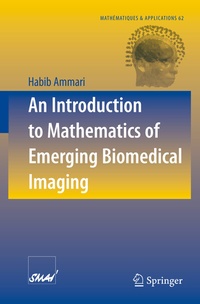
An Introduction to Mathematics of Emerging Biomedical Imaging
Description

Biomedical imaging is a fascinating research area to applied mathematicians. Challenging imaging problems arise and they often trigger the investigation of fundamental problems in various branches of mathematics.
This is the first book to highlight the most recent mathematical developments in emerging biomedical imaging techniques. The main focus is on emerging multi-physics and multi-scales imaging approaches. For such promising techniques, it provides the basic mathematical concepts and tools for image reconstruction. Further improvements in these exciting imaging techniques require continued research in the mathematical sciences, a field that has contributed greatly to biomedical imaging and will continue to do so.
The volume is suitable for a graduate-level course in applied mathematics and helps prepare the reader for a deeper understanding of research areas in biomedical imaging.
Reviews / Votes
From the reviews:
"This book consists of an introductive chapter, four parts, a bibliography, and an index. . The book may be useful for non-specialists . . Students may use this book . ." (Alexander G. Ramm, Zentralblatt MATH, Vol. 1181, 2010)
"This monograph presents an overview of medical imaging techniques based on many different modalities (X-rays, magnetic fields, ultrasound, microwaves, elasticity and others). The treatment is fairly concise . . The book can be used as a basis of a graduate course, or read as a survey of cutting-edge research in biomedical imaging." (Fritz Keinert, Mathematical Reviews, Issue 2010 j)
More details
Other editions
Additional editions
Person
Habib Ammari (born in June 1969) received the B.S., M.S., and Ph.D. degrees in mathematics from École Polytechnique Palaiseau in 1992, 1993, and 1995, respectively, and the Habilitation Degree from Université Pierre et Marie Curie (Paris 6), in 1999. He is currently Director of Research at the French Center of Scientific Research (CNRS). His current research interests include biomedical imaging, electrical impedance tomography, inverse problems, and electromagnetic modelling. He has contributed over 100 peer-reviewed articles and book chapters, authored four books and edited three others. He is serving as an editor of several mathematical journals. Habib Ammari has been invited to more than 30 international conferences. He produced 10 Ph.D. students and served as adviser for 10 post-docs.
