

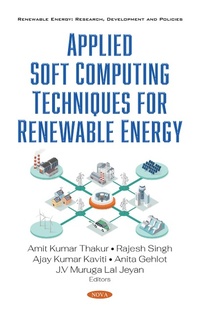
Applied Soft Computing Techniques for Renewable Energy
Published on 24. July 2020
278 pages
978-1-5361-8209-5 (ISBN)
Description

This book provides a better understanding of Fuzzy set theory, Fuzzy logic and Neural Networks and various other techniques seem very well suited for modeling and controlling a real system. Energy is of major importance to civilization, because it is driving force which binds human race. The estimation of energy in the form of renewable and sustainable is one of the important aspects to understand the how resources are harnessed and to predict what might happen under various possible future conditions. Using available modelling techniques to generate the best algorithms, the objective is to determine the best solution in terms of comparing the performances of the solutions through different parameters for a specific case. Consumption of Fossil fuels at a rapid pace has generated an alarming situation and with the subsequent increase in the number of vehicle the pollution level has reached well beyond human's control. This is frightening enough to observe the fact that the pollution level has surpassed all records and the need of the hour is to find an alternate fuel which can really be of great assistance in reducing the exhaust emission and augment the performance parameters of engine. Major researches are carried out on various engines to draw closer towards a realistic solution. Experiments performed on various engines are considered to be time consuming and the expenses met to perform these experiments are too costly, so the need of soft computing techniques involved in this area. Soft computing can be better described as the process to find the solution to an inexact problem. Soft computing has showed lot of potential in giving the researchers the exact solution may be in case of validating or predicting the performance and emission parameters. Artificial Neural Network (ANN), Adaptive Neuro Fuzzy Inference system (ANFIS), Fuzzy Expert System (FES), Response Surface Methodology (RSM) and Support Vector Machine (SVM) are the various soft computing techniques widely used. This book focuses on to carry out the comprehensive review and various other experimental works of various researchers who have carried out the work on these various soft computing techniques on various engines with various alternative fuels On the basis of modelling techniques, time is saved to a great extent and the capital investment involved is comparably very low. Various modelling technniques are being readily used to predict the performance parameters for various engines and modelling techniques have become the readily available tool to compare and validate the experimental work being carried out by researchers to get accurate matching with the experimental data.The benefit of this issue will be at large in connecting with varieties of work done in the field of Biomass which includes wood and wood waste, municipal solid waste. Landfill gas and biogas. Ethanol, Biodiesel, Hydropower, Geothermal, Wind, Solar.Thus soft computing techniques are fast and reliable hence, they can be a substitute for conventional experiments.
More details
Other editions
Additional editions
Amit Kumar Thakur
Applied Soft Computing Techniques for Renewable Energy
Book
07/2020
Nova Science Publishers Inc
€257.42
Shipment within 15-20 days
Content
- Intro
- Contents
- Preface
- Acknowledgments
- Abbreviations
- Chapter 1
- Investigation of Wind and Photovoltaic Energy Systems for Daily Load Dispatch on Reconfigurable Microgrid through Hybrid Fuzzy-MFO
- Abstract
- 1. Introduction
- 1.1. General Perspective
- 1.2. Literature Review
- 1.3. Motivation and Aims
- 2. Mathematical Formulation
- 2.1. Photovoltaic Energy System Modelling
- 2.2. Wind Energy System Modeling
- 2.3. Objective Function
- 2.3.1. Minimization of Total Generation Cost
- 2.3.2. Minimization of Bus Voltage Deviation
- Constraints
- Equality Constraints
- Inequality Constraints
- Generator Operation Constraints
- Line Flow Constraints
- DG Limits
- Ramp Up/Down Rate Constraint
- Storage Battery Constraints
- 3. Proposed Hybrid Algorithm
- 3.1. Moth-Flame Optimization Algorithm
- 3.2. Heuristic Fuzzy
- 3.2.1. Membership Function for TGC
- 3.2.2. Membership Function for VD
- 4. Test System Data and Assumptions
- 5. Simulation Results
- 5.1. Performance Investigation of Microgrid with the Presence of WES
- 5.2. Performance Investigation of Microgrid with the Presence of PVES
- 5.3. Performance Investigation of Microgrid with the Presence of WES and PVES
- Conclusion
- References
- About the Authors
- Chapter 2
- Biomass
- Abstract
- Introduction
- Biobased Feedstock Availability and Issues
- The Job of Biomass-Based Energy in Carbon Markets
- Economic Significance of Bioenergy
- New Technologies for Present Day Biomass Energy
- Gasification for Warmth and Power, Methanol and Hydrogen
- Gasification
- Gasifier Medium
- Pressure
- Gasifier Type
- Fixed Bed
- Permeating Fluid Bed
- Coursing Fluid Bed
- Entrained-Flow
- Methanol and Hydrogen Generation
- Methanol Generation Innovation Depiction
- Hydrogen Generation
- References
- Chapter 3
- Hydrogen: Present and Future Energy
- Abstract
- Introduction
- Use of Hydrogen as a Supplemented Mode with Conventional Diesel, Vegetable Oils and Their Blends
- Undesirable Combustion Phenomena
- Pre-Ignition
- Backfire
- Knocking
- Different Hydrogen Induction or Injection Techniques
- Continuous Carburetion (CC)
- Manifold Induction or Injection (MPI)
- References
- Chapter 4
- Safety Aspects in Handling and Storage of Ultra High Purity Gaseous Hydrogen
- Abstract
- Introduction
- Storage and Usage Area Construction
- Fire Extinguishers [1, 3]
- Electrification [1, 3]
- Wiring
- Luminaries
- Protection Concepts [1, 3]
- Flameproof - Ex d
- Ingress Protection
- Hydrogen Handling System Issues [1, 2]
- Engine Specific Systems [1, 2]
- Health-Related Hazards in Make Use of Hydrogen [1, 3]
- Marking of Hazardous Area Equipment as per IEC
- References
- Chapter 5
- Review on the Performance, Combustion, and Emissions of Butanol-Diesel Mixes in Compression Ignition Engine
- Abstract
- Introduction
- Reasons for Advocating Butanol
- Comparison of Physicochemical Properties
- The Outcome of Diesel-Butanol Mixes on Performance and Emissions of Diesel Engine
- Progress in Performance, Combustion, and Emissions of Butanol-Diesel Fuel Mixes
- Study Review and Future Recommendations
- Conclusion and Future Recommendations
- References
- Chapter 6
- Specific Soft Computing Strategies for Evaluating the Performance and Emissions of a Spark-Ignition Engine Using Alcohol-Gasoline Blended Fuels: A Comprehensive Analysis
- Abstract
- Introduction
- Various Soft Computing or Modeling Techniques
- Methodology of Anfis
- Load Data
- General FIS
- Train FIS
- Test FIS
- Review of Previous Work
- ANN Methodology
- Review of Previous Work
- Methodology of SVM
- Review of Previous Work
- Methodology of RSM
- Review of Previous Work
- Review of Previous Work of Fuzzy Expert System (FES)
- Conclusion
- References
- Chapter 7
- Energy Conservation Techniques for Food Processing and Manufacturing Industries
- Abstract
- Introduction
- Energy Consumption
- Major Energy Sources
- Methods to Reduce Energy Consumption
- Air Conditioning, Heating and Ventilation System
- Electric Drives
- Electric Heaters
- Lights
- Compressors
- Case Studies
- Conclusion
- References
- Chapter 8
- Effect of Biodiesel on Performance, Emissions and Combustion
- Abstract
- Introduction
- Scenario in India
- Performance Trends of Different Biodiesel
- Effect of Biodiesel on Brake Thermal Efficiency
- Effect of Biodiesel on Brake Specific Fuel Consumption
- Combustion Trends of Different Biodiesel
- Effect of Biodiesel on In-Cylinder Pressure
- Effect of Biodiesel on Ignition Delay
- Effect of Biodiesel on Heat Release Rate
- Emission Trends of Different Biodiesel
- Effect of Biodiesel on CO Emissions
- Effect of Biodiesel on HC Emissions
- Effect of Biodiesel on NOx Emissions
- Effect of Biodiesel on Particulate Matter
- Conclusion
- References
- Books
- Website
- Chapter 9
- Sustainable Development through Learning Climate Change: Adaptation Mitigation and Finance
- Abstract
- 1. Introduction
- 1.1. Main Drivers Affect the Temperature of the Earth
- 1.2. Effect of Temperature Rise on Various Parameters
- 1.2.1. Sea Level Rise
- 1.2.2. Ice Extent
- 1.2.3. Ocean Acidity
- 2. Exposure and Risk Associated with Climate Change
- 2.1. Assess the Impact of Climate Change
- 3. Adaptation to Climate Change
- 4. Mitigation
- 4.1. Industrial Organizations Contribution towards Mitigation of the Emission
- 4.1.1. Estimate GHGs Emission
- 4.1.2. Reduce GHGs Emissions
- 4.1.3. Offsetting/Compensation of Emissions
- 4.1.4. Set a Price on Carbon
- 4.1.5. Divert from Fossil Fuels
- 5. Climate Finance
- 5.1. The Risk Associated with Climate Finance
- 5.1.1. Market and Policy Risks
- 5.1.2. Physical Risks
- 5.2. Opportunities Associated with Climate Finance
- 5.2.1. The Sharing Economy
- 5.2.2. The Circular Economy
- 6. Contribution to the Mother Nature
- 6.1. Contribution from Individual
- 6.1.1. Switching or Reducing Home Energy Use
- 6.1.2. Hanging Diet
- 6.1.3. Rethinking Travel and Mobility
- 6.1.4. Buying Less and Reusing More
- 6.1.5. Educating Family and Friends
- 6.2. Contribution from Institutions
- 6.3. Actions by Regions and States
- 6.4. Actions by Countries
- 6.4.1. Regulatory Tools
- 6.4.2. Economic and Market Tools
- 6.4.3. Information and Awareness-Raising Tools
- 6.4.4. Voluntary Action
- 6.4.5. Action at the International Level
- 7. Major Agreements
- 7.1. First World Climate Conference
- 7.2. UN General Assembly (UNGA)
- 7.3. IPCC First Assessment Report
- 7.4. UN Framework Convention
- 7.4.1. Kyoto Protocol
- 7.4.2. Paris Pact
- Conclusion
- References
- About the Editors
- Index
- Blank Page
