

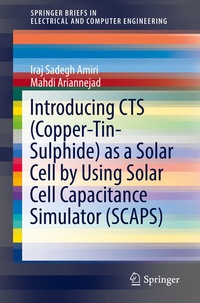
Introducing CTS (Copper-Tin-Sulphide) as a Solar Cell by Using Solar Cell Capacitance Simulator (SCAPS)
Description

This book discusses the enhancement of efficiency in currently used solar cells. The authors have characterized different structures of the solar cell system to optimize system parameters, particularly the performance of the Copper-Tin-Sulphide solar cell using Solar Cell Capacitance Simulator (SCAPS). This research can help scientist to overcome the current limitations and build up new designs of the system with higher efficiency and greater functionality. The authors have investigated the corresponding samples from various viewpoints, including structural (crystallinity, composition and surface morphology), optical (UV-vis-near-IR transmittance/re?ectance spectra) and electrical resistivity properties.
- Describes investigations on Cu2SnS3 solar cells and prospective low cost absorber layer of thin film solar cells;
- Discusses the potential device structure of Copper-Tin-Sulphide based on thin film technologies;
- Explains solar cell structure optimization to perform a higher conversion efficiency of Copper-Tin-Sulphide.
More details
Other editions
Additional editions
Persons
Iraj Sadegh Amiri has been doing research on several topics such as the optical soliton communications, laser physics, fiber lasers, plasmonics photonics devices, nonlinear fiber optics, optoelectronics devices using 2D materials, waveguides, quantum cryptography, and nanotechnology engineering.
Mahdi Ariannejad is a PhD student in University of Malaya (UM). His current project focuses on renewable energy systems and solar cells.
Content
Chapter1: Development of Solar Cell Photovoltaic: Introduction and principle working.- Chapter2: Solar Energy based Semiconductors: Working functions and mechanisms.- Chapter3: CTS (CU 2 SNS 3 ) solar cell structures and implemented methodology.- Chapter4: CTS solar cell performance analysis and efficiency characterizations.- Chapter5: A Summary of semiconductor solar cells and future works.
