

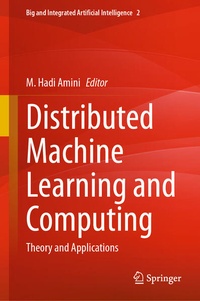
Distributed Machine Learning and Computing
Description

This book focuses on a wide range of distributed machine learning and computing algorithms and their applications in healthcare and engineering systems. The contributors explore how these techniques can be applied to different real-world problems. It is suitable for students and researchers interested in conducting research in multidisciplinary areas that rely on distributed machine learning and computing techniques.
More details
Other editions
Additional editions
Person
M. Hadi Amini is an Assistant Professor at the Knight Foundation School of Computing and Information Sciences, College of Engineering and Computing, Florida International University. He is the Director of Sustainability, Optimization, and Learning for InterDependent networks laboratory (www.solidlab.network), the Director of the ADvanced education and research for Machine learning-driven critical Infrastructure REsilience (ADMIRE) Center (funded by the U.S. DHS), and the Associate Director of the USDOT Transportation Center for Cybersecurity and Resiliency (TraCR). He received his Ph.D. in Electrical and Computer Engineering from Carnegie Mellon University in 2019, where he received his M.Sc. degree in 2015. He also holds a doctoral degree in Computer Science and Technology. Prior to that, he received M.Sc. degree from Tarbiat Modares University in 2013, and the B.Sc. degree from Sharif University of Technology in 2011. His research interests include distributed learning and optimization algorithms, distributed computing and intelligence, interdependent networks, and cyber-physical-social security and resilience. Application domains include smart cities, energy systems, transportation networks, and healthcare.
Dr. Amini is a Senior Member of IEEE, and a life member of IEEE-Eta Kappa Nu (IEEE-HKN), the honor society of IEEE. He also serves/has served as Associate Editor of IEEE Transactions on Information Forensics and Security, Associate Editor of SN Operations Research Forum, Associate Editor of Data Science for Communications (Frontiers in Communications and Networks), and International Transactions on Electrical Energy Systems. He edited/authored eight books, and is the recipient of the best paper award from "2019 IEEE Conference on Computational Science & Computational Intelligence'', "2024 Florida International University Top Scholar Award, Research and Creative Activities, Junior Faculty with Significant Grants (Sciences)", "2023Florida International University Faculty Excellence in Teaching Award", 2021 best journal paper award from "Springer Nature Operations Research Forum Journal", FIU's Knight Foundation School of Computing and Information Sciences' ``Excellence in Teaching Award'', best reviewer award from four IEEE Transactions, the best journal paper award in "Journal of Modern Power Systems and Clean Energy", and the dean's honorary award from the President of Sharif University of Technology.
