

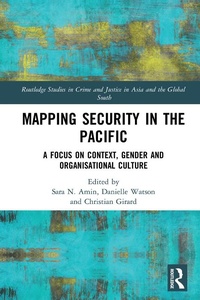
Mapping Security in the Pacific
A Focus on Context, Gender and Organisational Culture
1st Edition
Published on 25. February 2020
264 pages
978-0-429-62829-0 (ISBN)
Description

This book examines questions about the changing nature of security and insecurity in Pacific Island Countries (PICs). Previous discussions of security in the Pacific region have been largely determined by the geopolitical interests of the Global North. This volume instead attempts to centre PICs' security interests by focussing on the role of organisational culture, power dynamics and gender in (in)security processes and outcomes.
Mapping Security in the Pacific underscores the multidimensional nature of security, its relationship to local, international, organisational and cultural dynamics, the resistances engendered through various forms of insecurities, and innovative efforts to negotiate gender, context and organisational culture in reducing insecurity and enhancing justice. Covering the Pacific region widely, the volume brings forth context-specific analyses at micro-, meso- and macro-levels, allowing us to examine the interconnections between security, crime and justice, and point to the issues raised for crime and justice studies by environmental insecurity. In doing so, it opens up opportunities to rethink scholarly and policy frames related to security/insecurity about the Pacific.
Written in a clear and direct style, this book will appeal to students and scholars in criminology, sociology, cultural studies, social theory and those interested in learning about the Pacific region and different aspects of security.
Mapping Security in the Pacific underscores the multidimensional nature of security, its relationship to local, international, organisational and cultural dynamics, the resistances engendered through various forms of insecurities, and innovative efforts to negotiate gender, context and organisational culture in reducing insecurity and enhancing justice. Covering the Pacific region widely, the volume brings forth context-specific analyses at micro-, meso- and macro-levels, allowing us to examine the interconnections between security, crime and justice, and point to the issues raised for crime and justice studies by environmental insecurity. In doing so, it opens up opportunities to rethink scholarly and policy frames related to security/insecurity about the Pacific.
Written in a clear and direct style, this book will appeal to students and scholars in criminology, sociology, cultural studies, social theory and those interested in learning about the Pacific region and different aspects of security.
Reviews / Votes
Security in the Pacific is complex and highly contested sociologically, geopolitically and scholastically and the book comprehensively captures these complex and often competing discourses in a brilliant way. This is must read source for those seeking to be enlightened with original, deep and critical analysis of the multi-dimensional and intersectional nature of security in a dramatically transformational, culturally resilient and sometimes politically turbulent Pacific. -Prof Steven Ratuva, Director, Macmillan Brown Centre for Pacific Studies and Professor in Anthropology and Sociology, University of Canterbury. Chair, International Political Science Association Research Committee on Security, Conflict and Democratization.This important and timely book provides a comprehensive theoretical and empirical examination of security and insecurity in Pacific Island countries. The book's editors and contributors elucidate the complex, interrelated, and multidimensional dynamics and forms of security in these countries at different levels of analysis from the global to the local. Mapping Security in the Pacific challenges us to rethink issues of security and insecurity in the Global South, including how security is defined and approached; the role of local and international organizations; and the gendered nature of security, making this volume a must-read for both students and established scholars. -Nathan W. Pino, Professor of Sociology, Texas State University, USA
Mapping Security in the Pacific: A focus on context, gender and organizational culture provides an important contribution to understanding a wide range of security concerns and contexts from the perspective of the Pacific Islands. The multidisciplinary/multidimensional focus on different dimensions of security allows the reader to gain an understanding of the context, gender and organizational culture of Pacific Island security through a diverse range of contributions on issues ranging from policing, climate change, military reform, and economic (in) security. -Fiona Hukula, Senior Research Fellow, Building Safer Communities Research Program National Research Institute-Papua New Guinea
The pacific region is a large geographical area but very little remains known of the social structures and social relations of its many small nations. Even less is known of the way in which security is maintained, challenged, transformed and reformulated in this region. This book remedies these deficiencies by providing important essays that shed clear light on these concerns.-John Pratt, Professor of Criminology, Victoria University of Wellington, New Zealand Security in the Pacific is complex and highly contested sociologically, geopolitically and scholastically and the book comprehensively captures these complex and often competing discourses in a brilliant way. This is must read source for those seeking to be enlightened with original, deep and critical analysis of the multi-dimensional and intersectional nature of security in a dramatically transformational, culturally resilient and sometimes politically turbulent Pacific. - Prof Steven Ratuva, Director, Macmillan Brown Centre for Pacific Studies and Professor in Anthropology and Sociology, University of Canterbury. Chair, International Political Science Association Research Committee on Security, Conflict and Democratization.
This important and timely book provides a comprehensive theoretical and empirical examination of security and insecurity in Pacific Island countries. The book's editors and contributors elucidate the complex, interrelated and multidimensional dynamics and forms of security in these countries at different levels of analysis from the global to the local. Mapping Security in the Pacific challenges us to rethink issues of security and insecurity in the Global South, including how security is defined and approached; the role of local and international organisations; and the gendered nature of security, making this volume a must-read for both students and established scholars. - Nathan W. Pino, Professor of Sociology, Texas State University, USA
Mapping Security in the Pacific: A focus on context, gender and organisational culture provides an important contribution to understanding a wide range of security concerns and contexts from the perspective of the Pacific Islands. The multidisciplinary/multidimensional focus on different dimensions of security allows the reader to gain an understanding of the context, gender and organisational culture of Pacific Island security through a diverse range of contributions on issues ranging from policing, climate change, military reform and economic (in)security.- Fiona Hukula, Senior Research Fellow, Building Safer Communities Research Program National Research Institute-Papua New Guinea
The Pacific region is a large geographical area but very little remains known of the social structures and social relations of its many small nations. Even less is known of the way in which security is maintained, challenged, transformed and reformulated in this region. This book remedies these deficiencies by providing important essays that shed clear light on these concerns. - John Pratt, Professor of Criminology, Victoria University of Wellington, New Zealand
More details
Series
Edition
1. Auflage
Language
English
Place of publication
London
United Kingdom
Publishing group
Taylor & Francis Ltd
Target group
College/higher education
Illustrations
9 Tables, black and white; 6 Line drawings, black and white
ISBN-13
978-0-429-62829-0 (9780429628290)
Copyright in bibliographic data and cover images is held by Nielsen Book Services Limited or by the publishers or by their respective licensors: all rights reserved.
Schweitzer Classification
Other editions
Additional editions
Sara Amin | Danielle Watson | Christian Girard
Mapping Security in the Pacific
A Focus on Context, Gender and Organisational Culture
Book
06/2022
1st Edition
Routledge
€65.50
Shipment within 10-20 days
Sara Amin | Danielle Watson | Christian Girard
Mapping Security in the Pacific
A Focus on Context, Gender and Organisational Culture
Book
02/2020
1st Edition
Routledge
€207.80
Shipment within 15-20 days
Persons
Sara N. Amin is Senior Lecturer and Coordinator of Sociology at the University of the South Pacific. Her research focusses on migration; identity politics, violence and security; gender relations; and education. She has two ongoing projects: Religion and Policing in the Pacific and Changing Gender Relations in Families in South Asia.
Danielle Watson is Lecturer and Coordinator of the Pacific Policing Programme at the University of the South Pacific. She conducts research on police/civilian relations on the margins with particular interests in hotspot policing, police recruitment and training as well as many other areas specific to policing in developing country contexts.
Christian Girard, PhD, is an independent researcher and development practitioner based in Fiji and a former assistant professor in development studies at the Asian University for Women in Bangladesh. His professional experience and research interests include vulnerability, poverty, informality, housing, governance and public policy in Asia-Pacific, Africa and Latin America.
Danielle Watson is Lecturer and Coordinator of the Pacific Policing Programme at the University of the South Pacific. She conducts research on police/civilian relations on the margins with particular interests in hotspot policing, police recruitment and training as well as many other areas specific to policing in developing country contexts.
Christian Girard, PhD, is an independent researcher and development practitioner based in Fiji and a former assistant professor in development studies at the Asian University for Women in Bangladesh. His professional experience and research interests include vulnerability, poverty, informality, housing, governance and public policy in Asia-Pacific, Africa and Latin America.
Content
Introduction Chapter 1- (In)Security in the Pacific Island Countries Part 1: Reframing Security in the Pacific Chapter 2- Mapping circumstances in Oceania: Reconsidering human security in an age of globalisation Chapter 3- Economic (In)Security in the Pacific Chapter 4- Resisting the Tides: Responding to Nuclear and Environmental "Insecurity" in the Marshall Islands Chapter 5- Impact of Natural Disasters and Climate Change on National Security in the Pacific: Case Studies of Kiribati and Tuvalu Part 2: Sources of Gender Insecurity in the Pacific Chapter 6- Human security, International Agenda and Responses to Calls for "Women's Empowerment" Chapter 7- Mapping Gender Security-Insecurity in Fiji: Rape Myths and Sexual Prejudice Chapter 8- Gender and post-conflict security sector reform: Experiences from Bougainville and Solomon Islands Chapter 9- Gender vulnerability to climate change and natural hazards: The case of Tropical Cyclone Winston, Fiji Chapter 10- Can Theology Contribute to the Security of Women in the Pacific Household? Chapter 11- Insecurities and Strategies of the Leiti (Transgender) Community in Tonga and the Role of Businesses and Indigenous Reconciliation Practices Part 3: Organisational Culture, Security Providers, Partner Institutions and Security Outcomes Chapter 12- Contextualizing Policing in Melanesia: History, Adaptation and Adoption Problematized Chapter 13- Policing Sorcery Accusation Related Violence in Papua New Guinea Chapter 14- Insecurity, Policing and Marketisation: Papua New Guinea's Changing Security Landscape Chapter 15- Mapping Military Reform in Fiji: Timing it Right Chapter 16- Organization Repositioning for Improved Security Provision: Lessons from Guam on Implementing Community Policing Conclusion Chapter 17- Security, Resilience and Resistance in the PICs: Aligning Priorities and Relocating Responsibility
