

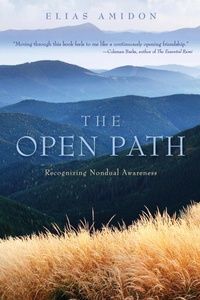
The Open Path
Recognizing Nondual Awareness
Published on 4. August 2021
242 pages
978-1-59181-255-5 (ISBN)
Description

The globally renowned spiritual teacher offers a guide to awakening our most enlightened nature-the unified awareness behind all consciousness.
Interest in nondual awareness as the essence of spiritual awakening is rapidly expanding throughout the Western world. Those who follow spiritual paths, such as Buddhism, Hinduism, Sufism, and Kabbalism, often come up against a kind of ceiling due to their religion's cultural context or a belief system that places awakening beyond the reach of adherents.
For years, Elias Amidon has helped seekers break through their blockages with his nine-month Open Path trainings conducted all over the world. In The Open Path, Amidon shares the lessons and exercises of these trainings. It is a guide to the realization of the silent ground of all being, and to expressing that realization in your daily life.
Interest in nondual awareness as the essence of spiritual awakening is rapidly expanding throughout the Western world. Those who follow spiritual paths, such as Buddhism, Hinduism, Sufism, and Kabbalism, often come up against a kind of ceiling due to their religion's cultural context or a belief system that places awakening beyond the reach of adherents.
For years, Elias Amidon has helped seekers break through their blockages with his nine-month Open Path trainings conducted all over the world. In The Open Path, Amidon shares the lessons and exercises of these trainings. It is a guide to the realization of the silent ground of all being, and to expressing that realization in your daily life.
More details
Other editions
Additional editions
Book
10/2012
Sentient Publications
€18.50
Shipment within 3-4 weeks
Person
Elias Amidon is the spiritual director (Pir) of the Sufi Way International. He has been an initiate of the Sufi Way for the past forty-two years. Pir Elias has also studied with Qadiri Sufis in Morocco, Theravaden Buddhist teachers in Thailand, Native American teachers of the Assemblies of the Morning Star, Christian monks in Syria, Zen teachers of the White Plum Sangha, and contemporary teachers in the Dzogchen tradition. FromIchild to elder, Pir Elias has lived a multifaceted, engaged life. The son of an artist and a social activist, he has worked as a schoolteacher, carpenter, architect, professor, writer, anthologist, environmental educator, peace activist, wilderness quest guide, and spiritual teacher. He helped develop several schools, including the Boulder Institute for Nature and the Human Spirit, the graduate program in Environmental Leadership at Naropa University, and the Open Path. He has a Bachelors degree in literature from Antioch College and has written six books. Pir Elias has been leading programs in Sufism for over three decades, and Open Path programs for the past six years. He resides in Boulder, Colorado but continues to travel widely, both teaching Open Path programs and engaging in citizen diplomacy. His website is www.open-path.org.
Content
- Cover
- Title Page
- Copyright
- Dedication
- Contents
- Preface
- A Note about the Sources of the Open Path
- 1. Open Awareness
- What Is Open Awareness?
- A Note about the Words Used Here
- The Unconditioned and the Conditioned
- Paradox
- Exercises: Open Awareness
- 1. Gravity and Awareness
- 2. Attributes of Awareness
- 2. The Practice of Subtle Opening
- The Contradiction of Practicing
- Expecting Nothing
- Posture
- The Practice of Subtle Opening
- 3. What Obscures Open Awareness?
- Identity Making
- Doing
- Liking and Disliking
- Willing and Controlling
- Knowing and Making Meaning
- Fear of Vanishing
- Nothing Obscures Open Awareness
- Exercises: What Obscures Open Awareness?
- 1. Personal Inventory
- 2. Noticing Behavior Patterns
- 3. Positive, Negative, and Pure Listening
- 4. Noticing Mental Constructions and Fixations
- Learning to Notice Mental Constructions and Fixations
- Fixations and Their Roots
- Noticing Fixations
- Acting Without Bias
- Release at Inception
- Exercises: Noticing Mental Constructions and Fixations
- 1. Observing Fixations
- 2. Fixation Dialogue
- 3. Meditation Practice
- 5. Self-Inquiry
- The Resonant Field
- The One Rule
- Unfindability
- Further Lines of Self-Inquiry
- Exercises: Self Inquiry
- A Few Contemplations on the Open Path
- 6. Motivation and Effortlessness
- An Overview
- Motivation
- Attitude
- Longing and Finding
- Effortlessness
- Conclusion
- Exercises: Motivation and Effortlessness
- Motivation and Attitude
- Effortlessness
- The River Flow Meditation
- 7. On Nonduality and Prayer
- To Begin at the End
- Starting Where We Are
- Prayers of Petition
- Indirect Benefits of a Prayerful Life
- Prayers of Approach and Nearness
- The Limits of Prayer
- Learning to Pray Wisely
- Prayers of Identity
- Prayers of Silence
- Exercises: on Nonduality and Prayer
- 8. The Art of Awakening
- The Idea that Something Is Missing
- The Art of Awakening
- Practicing the Art
- Conversations that Release
- Developing a Non-Doing Contemplative Practice
- Release at Inception
- 9. A Joyous Cosmology
- Introduction
- Theme I: Realizing the Absence of Story
- Theme II: Experiencing the Intimacy of Openness
- Theme III: Surrendering All at Once
- Theme IV: The Joy of Unbounded Wholeness
- 10. The Ocean of Kindness
- Immanence
- 1. Nondual Action
- 2. Equanimity
- 3. Unconditional Kindness
- Exercise: The Ocean of Kindness
- 11. The Heart of the Matter
- Summary, Chapters Six Through Ten
- The Heart of the Matter
- Falling From Heaven
- 1. Do Nothing
- 2. No Need to Know
- 3. No Subject
- 4. Listening to Listening
- 5. Pointings
- 6. Relax
- The Invisible Offering
- Notes
- Bibliography
- Gratitude to Teachers and Sources
- Acknowledgements
- About the Author
