

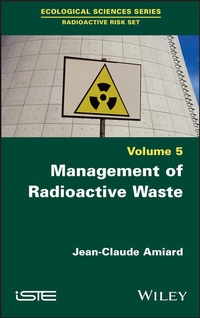
Management of Radioactive Waste
Description

Radioactive waste comes from numerous sources. The largest volumes are generated by the decommissioning and dismantling of nuclear facilities. Long-lived, medium- and high-activity waste - categorized as the most hazardous types of waste - are in fact largely produced by nuclear power reactors, spent fuel reprocessing plants and nuclear accidents.
Final disposal of very low-activity, low-activity and very short-lived waste is well controlled. However, final solutions for certain categories, including long-lived waste, sorted waste and spent graphite waste, are not yet in place.
Management of Radioactive Waste reviews all the possible solutions and presents those chosen by the various states, including a chapter detailing policy on radioactive waste management, taking France as an example.
More details
Other editions
Additional editions
Person
Jean-Claude Amiard is a Doctor of Radioecology, Emeritus Research Director at the CNRS (University of Nantes, France) and former Associate Professor in Quebec and China. He is the author of more than 250 publications, 80 books or book chapters and 150 presentations at international conferences.
Content
Preface xi
Acknowledgments xiii
Chapter 1. Classifications and Origins of Radioactive Waste 1
1.1. Introduction 1
1.2. What is radioactive waste? 2
1.3. Classifications of nuclear waste 3
1.3.1. General information on the classification of radioactive waste 3
1.3.2. The IAEA's recommendations 4
1.3.3. The French classification of radioactive waste 5
1.3.4. American classification 8
1.3.5. British classification 8
1.3.6. Russian classification 9
1.3.7. Comparisons of the various classifications 9
1.3.8. Classification of sealed sources 11
1.4. Origins of nuclear waste 11
1.4.1. The main radionuclides in radioactive waste 12
1.4.2. Wastes related to the nuclear fuel cycle 12
1.4.3. Nuclear waste from electricity production 14
1.4.4. Nuclear waste related to military activities 14
1.4.5. Wastes related to medical and industrial uses 15
1.4.6. Nuclear waste related to the dismantling of nuclear installations 16
1.4.7. Waste from nuclear accidents 17
1.5. The global radioactive waste balance 17
1.6. Conclusions 21
Chapter 2. Nuclear Waste Disposal Methods 23
2.1. Introduction. How do we get rid of nuclear waste? What solutions are there for nuclear waste in the future? 23
2.2. Nuclear waste management 24
2.2.1. Dilutions 24
2.2.2. Decontamination 26
2.2.3. Reduction of the volume of radioactive waste 27
2.2.4. Radioactive waste immobilizations 29
2.2.5. The separation of radionuclides 33
2.2.6. Packaging of radioactive waste packages 34
2.2.7. Physical decay 35
2.2.8. Final storage 37
2.2.9. Transport of nuclear materials and radioactive waste 38
2.3. The special case of long-lived radioactive waste management 39
2.3.1. Treatment and packaging 39
2.3.2. Temporary storage facilities 42
2.3.3. Long-term storage 46
2.3.4. Storage in the seabed 48
2.3.5. Geological storage in a deep continental repository 53
2.3.6. Sending into space 59
2.3.7. Immobilization in polar ice 60
2.3.8. Transmutation 61
2.4. Conclusions 65
Chapter 3. Management of Historic Radioactive Waste and Low-level Waste Around the World 67
3.1. Introduction 67
3.2. Management of historical radioactive waste 68
3.2.1. Uranium extraction and concentration waste 68
3.2.2. Direct discharges of liquid wastes into waterways and reservoirs 70
3.2.3. Historical military waste 72
3.2.4. The ancient uses of radium 73
3.2.5. Submergence in the ocean floor 73
3.3. International recommendations of the IAEA and NEA 78
3.3.1. General recommendations 79
3.3.2. Recommendations concerning graphite waste 83
3.3.3. Radioactive waste management solutions 83
3.3.4. Waiting and processing time for nuclear fuel 85
3.3.5. The need for teaching 85
3.4. Some examples of radioactive waste management 86
3.4.1. International inventories of radioactive waste 86
3.4.2. Surface storage 86
3.4.3. Geological disposal of radioactive waste 89
3.5. Radioactive waste outside the nuclear fuel cycle 93
3.5.1. Hospital and healthcare waste 93
3.5.2. Industrial and research waste 94
3.6. Conclusions 94
Chapter 4. Management of Intermediate- and High-level Nuclear Waste 97
4.1. Introduction 97
4.2. International recommendations of the IAEA and NEA 99
4.2.1. Spent fuel management 99
4.2.2. Management of radioactive waste resulting from a nuclear accident 100
4.2.3. Final repositories in deep geological layers 101
4.2.4. Site selection criteria 103
4.2.5. Temporal evolution of a deep geological repository 104
4.2.6. Underground laboratory 104
4.2.7. Retrievability and recovery 108
4.2.8. Safety file 109
4.2.9. Decision-making 112
4.2.10. Long-term evolution and post-closure monitoring 113
4.3. High-level radioactive waste management and the public 114
4.3.1. Public perception of the geological repository project 114
4.3.2. Public information or communication about the geological repository project 115
4.3.3. Measures to support a radioactive waste management project 116
4.3.4. Public participation in the geological repository project 117
4.3.5. Information for future generations 118
4.4. Alternative solutions 120
4.4.1. Underwater temporary storage 120
4.4.2. An interim solution: dry storage 120
4.4.3. A waiting stage: long-term storage 120
4.4.4. The American perspective of deep drilling 121
4.5. Management of high-level radioactive waste by the various States 121
4.5.1. States advocating a closed nuclear fuel cycle 123
4.5.2. States that have reprocessed spent fuel in the past 127
4.5.3. States with an open nuclear fuel cycle 136
4.6. Conclusions 143
Chapter 5. Nuclear Waste Management in France 145
5.1. Introduction 145
5.2. Direct discharges into the environment 147
5.2.1. The nuclear study centers 147
5.2.2. Nuclear reactors 148
5.2.3. Fuel cycle plants 148
5.3. The inventory of nuclear waste in France 149
5.3.1. Military waste 149
5.3.2. Civilian waste 152
5.4. Nuclear waste management in France 157
5.4.1. The regulatory context 157
5.4.2. The National Radioactive Materials and Waste Management Plan (PNGMDR) 158
5.4.3. The different actors in nuclear waste management in France 159
5.5. The organization of storage for identified waste 164
5.5.1. The various types of containers 164
5.5.2. The management of very short-lived radioactive waste 166
5.5.3. Management of very low-level radioactive waste 166
5.5.4. Disposal centers for low- and intermediate-level short-lived nuclear waste in France 167
5.5.5. Management of low-level, long-lived nuclear waste in France 168
5.5.6. Management of long-lived intermediate- and high-level waste in France 170
5.5.7. Fierce opposition and the arrival of social problems 184
5.5.8. A centralized pool as an interim option 185
5.5.9. Radioactive waste from the reprocessing of foreign spent fuel 186
5.6. The management of specific waste and waste without a channel 188
5.6.1. Management of historical waste 189
5.6.2. Storage of tritiated waste 190
5.6.3. Waste of natural origin 191
5.6.4. Submerged waste 194
5.7. French challenges to the radioactive waste management policy 195
5.8. Conclusions 197
5.8.1. Shortcomings in several categories of radioactive waste 197
5.8.2. Recent developments in French nuclear policy 197
5.8.3. Policy change on the closed cycle? 198
5.8.4. Redefinition of radioactive waste and radioactive material 198
5.8.5. The cost of waste management 199
Chapter 6. General Conclusions 201
6.1. Introduction 201
6.2. The main problems concerning radioactive waste 201
6.2.1. The problem of multiple classifications 201
6.2.2. Radioactive waste or nuclear material? 202
6.2.3. Waste without a channel 202
6.2.4. Long-lived waste 202
6.2.5. Very low-level waste 202
6.3. Innovations in radioactive waste management 203
6.3.1. Research on separation and transmutation 203
6.3.2. Research on the aging of packaging 204
6.3.3. Research on recycled nuclear fuel and cladding 206
6.3.4. Research on deep burial 207
6.3.5. Communication to the public 211
List of Acronyms 213
References 219
Index 251
1
Classifications and Origins of Radioactive Waste
1.1. Introduction
Compared to other categories of waste, the quantity of radioactive waste is relatively small. In France, nuclear waste represents 2 kg per year per inhabitant [AND 17a], compared to 580 kg of household waste, 900 kg of non-construction waste and 3.4 tons of industrial waste [ADE 20]. But these residues represent an immense problem because some of them are extremely radioactive and remain harmful over excessively long time scales, for some hundreds of thousands or millions of years, that humanity cannot control.
What can we do with this radioactive waste? In the past, the ocean has served as a dumping ground for nuclear powers, which have immersed tens of thousands of radioactive drums. This time is fortunately over. Some eccentric people have suggested dropping them into space. Fortunately, the idea was not pursued. The solution now being considered for the most dangerous waste is to bury it in deep layers of clay, granite, salt or tuff, hoping that nature and geology will compensate for the weaknesses of human technology [AMI 13]. Sweden was the first nation to choose an underground storage site. All other countries, faced with the concerns of their populations and the vagaries of political changes, have postponed their decisions. On the contrary, in the United States, the suspension of the Yucca Mountain storage project in Nevada, which was ready to open, is a sign of the American administration's desire to listen to the public. However, the State must find a new solution.
Since no alternative solution is yet mature, we must take our time in making a decision that will commit humanity for a long time. France, like Canada, Switzerland and Japan, has made the principle of reversibility central to its doctrine. On the contrary, Sweden and Finland do not require it, and the United Kingdom is still considering it. It is not only a question of being able to recover radioactive packages, but of leaving the decision-making process open and giving it back to the political institutions. Parliament has once again become the master of nuclear waste management and future generations have the guarantee that nothing will be decided inescapably. The approach is virtuous. Let us hope that it is not an admission of powerlessness in the face of an insoluble puzzle [AMI 13]. It should also be emphasized that this postponement amounts in practice to leaving to future generations the care to manage and pay for the waste produced by the present generation.
Those responsible for the civilian and especially the military use of nuclear energy have in the past been very unaware of the seriousness with which the problem of nuclear waste is treated today. For example, the Hanford site in the United States was heavily polluted by unauthorized dumping during intensive plutonium production after World War II. Recently, six underground tanks leaked. In the former Soviet Union (USSR), waste in the form of highly active liquid solutions was injected directly into deep storage [MAC 96]. The United Kingdom in particular, but also other countries, and even France, have thrown drums of waste into international waters, a practice that is now prohibited [CAS 02].
Nuclear energy has been questioned almost since its inception and one of the main problems concerning its social acceptability in the world is the management of nuclear waste [ROD 17]. It is therefore imperative that nuclear nations manage radioactive waste in an exemplary way.
1.2. What is radioactive waste?
A few definitions should be kept in mind. Radioactive waste is radioactive material for which no further use is planned or envisaged. Ultimately radioactive waste is radioactive waste that can no longer be treated under current technical and economic conditions, in particular by extracting its recoverable part or by reducing its polluting or dangerous nature (French Environmental Code, article L 542.1-1). Conversely, if a radioactive material also contains radionuclides, it has a potential future use. This is the case for depleted uranium or spent nuclear fuel that can eventually be reused.
A radioactive substance is a substance that contains radionuclides, natural or artificial, whose activity or concentration justifies radiation protection control. The radionuclides contained in radioactive waste can be of artificial origin, such as cesium-137, or natural origin, such as radium-226.
Radioactive waste has three main characteristics, the type of radionuclide, the activity and the half-life. The type of radionuclide contained is related to the radiation emitted (alpha, beta, gamma). The activity is the number of atomic nuclei that spontaneously disintegrate per unit of time; it is expressed in becquerels (Bq). The half-life is the time required for the activity of a radionuclide in a sample to decrease by half [IRS 13a, IRS 13b].
1.3. Classifications of nuclear waste
Waste classification is not unique. Indeed, while the IAEA has provided broad guidelines for defining and classifying radioactive waste, each state is free to use its own nomenclature.
1.3.1. General information on the classification of radioactive waste
As regards the classification of radioactive waste, there are two main approaches: one by a waste management channel and the other by a waste production channel. The latter approach is partly inherited from the historical concept of radiation protection.
The management pathway approach often combines the activity and lifetime parameters of the radionuclides constituting the waste. This classification was recommended by the IAEA in the Joint Convention on the Safety of Spent Fuel Management and on the Safety of Radioactive Waste Management. This classification is used in France, Belgium and Spain. Sometimes this approach is based only on activity. In Canada, for example, there are only three main categories of radioactive waste (ILW, HLW and spent fuel), except for the specific management of waste from mines. In the Netherlands, the classification has a larger number of categories, but no distinction is made between short- and long-lived waste and consequently there are no plans for surface disposal. In Germany, the classification is based mainly on the exothermic character of the waste.
The production chain approach leads to a more complex classification, with specific chains for certain types of waste, and combining activity and lifespan. This is the approach of the United States, Japan and Sweden (in fact in Sweden, the two types of approach coexist). In Finland, a category is sometimes added for waste from hospitals, universities, etc.
There are also national specificities, as in Belgium, which treats 50% of the radium sources used in the world (the result of uranium mining in the Congo, which is historically Belgian), or in Canada, which has large uranium mines. Similarly, in France, it should be noted that there is no release threshold for waste containing, or likely to contain, only very small quantities of radioactive elements [AMI 13].
1.3.2. The IAEA's recommendations
The IAEA proposes dividing radioactive waste into five categories, in addition to the category of waste considered as released (EW, Exempt Waste), according to two criteria, the amount of activity and the half-life of the radionuclide (Figure 1.1). These categories are very short-lived waste (VSLW), very low-level waste (VLLW), low-level waste (LLW), intermediate-level waste (ILW) and high-level waste (HLW) [IAE 09a].
In certain circumstances, such as acceptance into a radioactive waste disposal facility, Waste Acceptance Criteria (WACs) may be established for certain radionuclides. WACs are quantitative or qualitative criteria that may include, for example, restrictions on the activity concentration or total activity of particular radionuclides (or types of radionuclides) in the waste, or requirements regarding the form or packaging of the waste.
Figure 1.1. Proposed IAEA classification of radioactive waste (source: [IAE 09a]). EW: exempt waste; HLW: high-level waste; ILW: intermediate-level waste; LLW: low-level waste; VLLW: very low-level waste; VSLW: very short-lived waste. For a color version of this figure, see www.iste.co.uk/amiard/radioactive.zip
1.3.3. The French classification of radioactive waste
The details of the French classification are as follows. Radioactive waste is classified according to two criteria: mass activity and physical half-life. The "mass activity" criterion divides waste into four groups: déchets de très faible activité, called TFA or very low-level waste (VLLW), déchets de faible activité, FA or low-level waste (LLW), déchets de moyenne activité, MA or intermediate-level waste (ILW) and déchets de haute activité, high-level waste (HLW). The "life" criterion is divided into three classes to distinguish between déchets à vie courte, short-lived waste (SLW), déchets à vie moyenne, medium-lived waste (MLL) and déchets à vie longue, long-lived waste (LLW). The combination of the two criteria makes it possible to classify the waste into 12 categories (Table 1.1) [PNG 10].
Table 1.1. French classification of radioactive waste and storage sites in operation in France (source: modified from [PNG 10, MTE 18]). For a color version of this...
