

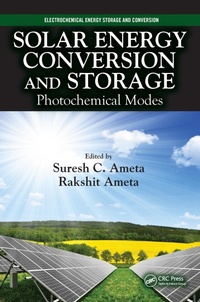
Solar Energy Conversion and Storage
Photochemical Modes
Published on 5. November 2015
283 pages
978-1-4822-4631-5 (ISBN)
Description

Solar Energy Conversion and Storage: Photochemical Modes showcases the latest advances in solar cell technology while offering valuable insight into the future of solar energy conversion and storage. Focusing on photochemical methods of converting and/or storing light energy in the form of electrical or chemical energy, the book:Describes various t
Reviews / Votes
"... provides an excellent overview of the historical and present literature concerning the different types and functionality of solar energy production cells. ... does a fantastic job introducing the variety of types of solar cells and their means of production of energy via photoelectrochemistry. ... A must have for anybody in the solar cells manufacturing industry."-Todd J. Menna, Ph.D, Element New Berlin, Wisconsin, USA
"... very interesting ... will appeal to researchers, students, and engineers in the field of renewable energy, specifically in photovoltaic systems."
-Songyuan Dai, North China Electric Power University, Beijing
More details
Series
Language
English
Place of publication
London
United Kingdom
Publishing group
Taylor & Francis Ltd
Target group
College/higher education
This book will be useful to anyone involved in electrochemistry, energy, solar, chemical engineering, chemistry, and clean tech.
Illustrations
65 s/w Abbildungen, 4 s/w Tabellen
65 b/w images, 4 tables and 100
File size
8,40 MB
ISBN-13
978-1-4822-4631-5 (9781482246315)
Copyright in bibliographic data and cover images is held by Nielsen Book Services Limited or by the publishers or by their respective licensors: all rights reserved.
Schweitzer Classification
Other editions
Additional editions
Book
03/2021
1st Edition
CRC Press
€72.60
Shipment within 15-20 days
Book
11/2015
1st Edition
CRC Press
€274.90
Article not available for order
Persons
Suresh C. Ameta obtained his master's degree, and was awarded a Gold Medal in 1970. He secured a first position in M. Phil. in 1978, and a Ph.D. in 1980 from Vikram University. He served as Professor and Head, Department of Chemistry, North Gujarat University Patan (1994) and M. L. Sukhadia University (2002-2005), and as Head, Department of Polymer Science (2005-2008). He also served as Dean, Postgraduate Studies, M. L. Sukhadia University (2004-2008). Now, he is Dean, Faculty of Science, PAHER University. Widely published and highly decorated, Professor Ameta has approximately 43 years of experience in teaching and research.
Rakshit Ameta obtained his Master of Science degree with first position, and was awarded a Gold Medal in 2002. He received the Fateh Singh Award from the Maharana Mewar Foundation for his meritorious performance. He has worked at M. L. Sukhadia University and at University of Kota, and presently is an Associate Professor of Chemistry at PAHER University. Widely published, Dr. Ameta has been elected as Scientist-in-Charge, Industrial and Applied Chemistry Section, Indian Chemical Society (2014-2016), and was also elected as a Council Member of the Indian Chemical Society (2011-2013) and the Indian Council of Chemists (2012-2014).
Rakshit Ameta obtained his Master of Science degree with first position, and was awarded a Gold Medal in 2002. He received the Fateh Singh Award from the Maharana Mewar Foundation for his meritorious performance. He has worked at M. L. Sukhadia University and at University of Kota, and presently is an Associate Professor of Chemistry at PAHER University. Widely published, Dr. Ameta has been elected as Scientist-in-Charge, Industrial and Applied Chemistry Section, Indian Chemical Society (2014-2016), and was also elected as a Council Member of the Indian Chemical Society (2011-2013) and the Indian Council of Chemists (2012-2014).
Content
Introduction. Photochemical Solar Energy Conversion. Basic Photoelectrochemistry. Photoelectrochemical Cells. Organic Photovoltaic Cells. Dye-Sensitized Solar Cells. Photogalvanic Cells. Hydrogen: An Alternative Fuel. Photocatalytic Reduction of Carbon Dioxide. Artificial Photosynthesis. Nanomaterials for Solar Energy. Other Solar Cells.
