

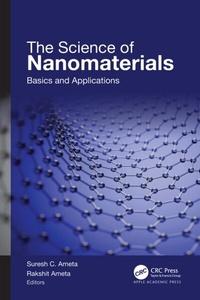
The Science of Nanomaterials
Basics and Applications
1st Edition
Published on 29. December 2022
400 pages
978-1-000-57566-8 (ISBN)
Description

Nanoparticles have a smaller size as compared to their micro, macro, or bulk counterparts. Reduction in size of these particles provides them with some unique characteristics, such as surface-to-volume ratio, quantum confinement effect, surface plasmon response, widening of band gap, etc. These nanoparticles have attracted attention of scientists all over the globe in last few decades.
Written in a convenient and easy-to-read style, this book covers the important aspects of nanomaterials by focusing on the many issues related to the food and textile industries, treatment of polluted water, health, energy crises, targeted drug delivery, etc. The editors take an interdisciplinary approach to discussing how the scenario will change on a global level in the future and explore when these nanomaterials will replace almost all micro- and macromaterials.
The Science of Nanomaterials is a ready-at-hand guide to the many issues related to the use of nanomaterials in drug and gene delivery, sensors, photosplitting of water, wastewater treatment, microbial diagnosis, textile industries, nanocomposites, food industries (safety, security, packaging and preservation), etc.
Written in a convenient and easy-to-read style, this book covers the important aspects of nanomaterials by focusing on the many issues related to the food and textile industries, treatment of polluted water, health, energy crises, targeted drug delivery, etc. The editors take an interdisciplinary approach to discussing how the scenario will change on a global level in the future and explore when these nanomaterials will replace almost all micro- and macromaterials.
The Science of Nanomaterials is a ready-at-hand guide to the many issues related to the use of nanomaterials in drug and gene delivery, sensors, photosplitting of water, wastewater treatment, microbial diagnosis, textile industries, nanocomposites, food industries (safety, security, packaging and preservation), etc.
More details
Edition
1. Auflage
Language
English
Place of publication
London
United Kingdom
Publishing group
Taylor & Francis Ltd
Target group
College/higher education
Professional and scholarly
Illustrations
7 Line drawings, color; 31 Line drawings, black and white; 2 Halftones, color; 14 Halftones, black and white; 9 Illustrations, color; 45 Illustrations, black and white
ISBN-13
978-1-000-57566-8 (9781000575668)
Copyright in bibliographic data and cover images is held by Nielsen Book Services Limited or by the publishers or by their respective licensors: all rights reserved.
Schweitzer Classification
Other editions
Additional editions
Book
12/2022
1st Edition
Apple Academic Press Inc.
€181.50
Shipment within 3-4 weeks
Persons
Suresh C. Ameta, PhD, is currently Professor of Eminence and Former Dean, Faculty of Science at PAHER University, Udaipur, India. He has served as Professor and Head of the Department of Chemistry at North Gujarat University Patan and at M. L. Sukhadia University, Udaipur, and as Head of the Department of Polymer Science. He also served as Dean of Postgraduate Studies. Prof. Ameta has held the position of President of the Indian Chemical Society, Kotkata, and is now a life-long Vice President. He was awarded a number of prestigious awards during his career, such as national prizes twice for writing chemistry books in Hindi. He also received the Prof. M. N. Desai Award (2004), the Prof. W. U. Malik Award (2008), the National Teacher Award (2011), the Prof. G. V. Bakore Award (2007), a Life-Time Achievement Award by the Indian Chemical Society (2011) as well as the Indian Council of Chemist (2015), etc. Having more than 350 research publications to his credit in journals of national and international repute, he is also the author of many undergraduate- and postgraduate-level books. He has published three books with Apple Academic Press: Chemical Applications of Symmetry and Group Theory; Microwave-Assisted Organic Synthesis; and Green Chemistry: Fundamentals and Applications; and two with Taylor and Francis: Solar Energy Conversion and Storage and Photocatalysis. He has also written chapters in books published by several other international publishers. Prof. Ameta has delivered lectures and chaired sessions at national conferences and is a reviewer of number of international journals. In addition, he has completed major research projects for different funding agencies, such as DST, UGC, CSIR, and Ministry of Energy, Govt. of India.
Rakshit Ameta, PhD, is Associate Professor of Chemistry, J. R. N. Rajasthan Vidyapeeth University, India. He has several years of experience in teaching and research in chemistry as well as industrial chemistry and polymer science. He is presently guiding six research students for their PhD theses, and eight students have already obtained their PhDs under his supervision in green chemistry. Dr. Rakshit Ameta has received various awards and recognition in his career, including being awarded first position and the gold medal for his MSc and receiving the Fateh Singh Award from the Maharana Mewar Foundation, Udaipur, for his meritorious performance. He has served at M. L. Sukhadia University, Udaipur; the University of Kota, Kota; and PAHER University, Udaipur. He has over 100 research publications to his credit in journals of national and international repute. He holds one patent, and two more are under way. Dr. Rakshit has organized several national conferences as Organizing Secretary at the University of Kota and PAHER University. He has delivered invited lectures and has chaired sessions in conferences held by the Indian Chemical Society and the Indian Council of Chemists. Dr. Rakshit was elected as council member of the Indian Chemical Society, Kolkata, and council member and zonal secretary, the Indian Council of Chemists, Agra, as well as Associate Editor, Physical Chemistry Section of Indian Chemical Society. Dr. Rakshit has also worked as Scientist-in-Charge in the Industrial and Applied Chemistry Section of the Indian Chemical Society. He has written five degree-level books and has contributed chapters to books published by several international publishers. He has published three books with Apple Academic Press: Chemical Applications of Symmetry and Group Theory; Microwave-Assisted Organic Synthesis; and Green Chemistry: Fundamentals and Applications; and two with Taylor and Francis: Solar Energy Conversion and Storage and Photocatalysis. His research areas focus on wastewater treatment, photochemistry, green chemistry, microwaveassisted reactions, environmental chemistry, nanochemistry, solar cells, and bioactive and conducting polymers.
Rakshit Ameta, PhD, is Associate Professor of Chemistry, J. R. N. Rajasthan Vidyapeeth University, India. He has several years of experience in teaching and research in chemistry as well as industrial chemistry and polymer science. He is presently guiding six research students for their PhD theses, and eight students have already obtained their PhDs under his supervision in green chemistry. Dr. Rakshit Ameta has received various awards and recognition in his career, including being awarded first position and the gold medal for his MSc and receiving the Fateh Singh Award from the Maharana Mewar Foundation, Udaipur, for his meritorious performance. He has served at M. L. Sukhadia University, Udaipur; the University of Kota, Kota; and PAHER University, Udaipur. He has over 100 research publications to his credit in journals of national and international repute. He holds one patent, and two more are under way. Dr. Rakshit has organized several national conferences as Organizing Secretary at the University of Kota and PAHER University. He has delivered invited lectures and has chaired sessions in conferences held by the Indian Chemical Society and the Indian Council of Chemists. Dr. Rakshit was elected as council member of the Indian Chemical Society, Kolkata, and council member and zonal secretary, the Indian Council of Chemists, Agra, as well as Associate Editor, Physical Chemistry Section of Indian Chemical Society. Dr. Rakshit has also worked as Scientist-in-Charge in the Industrial and Applied Chemistry Section of the Indian Chemical Society. He has written five degree-level books and has contributed chapters to books published by several international publishers. He has published three books with Apple Academic Press: Chemical Applications of Symmetry and Group Theory; Microwave-Assisted Organic Synthesis; and Green Chemistry: Fundamentals and Applications; and two with Taylor and Francis: Solar Energy Conversion and Storage and Photocatalysis. His research areas focus on wastewater treatment, photochemistry, green chemistry, microwaveassisted reactions, environmental chemistry, nanochemistry, solar cells, and bioactive and conducting polymers.
Content
1. Nanomaterials: An Introduction 2. Optical Properties of Nanostructured Materials and Their Sensing Applications 3. Nanotechnology for Selective Targeting and Cancer Drug Delivery 4. Cogent and Strategic Approaches for Gene Delivery with Nanostructures 5. Nanomaterials for Nanomedical and Nanobiotechnological Studies: Current Status and Applications of Carbon-Based Nanomaterials and Quantum Dots 6. Carbon Nanotubes for Photosplitting of Water 7. Nanomaterials as Effective Tools for Detection and Microbial Diagnosis of Foodborne Pathogens 8. Use of Nanomaterials in Wastewater Treatment 9. Layer-by-Layer Assembly as a Powerful Nanofabrication Technique for the Design of Antimicrobial Surfaces in the Textile Industry 10. Prospect of Utilizing Novel Nanomaterials for Effective Food Security, Safety, Packaging, and Preservation 11. Bio- and Synthetic Nanocomposites for Food Packaging 12. Fabrication and Applications of Nanocomposites
