

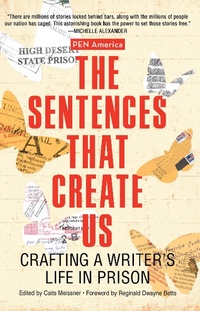
The Sentences That Create Us
Description

The Sentences That Create Us is a comprehensive resource writers can grow with, beginning with the foundations of creative writing. A roster of impressive contributors including Reginald Dwayne Betts (Felon: Poems), Mitchell S. Jackson (Survival Math), Wilbert Rideau (In the Place of Justice) and Piper Kerman (Orange is the New Black), among many others, address working within and around the severe institutional, emotional, psychological and physical limitations of writing prison through compelling first-person narratives. The book's authors offer pragmatic advice on editing techniques, pathways to publication, writing routines, launching incarcerated-run prison publications and writing groups, lesson plans from prison educators and next-step resources.
Threaded throughout the book is the running theme of addressing lived trauma in writing, and writing's capacity to support an authentic healing journey centered in accountability and restoration. While written towards people in the justice system, this book can serve anyone seeking hard won lessons and inspiration for their own creative-and human-journey.
More details
Persons
Founded in 1922, PEN America stands at the intersection of literature and human rights to protect free expression in the United States and worldwide. PEN America is the largest of the more than 100 centers worldwide that comprise the PEN International network. Our membership forms a nationwide community of writers and literary professionals, as well as devoted readers and supporters who join with them to carry out PEN America's mission. PEN America advocates for writers under threat worldwide and public policies that bolster freedom of speech; celebrates the literature of eminent and emerging writers through awards, publications, festivals, and public programming; produces original research on pressing threats to free expression; and offers platforms to lift up the work and views of those whose voices have too often gone unheard or been ignored. PEN America's Prison and Justice Writing Program, founded in 1971 in the wake of the Attica riots, advances the transformative possibilities of writing, and has offered many thousands of incarcerated writers free access to literary resources, skilled writing mentors, and audiences for their work. Our program extends PEN America's mission of supporting free expression, and encourages the use of the written word as a legitimate form of power.
Caits Meissner is the Director of Prison and Justice Writing at PEN America. She is also the author and illustrator of hybrid poetry book Let It Die Hungry (The Operating System, 2016). A multidisciplinary creator, Meissner's written and visual work has been published in venues including The Guardian, Harper's Bazaar, Medium's Human Parts, The Literary Review, Narrative, Adroit, Drunken Boat, Literary Hub, The Rumpus, [Pank], The Journal and The Offing, among others.
Content
- Intro
- Copyright
- Contents
- About PEN America
- Foreword
- Editor's Note: How to Read This Book
- PEN Prison Writing: Then and Now, In and Out
- Part I: Foundations of Creative Writing
- On Poetry
- On Fiction
- On Nonfiction Memoir
- On Dramatic Theater
- On Screenwriting
- On Graphic Narrative
- On Journalism
- The Prison Journalism Project's Quick Journalism Reference Guide
- A Guide to Grammar and Punctuation
- After Grammar: Learning How to Transition
- Re-Vision
- Part II: Crafting a Writer's Life in Prison
- Introduction
- The Price of Remaining Human
- The Most Important Thing (and a Few Other Rules)
- On Publishing from Prison
- Copyright Protection in Brief
- Burn the Spot: On Writing about People You Know
- The Power of Grieving in Words
- And Still I Write: Creative Expression for Self-Advocacy
- Every Story Needs Hope: Why You Should Write about Prison
- Start and End with the Feeling of Home: How I Developed My Poetry Manuscript
- On Writing and Staging a Play in Prison
- Gift Culture: On Collaborating through the Walls
- As for the Rest of Us: How to Win a Fellowship with No Support
- "Prison Writer": A Meditation on Histories and the Sentences that Create Them
- Part III: On Building Writing Community
- Introduction
- On Building Prison Writing Communities
- Remix the Plan, Return to the Purpose: How to Center Participant Storytelling in Writing Workshops
- No Pen or Paper Required: The Art and Practice of Community Storytelling
- Part IV: Writing Exercises
- Translating to the Page
- On Using Small Stories to Illuminate Big Issues
- Writing the Poem of the Moment
- Attention to Memory
- The Inherent Magic of Objects
- Apple Is for Identity and Other Prompts
- Personifying Location
- A Letter to My Ancestors
- Imagining Worlds: From Page to Stage
- Workshop Solitaire: Using Questions to Strengthen a Story
- Epilogue: A Writing Life in Community-from Inside Out
- Further Reading
- Further Resources
- Acknowledgments
- About the Contributors
- Permissions
- Index
- Back Cover
