

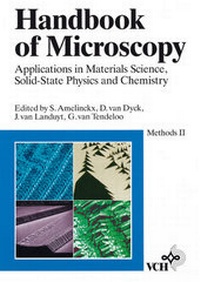
Handbook of Microscopy
Applications in Materials Science, Solid-State Physics, and Chemistry. Methods II
1st Edition
Published on 11. July 2008
XXV, 482 pages
978-3-527-62053-1 (ISBN)
Description

Comprehensive in coverage, written and edited by leading experts in the field, this Handbook is a definitive, up-to-date reference work. The Volumes Methods I and Methods II detail the physico-chemical basis and capabilities of the various microscopy techniques used in materials science. The Volume Applications illustrates the results obtained by all available methods for the main classes of materials, showing which technique can be successfully applied to a given material in order to obtain the desired information.
With the Handbook of Microscopy, scientists and engineers involved in materials characterization will be in a position to answer two key questions: "How does a given technique work?", and "Which techique is suitable for characterizing a given material?"
With the Handbook of Microscopy, scientists and engineers involved in materials characterization will be in a position to answer two key questions: "How does a given technique work?", and "Which techique is suitable for characterizing a given material?"
More details
Other editions
Additional editions

S. Amelinckx
Handbook of Microscopy - Applications in Materials Science, Solid-State Physics, and Chemistry Methods II
Software
06/2008
Wiley-VCH
€471.66
No shipping information available
S. Amelinckx | Dirk van Dyck | J. van Landuyt
Handbook of Microscopy
Applications in Materials Science, Solid-State Physics, and Chemistry / Methods II
Book
12/1996
Wiley-VCH
from
€339.00
Article exhausted; check different version
Persons
S. Amelinckx, Electron Microscopy for Materials Science (EMAT), University of Antwerp, Belgium.
Dirk van Dyck, Electron Microscopy for Materials Science (EMAT), University of Antwerp, Belgium.
J. van Landuyt, Electron Microscopy for Materials Science (EMAT), University of Antwerp, Belgium.
Gustaaf van Tendeloo, Electron Microscopy for Materials Science (EMAT), University of Antwerp, Belgium.
Editor
Electron Microscopy for Materials Science (EMAT), University of Antwerp, Belgium
Electron Microscopy for Materials Science (EMAT), University of Antwerp, Belgium
Electron Microscopy for Materials Science (EMAT), University of Antwerp, Belgium
Content
METHODS I:
LIGHT MICROSCOPY
Reflection Microscopy
Transmission Microscopy
Raman Microscopy
Three-dimensional Light Microscopy
Near Field Light Microscopy
Infrared Microscopy
X-RAY MICROSCOPY
Soft X-ray Imaging
X-ray Microradiography
X-ray Microtomography
X-ray Holographic Imaging
X-ray Topography
ACOUSTIC MICROSCOPY
Scanning Acoustic Microscopy
Photoacoustic Microscopy
Electron Acoustic Microscopy
Scanning Laser Acoustic Microscopy
ELECTRON MICROSCOPY
Stationary Beam Methods
METHODS II:
ELECTRON MICROSCOPY
Scanning Beam Methods
Magnetic Methods: NMR-Microscopy
Scanning Electron Microscopy with Polarization Analysis (SEMPA)
EMISSION METHODS
Photoemission Electron Microscopy
Field Emission Microscopy (FEM)
Field Ion Microscopy
SCANNING POINT PROBE TECHNIQUES
Scanning Tunnelling Microscopy STM
Atomic Force Microscopy AFM
Magnetic Force Microscopy MFM
Ballistic Electron Emission Microscopy (BEEM)
Methods Under Development
IMAGE RECORDING
HANDLING AND PROCESSING
Electronic Image Recording
Image Processing
SPECIAL TOPICS
Coincidence Microscopy
Low Energy Holography
APPLICATIONS:
CLASSES OF MATERIALS
Metals and Alloys
Rocks and Minerals
Semiconductors and Semiconducting Devices
Opto-electronic Materials
Ferroic Materials
Structural Ceramics
Gemmological Applications
Superconductors: Intermetallics and Ceramics
Nonperiodic Structures
Dental and Biomaterials
Application of TEM and SAED
Different Forms of Carbon
Composite Structural Materials
Polymers
Nuclear Materials
Magnetic Materials
SPECIAL TOPICS
Phase Transformations
Specimen Preparation Techniques
Environmental Problems
Thin Film Growth
Quantitative Hyleography
LIGHT MICROSCOPY
Reflection Microscopy
Transmission Microscopy
Raman Microscopy
Three-dimensional Light Microscopy
Near Field Light Microscopy
Infrared Microscopy
X-RAY MICROSCOPY
Soft X-ray Imaging
X-ray Microradiography
X-ray Microtomography
X-ray Holographic Imaging
X-ray Topography
ACOUSTIC MICROSCOPY
Scanning Acoustic Microscopy
Photoacoustic Microscopy
Electron Acoustic Microscopy
Scanning Laser Acoustic Microscopy
ELECTRON MICROSCOPY
Stationary Beam Methods
METHODS II:
ELECTRON MICROSCOPY
Scanning Beam Methods
Magnetic Methods: NMR-Microscopy
Scanning Electron Microscopy with Polarization Analysis (SEMPA)
EMISSION METHODS
Photoemission Electron Microscopy
Field Emission Microscopy (FEM)
Field Ion Microscopy
SCANNING POINT PROBE TECHNIQUES
Scanning Tunnelling Microscopy STM
Atomic Force Microscopy AFM
Magnetic Force Microscopy MFM
Ballistic Electron Emission Microscopy (BEEM)
Methods Under Development
IMAGE RECORDING
HANDLING AND PROCESSING
Electronic Image Recording
Image Processing
SPECIAL TOPICS
Coincidence Microscopy
Low Energy Holography
APPLICATIONS:
CLASSES OF MATERIALS
Metals and Alloys
Rocks and Minerals
Semiconductors and Semiconducting Devices
Opto-electronic Materials
Ferroic Materials
Structural Ceramics
Gemmological Applications
Superconductors: Intermetallics and Ceramics
Nonperiodic Structures
Dental and Biomaterials
Application of TEM and SAED
Different Forms of Carbon
Composite Structural Materials
Polymers
Nuclear Materials
Magnetic Materials
SPECIAL TOPICS
Phase Transformations
Specimen Preparation Techniques
Environmental Problems
Thin Film Growth
Quantitative Hyleography
