

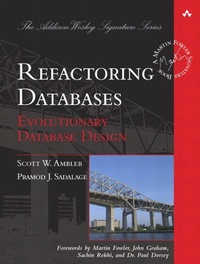
Refactoring Databases
Evolutionary Database Design
1st Edition
Published on 14. July 2021
384 pages
978-0-321-46805-5 (ISBN)
Description

Refactoring has proven its value in a wide range of development projects-helping software professionals improve system designs, maintainability, extensibility, and performance. Now, for the first time, leading agile methodologist Scott Ambler and renowned consultant Pramodkumar Sadalage introduce powerful refactoring techniques specifically designed for database systems.
Ambler and Sadalage demonstrate how small changes to table structures, data, stored procedures, and triggers can significantly enhance virtually any database design-without changing semantics. You'll learn how to evolve database schemas in step with source code-and become far more effective in projects relying on iterative, agile methodologies.
This comprehensive guide and reference helps you overcome the practical obstacles to refactoring real-world databases by covering every fundamental concept underlying database refactoring. Using start-to-finish examples, the authors walk you through refactoring simple standalone database applications as well as sophisticated multi-application scenarios. You'll master every task involved in refactoring database schemas, and discover best practices for deploying refactorings in even the most complex production environments.
The second half of this book systematically covers five major categories of database refactorings. You'll learn how to use refactoring to enhance database structure, data quality, and referential integrity; and how to refactor both architectures and methods. This book provides an extensive set of examples built with Oracle and Java and easily adaptable for other languages, such as C#, C++, or VB.NET, and other databases, such as DB2, SQL Server, MySQL, and Sybase.
Using this book's techniques and examples, you can reduce waste, rework, risk, and cost-and build database systems capable of evolving smoothly, far into the future.
Ambler and Sadalage demonstrate how small changes to table structures, data, stored procedures, and triggers can significantly enhance virtually any database design-without changing semantics. You'll learn how to evolve database schemas in step with source code-and become far more effective in projects relying on iterative, agile methodologies.
This comprehensive guide and reference helps you overcome the practical obstacles to refactoring real-world databases by covering every fundamental concept underlying database refactoring. Using start-to-finish examples, the authors walk you through refactoring simple standalone database applications as well as sophisticated multi-application scenarios. You'll master every task involved in refactoring database schemas, and discover best practices for deploying refactorings in even the most complex production environments.
The second half of this book systematically covers five major categories of database refactorings. You'll learn how to use refactoring to enhance database structure, data quality, and referential integrity; and how to refactor both architectures and methods. This book provides an extensive set of examples built with Oracle and Java and easily adaptable for other languages, such as C#, C++, or VB.NET, and other databases, such as DB2, SQL Server, MySQL, and Sybase.
Using this book's techniques and examples, you can reduce waste, rework, risk, and cost-and build database systems capable of evolving smoothly, far into the future.
More details
Series
Edition
1. Auflage
Language
English
Place of publication
Boston
United States
Publishing group
Pearson Education (US)
Target group
Professional and scholarly
File size
2,72 MB
ISBN-13
978-0-321-46805-5 (9780321468055)
Copyright in bibliographic data and cover images is held by Nielsen Book Services Limited or by the publishers or by their respective licensors: all rights reserved.
Schweitzer Classification
Other editions
Additional editions
Book
03/2011
Addison Wesley
€47.00
Shipment within 10-20 days
Persons
Scott W. Ambler is a software process improvement (SPI) consultant living just north of Toronto. He is founder and practice leader of the Agile Modeling (AM) (www.agilemodeling.com), Agile Data (AD) (www.agiledata.org), Enterprise Unified Process (EUP) (www.enterpriseunifiedprocess.com), and Agile Unified Process (AUP) (www.ambysoft.com/unifiedprocess) methodologies. Scott is the (co-)author of several books, including Agile Modeling (John Wiley & Sons, 2002), Agile Database Techniques (John Wiley & Sons, 2003), The Object Primer, Third Edition (Cambridge University Press, 2004), The Enterprise Unified Process (Prentice Hall, 2005), and The Elements of UML 2.0 Style (Cambridge University Press, 2005). Scott is a contributing editor with Software Development magazine (www.sdmagazine.com) and has spoken and keynoted at a wide variety of international conferences, including Software Development, UML World, Object Expo, Java Expo, and Application Development. Scott graduated from the University of Toronto with a Master of Information Science. In his spare time Scott studies the Goju Ryu and Kobudo styles of karate.
Pramod J. Sadalage is a consultant for ThoughtWorks, an enterprise application development and integration company. He first pioneered the practices and processes of evolutionary database design and database refactoring in 1999 while working on a large J2EE application using the Extreme Programming (XP) methodology. Since then, Pramod has applied the practices and processes to many projects. Pramod writes and speaks about database administration on evolutionary projects, the adoption of evolutionary processes with regard to databases, and evolutionary practices' impact upon database administration, in order to make it easy for everyone to use evolutionary design in regards to databases. When he is not working, you can find him spending time with his wife and daughter and trying to improve his running.
Pramod J. Sadalage is a consultant for ThoughtWorks, an enterprise application development and integration company. He first pioneered the practices and processes of evolutionary database design and database refactoring in 1999 while working on a large J2EE application using the Extreme Programming (XP) methodology. Since then, Pramod has applied the practices and processes to many projects. Pramod writes and speaks about database administration on evolutionary projects, the adoption of evolutionary processes with regard to databases, and evolutionary practices' impact upon database administration, in order to make it easy for everyone to use evolutionary design in regards to databases. When he is not working, you can find him spending time with his wife and daughter and trying to improve his running.
Content
About the Authors xv
Forewords xvii
Preface xxi
Acknowledgments xxvii
Chapter 1: Evolutionary Database Development 1
Chapter 2: Database Refactoring 13
Chapter 3: The Process of Database Refactoring 29
Chapter 4: Deploying into Production 49
Chapter 5: Database Refactoring Strategies 59
Chapter 6: Structural Refactorings 69
Chapter 7: Data Quality Refactorings 151
Chapter 8: Referential Integrity Refactorings 203
Chapter 9: Architectural Refactorings 231
Chapter 10: Method Refactorings 277
Chapter 11: Transformations 295
Appendix: The UML Data Modeling Notation 315
Glossary 321
References and Recommended Reading 327
Index 331
Forewords xvii
Preface xxi
Acknowledgments xxvii
Chapter 1: Evolutionary Database Development 1
Chapter 2: Database Refactoring 13
Chapter 3: The Process of Database Refactoring 29
Chapter 4: Deploying into Production 49
Chapter 5: Database Refactoring Strategies 59
Chapter 6: Structural Refactorings 69
Chapter 7: Data Quality Refactorings 151
Chapter 8: Referential Integrity Refactorings 203
Chapter 9: Architectural Refactorings 231
Chapter 10: Method Refactorings 277
Chapter 11: Transformations 295
Appendix: The UML Data Modeling Notation 315
Glossary 321
References and Recommended Reading 327
Index 331
