

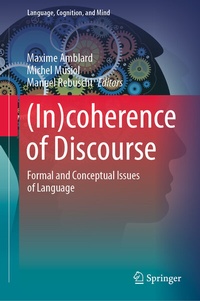
(In)coherence of Discourse
Description

This present book explores recent advances in modeling discourse processes, in particular, new approaches aimed at understanding pathological language behavior specific to schizophrenia. The contributors examine the modeling paradigm of formal semantics, which falls within the scope of both linguistics and logic while providing overlapping links with other fields such as philosophy of language and cognitive psychology.
This book is based on results presented during the series of workshops on (In)Coherence and Discourse organized by SLAM (Schizophrenia and Language: Analysis and Modeling), a project developed to systemize the study of pathological language processing by taking an overarching interdisciplinary approach combining psychology, linguistics, computer science and philosophy. The principle focus is on conversations produced by people with psychiatric disorders such as schizophrenia and autism. The contributions come from young and experienced researchers, and invited speakers. The book appeals to likeminded students and researchers.
More details
Other editions
Additional editions
Persons
Maxime Amblard is Associate Professor of Computer Science and Researcher at the Laboratoire Lorrain de Recherche en Informatique et ses Applications. He is Head of the Master in Natural Language Processing program at the University of Lorraine. His research areas are formal language modeling, and the development of resources and tools for the parsing of semantics, discourse and dialogue. His work links formalizations and applications to real-life data.
Michel Musiol is Professor of Psycholinguistics and Assistant Director at the Analyse et Traitement Informatique de la Langue Française Laboratory. He is interested in the analysis of the manifestation of thought disorders throughout language. He has studied these particularities through interviews with patients with schizophrenia.
Manuel Rebuschi is Associate Professor of Philosophy, Researcher at the Poincaré-Archives and Head of the Master in Cognitive Science program at the University of Lorraine. His research areas are philosophy of language and philosophy of mind, particularly rationality and/or intention ascriptions in various contexts. He is involved in several interdisciplinary projects with psychologists, linguists and computer scientists.
Content
Chapter 1. Discourse coherence - From psychology to linguistics and back again (Maxime Amblard, Michel Musiol, Manuel Rebuschi).- Chapter 2. Linguistic Recursion and Danish Discourse Particles, Language in Children with Autism Spectrum Disorder (Patrick Blackburn, Torben Braüner, Irina Polyanskaya).- Chapter 3. Reasoning in multiparty dialogue involving patients with schizophrenia (Ellen Breitholtz, Robin Cooper, Christine Howes, Mary Lavelle).- Chapter 4. Picturing Questions and Answers - a formal approach to SLAM (Maria Boritchev, Maxime Amblard).- Chapter 5. Incoherences in Dialogues and their Formalization Focus on Dialogues with Schizophrenic Individuals (Christophe Fouqueré, Jean-Jacques Pinto, Myriam Quatrini).- Chapter 6. Metaphorical Thinking and Delusions in Psychosis (Felicity Deamer, Sam Wilkinson).- Chapter 7. The myth of irrationality: a Wittgensteinian approach to delusions and to the principle of charity (Mathieu Frérejouan).- Chapter 8. (In)Coherences in the discourse of the schizophrenic: an anthropological approach to the mind (Fabrice Louis).- Chapter 9. Conversations with madness, Meaning, Context and Incoherence (Valérie Aucouturier).
