

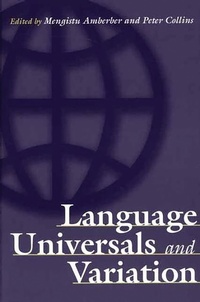
Language Universals and Variation
1st Edition
Published on 30. June 2002
296 pages
978-0-313-01248-8 (ISBN)
Description

Issues addressed in this contributed volume include lexical semantics, morphosyntax, and phonology based on the broad theme of formal approaches to language universals and variation. Aspects of natural language variation are investigated from a formal theoretical perspective, including the Principles and Parameters/Minimalist Program, Lexical Functional Grammar and Optimality Theory. A wide range of languages and language families are considered, including Amharic, Arabic, Bantu, Berber, Chamorro, English, French, Japanese, Malyalam, Polish, Spanish, Tagalog, Turkish, and Warlpiri.
This is an important addition to the growing body of literature on language universals and variation from formal theoretical perspectives. It will be a useful reference to linguistics specialists and other cognitive scientists. The topics covered are also diverse, ranging from pronominal clitic variation in dialects of Spanish to passives in Bantu and Polish and the typology of Wh-in-situ questions and vowel place constraints.
This is an important addition to the growing body of literature on language universals and variation from formal theoretical perspectives. It will be a useful reference to linguistics specialists and other cognitive scientists. The topics covered are also diverse, ranging from pronominal clitic variation in dialects of Spanish to passives in Bantu and Polish and the typology of Wh-in-situ questions and vowel place constraints.
More details
Series
Edition
1. Auflage
Language
English
Place of publication
New York
United States
Publishing group
Bloomsbury Publishing Plc
Target group
Interest Age: From 7 to 17 years
ISBN-13
978-0-313-01248-8 (9780313012488)
Copyright in bibliographic data and cover images is held by Nielsen Book Services Limited or by the publishers or by their respective licensors: all rights reserved.
Schweitzer Classification
Other editions
Additional editions
Mengistu Amberber | Peter Collins
Language Universals and Variation
Book
06/2002
Praeger Publishers Inc
€99.00
Shipment within 15-20 days
Persons
MENGISTU AMBERBER is a lecturer in linguistics at the School of Modern Language Studies at the University of New South Wales, Australia.
PETER COLLINS is Associate Professor of Linguistics and Head of the Linguistics Department at the University of New South Wales, Australia.
PETER COLLINS is Associate Professor of Linguistics and Head of the Linguistics Department at the University of New South Wales, Australia.
Content
Preface
Quirky Alternations of Transitivity: The Case of Ingestive Predicates by Mengistu Amberber
Explaining Clitic Variation in Spanish by José Camacho and Liliana Sánchez
Slavic Passives, Bantu Passives, and Human Cognition by Peter Kipka
The Split VP Hypothesis: Evidence from Language Acquisition by Masatoshi Koizumi
Syntactic Constraints in a "Free Word Order" Language by Mary Laughren
On the Range and Variety of Cases Assigned by Adpositions by Alan Libert
Optimality and Three Western Austronesian Case Systems by Anna Machlachlan
Affixes, Clitics, and Bantu Morphosyntax by Sam Mchombo
Two Types of Wh-in-situ by Masanori Nakamura
Vowel Place Contrasts by Keren Rice
References
Index of Authors
Index of Languages and Language Families
Subject Index
Quirky Alternations of Transitivity: The Case of Ingestive Predicates by Mengistu Amberber
Explaining Clitic Variation in Spanish by José Camacho and Liliana Sánchez
Slavic Passives, Bantu Passives, and Human Cognition by Peter Kipka
The Split VP Hypothesis: Evidence from Language Acquisition by Masatoshi Koizumi
Syntactic Constraints in a "Free Word Order" Language by Mary Laughren
On the Range and Variety of Cases Assigned by Adpositions by Alan Libert
Optimality and Three Western Austronesian Case Systems by Anna Machlachlan
Affixes, Clitics, and Bantu Morphosyntax by Sam Mchombo
Two Types of Wh-in-situ by Masanori Nakamura
Vowel Place Contrasts by Keren Rice
References
Index of Authors
Index of Languages and Language Families
Subject Index
