

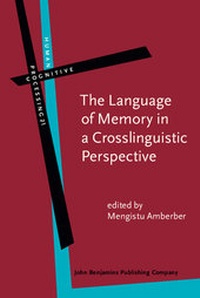
The Language of Memory in a Crosslinguistic Perspective
1st Edition
Published on 14. November 2007
XII, 284 pages
978-90-272-9179-0 (ISBN)
Description

This book offers, for the first time, a detailed comparative study of how speakers of different languages express memory concepts. While there is a robust body of psycholinguistic research that bears on how memory and language are related, there is no comparative study of how speakers themselves conceptualize memory as reflected in their use of language to talk about memory. This book addresses a key question: how do speakers of different languages talk about the experience of having prior experiences coming to mind ('remembering') or failing to come to mind ('forgetting')? A complex array of answers is provided through detailed grammatical and semantic investigation of different languages, including English, German, Polish, Russian and also a number of non-Indo-European languages, Amharic, Cree, Dalabon, Korean, and Mandarin. In addition, the book calls for a broader interdisciplinary engagement by urging that cognitive semantics be integrated with other sciences of memory.
More details
Other editions
Additional editions
Mengistu Amberber
The Language of Memory in a Crosslinguistic Perspective
Book
11/2007
John Benjamins Publishing Co
€111.30
Shipment within 10-15 days
Person
Content
- The Language of Memory in a Crosslinguistic Perspective
- Editorial page
- Title page
- LCC data
- Table of contents
- Preface
- About the contributors
- 1. Introduction
- Grammar and the lexical semantics of memory
- The chapters
- References
- 2. Is "remember" a universal human concept?
- 1. "Memory" as a psychological construct
- 2. The Natural Semantic Metalanguage ("NSM")
- 3. "Memory" as a cultural construct
- 4. "Voluntary memory" and "involuntary memory"
- 5. "Remember" - the change in meaning
- 6. The meaning of some Polish words related to "memory"
- 7. Conclusion
- References
- 3. Language, memory, and concepts of memory
- 1. The interdisciplinary study of memory and remembering
- 2. The psychology of memory: science, history, and linguocentrism
- 3. Conceptual analysis, experiential remembering, semantics, and cultural elaboration
- 4. Semantic diversity and the study of memory: some questions and challenges
- References
- 4. Standing up your mind
- 1. Introduction
- 2. Memory and the Dalabon language: some basic parameters
- 3. Memory and stimulus source
- 4. How distinct are expressions of memory from those for other cognitive activity?
- 5. Conclusion
- Appendix: on defi nition constructions and primitives
- Abbreviations in glosses
- References
- 5. The conceptualisation of remembering and forgetting in Russian
- 1. Introduction
- 2. The conceptualisation of remembering
- 3. The conceptualisation of forgetting
- 4. Concluding remarks
- References
- 6. A "lexicographic portrait" of forgetting
- 1. Introduction
- 2. To- complement ( forget to - ) and related NP-complements
- 3. That- complement ( forget that - ) and related NP-complements
- 4. Wh- complement ( forget where, what, why , etc.) and related NP-complements
- 5. Forget about . . .
- 6. Experiential constructions: Never forget . . ., can't forget . . ., etc.
- 7. Other specialised meanings
- 8. Concluding remarks
- Appendices
- References
- 7. 'Memorisation,' learning, and cultural cognition
- 1. The paradox of the Chinese learner and the need for a culture-internal perspective
- 2. The importance of 'memorisation' in Chinese learning: Illustrations
- 3. Focusing on b è i - what is it?
- 4. Why is b è i an emphasised learning practice?
- 5. Theoretical and methodological implications
- Abbreviations
- References
- Dictionaries
- 8. A corpus-based analysis of German (sich) erinnern
- 1. Introduction
- 2. Prototypical components of REMEMBER
- 3. Different 'readings' of German erinnern
- 4. Reflexive form sich erinnern
- 5. Conclusion
- References
- 9. "Do you remember where you put the key?"
- 1. Introduction
- 2. The research method: Natural Semantic Metalanguage theory
- 3. The Korean model of remembering
- 4. Concluding remarks
- Typographical conventions
- Romanisation and Abbreviations in Interlinear Glosses
- Corpora used for Korean examples
- References
- 10. The language of memory in East Cree
- Introduction
- 1. Background on East Cree Language and Culture
- 2. Memory in lexical items
- 3. Memory in grammatical items
- 4. Memory in discourse
- Conclusion
- References
- 11. Remember, remind, and forget in Amharic
- 1. Introduction
- 2. Typological overview
- 3. Three verbs of memory
- 4. Polysemy with "thinking" and "knowing"
- 5. Conclusion
- References
- Author index
- Language index
- Subject index
- The series Human Cognitive Processing
