

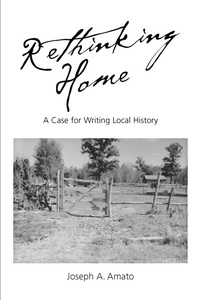
Rethinking Home
A Case for Writing Local History
1st Edition
Published on 1. April 2002
261 pages
978-0-520-93633-1 (ISBN)
Description

Joseph A. Amato proposes a bold and innovative approach to writing local history in this imaginative, wide-ranging, and deeply engaging exploration of the meaning of place and home. Arguing that people of every place and time deserve a history, Amato draws on his background as a European cultural historian and a prolific writer of local history to explore such topics as the history of cleanliness, sound, anger, madness, the clandestine, and the environment in southwestern Minnesota. While dedicated to the unique experiences of a place, his lively work demonstrates that contemporary local history provides a vital link for understanding the relation between immediate experience and the metamorphosis of the world at large. In an era of encompassing forces and global sensibilities, Rethinking Home advocates the power of local history to revivify the individual, the concrete, and the particular. This singular book offers fresh perspectives, themes, and approaches for energizing local history at a time when the very notion of place is in jeopardy.
Amato explains how local historians shape their work around objects we can touch and institutions we have directly experienced. For them, theory always gives way to facts. His vivid portraits of individual people, places, situations, and cases (which include murders, crop scams, and taking custody of the law) are joined to local illustrations of the use of environmental and ecological history. This book also puts local history in the service of contemporary history with the examination of recent demographic, social, and cultural transformations. Critical concluding chapters on politics and literature--especially Sinclair Lewis's Main Street and Longfellow's Hiawatha--show how metaphor and myth invent, distort, and hold captive local towns, peoples, and places.
Amato explains how local historians shape their work around objects we can touch and institutions we have directly experienced. For them, theory always gives way to facts. His vivid portraits of individual people, places, situations, and cases (which include murders, crop scams, and taking custody of the law) are joined to local illustrations of the use of environmental and ecological history. This book also puts local history in the service of contemporary history with the examination of recent demographic, social, and cultural transformations. Critical concluding chapters on politics and literature--especially Sinclair Lewis's Main Street and Longfellow's Hiawatha--show how metaphor and myth invent, distort, and hold captive local towns, peoples, and places.
More details
Other editions
Additional editions
Book
04/2002
1st Edition
University of California Press
€29.71
Shipment within 10-20 days

Book
04/2002
1st Edition
University of California Press
€46.99
Article exhausted; check different version
Person
Joseph A. Amato is Professor of Rural and Regional Studies at Southwest State University in Marshall, Minnesota, and principal founder of the Society for Local and Regional History. He is the author of Dust: A History of the Small and the Invisible (California, 2000), Bypass: a Memoir (2000), Golf Beats Us All (So We Love It) (1997); The Decline of Rural Minnesota (1993); The Great Jerusalem Artichoke Circus: The Buying and Selling of the American Rural Dream (1993); and Victims and Values: A History and Theory of Suffering (1990), and a forthcoming history of walking.
Content
Maps
Foreword
Introduction. The Concept and the Practitioners of Local History
1. A Place Called Home
2. Grasses, Waters, and Muskrats: A Region's Compasses
3. The Rule of Market and the Law of the Land
4. Writing History through the Senses: Sounds
5. Anger: Mapping the Emotional Landscape
6. The Clandestine
7. Madness
8. Madame Bovary and a Lilac Shirt: Literature and Local History
9. The Red Rock: Inventing Peoples and Towns
10. Business First and Always
Conclusion: The Plight of the Local Historian
Notes
Acknowledgments and Sources
Index
Foreword
Introduction. The Concept and the Practitioners of Local History
1. A Place Called Home
2. Grasses, Waters, and Muskrats: A Region's Compasses
3. The Rule of Market and the Law of the Land
4. Writing History through the Senses: Sounds
5. Anger: Mapping the Emotional Landscape
6. The Clandestine
7. Madness
8. Madame Bovary and a Lilac Shirt: Literature and Local History
9. The Red Rock: Inventing Peoples and Towns
10. Business First and Always
Conclusion: The Plight of the Local Historian
Notes
Acknowledgments and Sources
Index
