

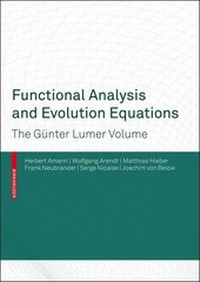
Functional Analysis and Evolution Equations
The Günter Lumer Volume
1st Edition
Published on 28. February 2008
XVII, 637 pages
978-3-7643-7794-6 (ISBN)
Description

Günter Lumer was an outstanding mathematician whose work has great influence on the research community in mathematical analysis and evolution equations. He was at the origin of the breath-taking development the theory of semigroups saw after the pioneering book of Hille and Phillips of 1957. This volume contains invited contributions presenting the state of the art of these topics and reflecting the broad interests of Günter Lumer.
More details
Other editions
Additional editions
Herbert Amann | Wolfgang Arendt | Frank Neubrander
Functional Analysis and Evolution Equations
The Günter Lumer Volume
Book
12/2007
Birkhäuser
€53.49
Shipment within 10-15 days
Content
Expansions in Generalized Eigenfunctions of the Weighted Laplacian on Star-shaped Networks.- Diffusion Equations with Finite Speed of Propagation.- Subordinated Multiparameter Groups of Linear Operators: Properties via the Transference Principle.- An Integral Equation in AeroElasticity.- Eigenvalue Asymptotics Under a Non-dissipative Eigenvalue Dependent Boundary Condition for Second-order Elliptic Operators.- Feynman-Kac Formulas, Backward Stochastic Differential Equations and Markov Processes.- Generation of Cosine Families on L p (0,1) by Elliptic Operators with Robin Boundary Conditions.- Global Smooth Solutions to a Fourth-order Quasilinear Fractional Evolution Equation.- Positivity Property of Solutions of Some Quasilinear Elliptic Inequalities.- On a Stochastic Parabolic Integral Equation.- Resolvent Estimates for a Perturbed Oseen Problem.- Abstract Delay Equations Inspired by Population Dynamics.- Weak Stability for Orbits of C 0-semigroups on Banach Spaces.- Contraction Semigroups on L ?(R).- On the Curve Shortening Flow with Triple Junction.- The Dual Mixed Finite Element Method for the Heat Diffusion Equation in a Polygonal Domain, I.- Maximal Regularity of the Stokes Operator in General Unbounded Domains of ? n .- Linear Control Systems in Sequence Spaces.- On the Motion of Several Rigid Bodies in a Viscous Multipolar Fluid.- On the Stokes Resolvent Equations in Locally Uniform L p Spaces in Exterior Domains.- Generation of Analytic Semigroups and Domain Characterization for Degenerate Elliptic Operators with Unbounded Coefficients Arising in Financial Mathematics. Part II.- Numerical Approximation of Generalized Functions: Aliasing, the Gibbs Phenomenon and a Numerical Uncertainty Principle.- No Radial Symmetries in the Arrhenius-Semenov ThermalExplosion Equation.- Mild Well-posedness of Abstract Differential Equations.- Backward Uniqueness in Linear Thermoelasticity with Time and Space Variable Coefficients.- Measure and Integral: New Foundations after One Hundred Years.- Post-Widder Inversion for Laplace Transforms of Hyperfunctions.- On a Class of Elliptic Operators with Unbounded Time- and Space-dependent Coefficients in ? N .- Time-dependent Nonlinear Perturbations of Analytic Semigroups.- A Variational Approach to Strongly Damped Wave Equations.- Exponential and Polynomial Stability Estimates for the Wave Equation and Maxwell's System with Memory Boundary Conditions.- Maximal Regularity for Degenerate Evolution Equations with an Exponential Weight Function.- An Analysis of Asian options.- Linearized Stability and Regularity for Nonlinear Age-dependent Population Models.- Space Almost Periodic Solutions of Reaction Diffusion Equations.- On the Oseen Semigroup with Rotating Effect.- Exact Controllability in L 2(?) of the Schrödinger Equation in a Riemannian Manifold with L 2(?1)-Neumann Boundary Control.
Feynman-Kac Formulas, Backward Stochastic Differential Equations and Markov Processes (p. 81-82)
Jan A. Van Casteren
This article is written in honor of G. Lumer whom I consider as my semi-group teacher
Abstract. In this paper we explain the notion of stochastic backward differential equations and its relationship with classical (backward) parabolic Differential equations of second order. The paper contains a mixture of stochastic processes like Markov processes and martingale theory and semi-linear partial Differential equations of parabolic type. Some emphasis is put on the fact that the whole theory generalizes Feynman-Kac formulas. A new method of proof of the existence of solutions is given. All the existence arguments are based on rather precise quantitative estimates.
1. Introduction
Backward stochastic Differential equations, in short BSDEs, have been well studied during the last ten years or so. They were introduced by Pardoux and Peng [20], who proved existence and uniqueness of adapted solutions, under suitable squareintegrability assumptions on the coeffcients and on the terminal condition. They provide probabilistic formulas for solution of systems of semi-linear partial Differential equations, both of parabolic and elliptic type. The interest for this kind of stochastic equations has increased steadily, this is due to the strong connections of these equations with mathematical finance and the fact that they provide a generalization of the well-known Feynman-Kac formula to semi-linear partial differential equations. In the present paper we will concentrate on the relationship between time-dependent strong Markov processes and abstract backward stochastic Differential equations. The equations are phrased in terms of a martingale type problem, rather than a strong stochastic Differential equation. They could be called weak backward stochastic Differential equations. Emphasis is put on existence and uniqueness of solutions. The paper in [27] deals with the same subject, but it concentrates on comparison theorems and viscosity solutions.
The notion of squared gradient operator is implicitly used by Bally at al in [4]. The latter paper was one of the motivations to write the present paper with an emphasis on the squared gradient operator. In addition, our results are presented in such a way that the state space of the underlying Markov process, which in most of the other papers on BSDEs is supposed to be Rn, can be any diffusion with an abstract state space, which throughout our text is denoted by E. In fact in the existing literature the underlying Markov process is a (strong) solution of a (forward) stochastic Differential equation: see, e.g., [4], [8] and [7] and [19]. For more on this see Remark 2.9 below. In particular our results are applicable in case the Markov process under consideration is Brownian motion on a Riemannian manifold. Our condition on the generator (or coefficient) of the BSDE f in terms of the squared gradient is very natural. In the Lipschitz context it is more or less optimal. Moreover, our proof of existence is not based on standard regularization methods by using convolution products with smooth functions, but on a homotopy argument due to Crouzeix [11], which seems more direct than the classical approach. We also obtain rather precise quantitative estimates. Only very rudimentary sketches of proofs are given, details will appear elsewhere.
Jan A. Van Casteren
This article is written in honor of G. Lumer whom I consider as my semi-group teacher
Abstract. In this paper we explain the notion of stochastic backward differential equations and its relationship with classical (backward) parabolic Differential equations of second order. The paper contains a mixture of stochastic processes like Markov processes and martingale theory and semi-linear partial Differential equations of parabolic type. Some emphasis is put on the fact that the whole theory generalizes Feynman-Kac formulas. A new method of proof of the existence of solutions is given. All the existence arguments are based on rather precise quantitative estimates.
1. Introduction
Backward stochastic Differential equations, in short BSDEs, have been well studied during the last ten years or so. They were introduced by Pardoux and Peng [20], who proved existence and uniqueness of adapted solutions, under suitable squareintegrability assumptions on the coeffcients and on the terminal condition. They provide probabilistic formulas for solution of systems of semi-linear partial Differential equations, both of parabolic and elliptic type. The interest for this kind of stochastic equations has increased steadily, this is due to the strong connections of these equations with mathematical finance and the fact that they provide a generalization of the well-known Feynman-Kac formula to semi-linear partial differential equations. In the present paper we will concentrate on the relationship between time-dependent strong Markov processes and abstract backward stochastic Differential equations. The equations are phrased in terms of a martingale type problem, rather than a strong stochastic Differential equation. They could be called weak backward stochastic Differential equations. Emphasis is put on existence and uniqueness of solutions. The paper in [27] deals with the same subject, but it concentrates on comparison theorems and viscosity solutions.
The notion of squared gradient operator is implicitly used by Bally at al in [4]. The latter paper was one of the motivations to write the present paper with an emphasis on the squared gradient operator. In addition, our results are presented in such a way that the state space of the underlying Markov process, which in most of the other papers on BSDEs is supposed to be Rn, can be any diffusion with an abstract state space, which throughout our text is denoted by E. In fact in the existing literature the underlying Markov process is a (strong) solution of a (forward) stochastic Differential equation: see, e.g., [4], [8] and [7] and [19]. For more on this see Remark 2.9 below. In particular our results are applicable in case the Markov process under consideration is Brownian motion on a Riemannian manifold. Our condition on the generator (or coefficient) of the BSDE f in terms of the squared gradient is very natural. In the Lipschitz context it is more or less optimal. Moreover, our proof of existence is not based on standard regularization methods by using convolution products with smooth functions, but on a homotopy argument due to Crouzeix [11], which seems more direct than the classical approach. We also obtain rather precise quantitative estimates. Only very rudimentary sketches of proofs are given, details will appear elsewhere.
