

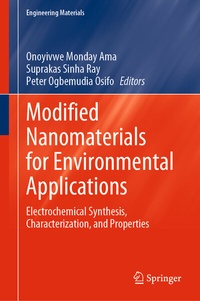
Modified Nanomaterials for Environmental Applications
Description

This book focuses on the electrochemical and nanostructural properties of new photoanode/electrolyte combinations used in the development of novel surface-modified nanomaterials for environmental applications. As water treatment is rapidly becoming a global challenge due to the increasing complexity and number of the various pollutants present, the book explores fundamental issues relating to environmental applications of nanomaterials. It addresses relevant topics ranging from electrochemical synthesis and characterization, to applications of photoanodes in corrosion prevention and biosensors for wastewater treatment. Featuring up-to-date experimental results on nanomaterials for detection of pharmaceuticals and heavy metals in wastewater, this contributed volume is useful to electrochemical researchers, materials scientists, and chemical and civil engineers interested in advanced photoelectrochemical research for environmental applications.
More details
Other editions
Additional editions
Persons
Dr. Onoyivwe Monday Ama received a Ph.D. degree in chemistry at the University of Johannesburg, South Africa, in 2017. He is the author of twenty-one international articles in high-impact international journals. His multi-disciplinary work cuts across electrochemistry, water science, materials science, and nanotechnology. It successfully highlights the applicability of exfoliated graphite nanocomposites in electrochemical technology. His contribution paves the way for the development of electrochemical reactors, powered by solar light in our society, for water treatment shortly. He is a visiting research associate in the Centre for Nanostructures and Advanced Materials, DSI-CSIR Nanotechnology Innovation Centre, and Council for Scientific and Industrial Research, Pretoria, South Africa. He is the author of 1 book and 12 book-chapters on several aspects of electrochemistry and author and co-author of 21 articles in high-impact international journals.
Prof. Suprakas Sinha Ray is the chief scientist and manager of the CSIR Centre for Nanostructures and Advanced Materials, South Africa. He received his PhD in chemistry at the University of Calcutta in 2001. He is the author and co-author of 8 books and 425 articles in high-impact international journals. He also has 6 patents and 7 demonstrated technologies. So far, his team has commercialized 19 different products. He is also appointed as a distinguished professor of chemistry, University of Johannesburg. Currently, he is serving as an associate editor of the RSC Advances and editorial board member of Macromolecular Materials and Engineering, Journal of Films and Sheeting, and ACS Omega. He is one of the most active and highly cited authors in polymer nanocomposite materials, and he has recently been rated by Thomson Reuters as one of the top 1% most impactful and influential scientists and top 50 high-impact chemists.
Prof. Peter O. Osifo is the current acting executive dean in the Faculty of Engineering and Technology, Vaal University of Technology (VUT), Vanderbijlpark, South Africa. He has the following qualifications; BEng in Chemical Engineering, MTech in Biotechnology, and PhD in Chemical Engineering. He has worked in the academic environment >22yrs. At the VUT has served in the position of lecturer, senior lecturer, HOD of Chemi^22 papers in accredited journals and 9 book chapters and attended several local and international conferences. He has examined >10 dissertations and thesis, graduated 5 masters' and 1 Ph.D. students.