

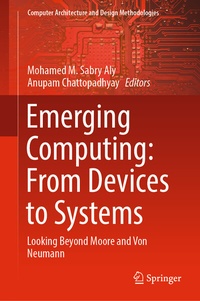
Emerging Computing: From Devices to Systems
Description

Chapters "Innovative Memory Architectures Using Functionality Enhanced Devices" and "Intelligent Edge Biomedical Sensors in the Internet of Things (IoT) Era" are available open access under a Creative Commons Attribution 4.0 International License via link.springer.com.
More details
Other editions
Additional editions
Persons
Mohamed M. Sabry Aly is an Assistant Professor at Nanyang Technological University, Singapore, and the founder of EMASS. He received his Ph.D. degree in electrical and computer engineering from École Polytechnique Fédérale de Lausanne (EPFL), in 2013. He was a postdoctoral research fellow at Stanford University from 2014 till 2017. His current research interests include system-level design and optimization of computing systems enabled by emerging technologies, with particular emphasis on computing systems for artificial intelligence. He is a currently the program manager of the Singapore flagship AME programmatic project (Hardware Software Co-optimization for Deep Learning). He is an active close collaborator with top industrial and academic partners such as, Stanford University and TSMC. Prof. Aly is a Senior IEEE member and he was the recipient of the Swiss National Science Foundation Early Post-Doctoral Mobility Fellowship in 2013.
Anupam Chattopadhyay is an Associate Professor in the School of Computer Science and Engineering, Nanyang Technological University, Singapore. He received his B.E. degree from Jadavpur University, India in 2000. He received his MSc. from ALaRI, Switzerland and PhD from RWTH Aachen in 2002 and 2008 respectively. From 2008 to 2009, he worked as a Member of Consulting Staff in CoWare R&D, Noida, India. From 2010 to 2014, he led the MPSoC Architectures Research Group in RWTH Aachen, Germany as a Junior Professor. During his PhD, he worked on automatic RTL generation from the architecture description language LISA, which was commercialized later by a leading EDA vendor. Together with his doctoral students, he proposed new research directions in high-level synthesis, application-specific processors and emerging technologies. In these areas, he published as a (co)-author over 150 conference/ journal papers, several book-chapters and books. He is a senior member of ACM, senior member ofIEEE and fellow of Intercontinental Academia.
