
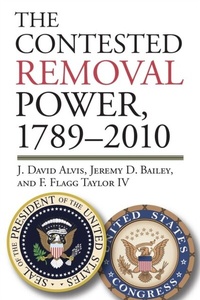
The Contested Removal Power, 1789-2010
Description
Alles über E-Books | Antworten auf Fragen rund um E-Books, Kopierschutz und Dateiformate finden Sie in unserem Info- & Hilfebereich.
Choice Outstanding Title
The U.S. Constitution is clear on the appointment of executive officials: the president nominates, the Senate approves. But on the question of removing those officials, the Constitution is silent?although that silence has not discouraged strenuous efforts to challenge, censure, and even impeach presidents from Andrew Jackson to Bill Clinton. As J. David Alvis, Jeremy D. Bailey, and Flagg Taylor show, the removal power has always been and continues to be a thorny issue, especially as presidential power has expanded dramatically during the past century.
Linking this provocative issue to American political and constitutional development, the authors recount removal power debate from the Founding to the present day. Understanding the historical context of outbreaks in the debate, they contend, is essential to sorting out the theoretical claims from partisan maneuvering and sectional interests, enabling readers to better understand the actual constitutional questions involved.
After a detailed review of the Decision of 1789, the book examines the initial assertions of executive power theory, particularly by Thomas Jefferson and Andrew Jackson, then the rise of the argument for congressional delegation, beginning with the Whigs and ending with the impeachment of Andrew Johnson. The authors chronicle the return of executive power theory in the efforts of Presidents Grant, Hayes, Garfield, and Cleveland, who all battled with Congress over removals, then describe the emergence of new institutional arrangements with the creation of independent regulatory commissions. They conclude by tracking the rise of the unitarians and the challenges that this school has posed to the modern administrative state.
Although many scholars consider the matter to have been settled in 1789, the authors argue that a Supreme Court case as recent as 2010?Free Enterprise Fund v. Public Company Accounting Oversight Board?shows the extent to which questions surrounding removal power remain unresolved and demand more attention. Their work offers a more nuanced and balanced account of the debate, teasing out the logic of the different institutional perspectives on this important constitutional question as no previous book has.
All prices
More details
Other editions
Additional editions
Persons
Content
Acknowledgments
Introduction
1. The Decision of 1789
2. From Responsibility to Rotation
3. Jackson to Johnson: The Rise of Congressional Delegation
4. The Revenge of Executive Power: From the Tenure of Office Act
to Myers v. United States
5. The Progressive Era and Independent Regulatory Commissions
6. The New Unitarians
Conclusion
Notes
Index

System requirements
File format: ePUB
Copy protection: Adobe-DRM (Digital Rights Management)
System requirements:
- Computer (Windows; MacOS X; Linux): Install the free reader Adobe Digital Editions prior to download (see eBook Help).
- Tablet/smartphone (Android; iOS): Install the free app Adobe Digital Editions or the app PocketBook before downloading (see eBook Help).
- E-reader: Bookeen, Kobo, Pocketbook, Sony, Tolino and many more (not Kindle).
The file format ePub works well for novels and non-fiction books – i.e., „flowing” text without complex layout. On an e-reader or smartphone, line and page breaks automatically adjust to fit the small displays.
This eBook uses Adobe-DRM, a „hard” copy protection. If the necessary requirements are not met, unfortunately you will not be able to open the eBook. You will therefore need to prepare your reading hardware before downloading.
Please note: We strongly recommend that you authorise using your personal Adobe ID after installation of any reading software.
For more information, see our ebook Help page.
File format: PDF
Copy-Protection: Adobe-DRM (Digital Rights Management)
System requirements:
- Computer (Windows; MacOS X; Linux): Install the free reader Adobe Digital Editions prior to download (see eBook Help).
- Tablet/smartphone (Android; iOS): Install the free app Adobe Digital Editions or the app PocketBook before downloading (see eBook Help).
- E-reader: Bookeen, Kobo, Pocketbook, Sony, Tolino and many more (only limited: Kindle).
The file format PDF always displays a book page identically on any hardware. This makes PDF suitable for complex layouts such as those used in textbooks and reference books (images, tables, columns, footnotes). Unfortunately, on the small screens of e-readers or smartphones, PDFs are rather annoying, requiring too much scrolling.
This eBook uses Adobe-DRM, a „hard” copy protection. If the necessary requirements are not met, unfortunately you will not be able to open the eBook. You will therefore need to prepare your reading hardware before downloading.
Please note: We strongly recommend that you authorise using your personal Adobe ID after installation of any reading software.
For more information, see our eBook Help page.
File format: ePUB
Copy protection: Watermark-DRM (Digital Rights Management)
System requirements:
- Computer (Windows; MacOS X; Linux): Use a reading software that can process the file format ePUB: e.g., Adobe Digital Editions or FBReader – both free (see eBook Help).
- Tablet/Smartphone (Android; iOS): Before downloading, install the free app Adobe Digital Editions (see eBook Help).
- E-reader: Bookeen, Kobo, Pocketbook, Sony, Tolino and many more (not Kindle).
The file format ePUB works well for novels and non-fiction books – i.e., „flowing” text without complex layout. On an e-reader or smartphone, line and page breaks automatically adjust to fit the small displays.
This eBook uses Watermark-DRM, a „soft” copy protection. This means that there are no technical restrictions to prevent illegal distribution. However, there is a personalised watermark embedded in the eBook that can be used to identify the purchaser of the eBook in the event of misuse and to provide evidence for legal purposes.
For more information, see our eBook Help page.
