

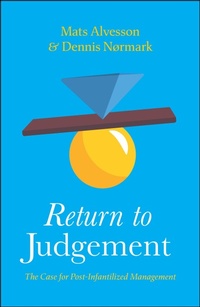
Return to Judgement
The Case for Post-Infantilized Management
1st Edition
Published on 26. May 2026
304 pages
978-1-5292-4444-1 (ISBN)
Description

Today's organizations are increasingly complex with many structures, practices and rules to follow. While the organizational head - an administrative knowing better class - becomes larger, the space for people doing the core job of the organization to think outside the box and take personal responsibility shrinks.
How can we tackle this and give workers more space to use their judgement?
Drawing on cases from universities, healthcare and other industries, this book reveals how the growth of management, policies and expertise are often counterproductive. The authors provide solutions for rethinking work and organization and to encourage what they call post-infantilized management.
Highlighting key debates around organizations and bureaucracy, this book presents an alternative vision for the future of work and management.
How can we tackle this and give workers more space to use their judgement?
Drawing on cases from universities, healthcare and other industries, this book reveals how the growth of management, policies and expertise are often counterproductive. The authors provide solutions for rethinking work and organization and to encourage what they call post-infantilized management.
Highlighting key debates around organizations and bureaucracy, this book presents an alternative vision for the future of work and management.
Reviews / Votes
'At work, do you feel encompassed by rules, regulations, by digital disciplining that seems pointless, by being advised to conform to standards, procedures, policies, rubrics and much else that seem to be systematic traps for ensnaring your time and diminishing your autonomy as a person? You're not alone. Alvesson and Normark have written a book that demonstrates this clearly. The existential state they describe is one in which there is an excess of "post-infantilized management" treating knowledgeable and capable adults as if dim-witted children. Kant prefigured enlightenment as liberation from the deadweight of pointless traditions and rituals; today careers are generated in creating increasingly more "modern" rituals of unfreedom from which only our minds, ourselves, can liberate us, by thinking thoughtfully, cultivating maturity and taking responsibility in organizations designed to encourage rather than diminish these features of being a competent person.' Stewart Clegg, University of Sydney 'On a scientific basis, the authors challenge many of the obvious assumptions that characterize today's leadership training. They question simplified models, trendy management concepts and overly positive rhetoric - and instead point to the need for judgment, maturity and critical thinking. Otherwise, there is a risk that organizations will be characterized by empty rhetoric, excessive administration and symbolic politics.For those who work with leadership, governance or organizational development, this book offers an intellectually sharp and thought-provoking critique. Read and reflect.' Paer Boman, Chairman of Volvo and Handelsbanken 'The book addresses and analyses an important and timely issue: the growing bureaucracy and the increasing legal requirements faced by both public and private organizations. This results in a rising overhead burden that the core operations are forced to carry unless effective countermeasures are implemented. The analysis presented here is therefore highly insightful, and the proposals put forward are both valuable and well chosen - for example, making leadership less all-encompassing and more focused on specific needs.' Per Eriksson, former Vice-Chancellor, Lund University
More details
Edition
First Edition
Language
English
Place of publication
Bristol
United Kingdom
Target group
Professional and scholarly
Product notice
Reflowable
Illustrations
1 s/w Abbildung
1 Illustrations, black and white
File size
0,87 MB
ISBN-13
978-1-5292-4444-1 (9781529244441)
Copyright in bibliographic data and cover images is held by Nielsen Book Services Limited or by the publishers or by their respective licensors: all rights reserved.
Schweitzer Classification
Other editions
Additional editions
Book
05/2026
1st Edition
Bristol University Press
€28.50
Shipment within 3-4 weeks
Persons
Mats Alvesson is Professor at the University of Bath, Lund University and City University of London.
Dennis Normark is an anthropologist, author and speaker.
Dennis Normark is an anthropologist, author and speaker.
Content
1. How It Used to be Simpler
2. Excess of Professional Administrators and Knowledge Workers
3. The Colonization of the Lifeworld
4. The Rise of Managerialism and the Decline of Productivity
5. A World of Imperfections and Vulnerabilities
6. The New Unfreedom
7. The (False?) Need for Regulation and Improvement
8. Judgement as the Key Principle
9. Post-Infantilized Management
10. Conclusion and Perspectives
2. Excess of Professional Administrators and Knowledge Workers
3. The Colonization of the Lifeworld
4. The Rise of Managerialism and the Decline of Productivity
5. A World of Imperfections and Vulnerabilities
6. The New Unfreedom
7. The (False?) Need for Regulation and Improvement
8. Judgement as the Key Principle
9. Post-Infantilized Management
10. Conclusion and Perspectives
