

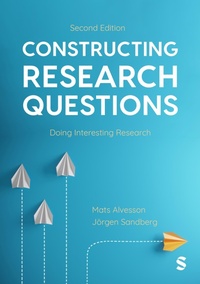
Constructing Research Questions
Doing Interesting Research
2nd Edition
Published on 28. March 2024
160 pages
978-1-5296-7850-5 (ISBN)
Description

A key step for researchers wanting to produce interesting and influential theory development is formulating innovative research questions.
In this text, Alvesson and Sandberg have developed a problematization methodology for identifying and challenging the assumptions underlying existing knowledge, and for generating research questions that can lead to more impactful theories.
The second edition of this popular text has been fully updated, with more illustrative examples and insights from a diverse range of recent studies which explore methods for conducting more innovative research. This book is essential reading for students and researchers looking to formulate interesting research questions and conduct more engaging and original research.
Mats Alvesson is Professor of Business Administration at the University of Bath, and also affiliated with Lund University, Stockholm School of Economics and Bayes Business School, City, University of London.
Joergen Sandberg is Professor in the University of Queensland (UQ) Business School and Honorary Professor at Warwick Business School.
In this text, Alvesson and Sandberg have developed a problematization methodology for identifying and challenging the assumptions underlying existing knowledge, and for generating research questions that can lead to more impactful theories.
The second edition of this popular text has been fully updated, with more illustrative examples and insights from a diverse range of recent studies which explore methods for conducting more innovative research. This book is essential reading for students and researchers looking to formulate interesting research questions and conduct more engaging and original research.
Mats Alvesson is Professor of Business Administration at the University of Bath, and also affiliated with Lund University, Stockholm School of Economics and Bayes Business School, City, University of London.
Joergen Sandberg is Professor in the University of Queensland (UQ) Business School and Honorary Professor at Warwick Business School.
More details
Edition
Second Edition
Language
English
Place of publication
London
United Kingdom
Publishing group
Sage Publications Ltd (Digital)
Target group
College/higher education
Product notice
Reflowable
File size
3,42 MB
ISBN-13
978-1-5296-7850-5 (9781529678505)
Copyright in bibliographic data and cover images is held by Nielsen Book Services Limited or by the publishers or by their respective licensors: all rights reserved.
Schweitzer Classification
Other editions
Additional editions
Book
04/2024
2nd Edition
SAGE Publications Ltd
€53.04
Shipment within 3-4 weeks

Book
04/2024
2nd Edition
SAGE Publications Ltd
€152.60
Shipment within 3-4 weeks
Persons
Mats Alvesson is Professor of Organization Studies at the University of Bath, and also affiliated with Lund University, Stockholm School of Economics and Bayes Business School, City, University of London.
Joergen Sandberg is Professor in the University of Queensland (UQ) Business School and Honorary Professor at Warwick Business School.
Joergen Sandberg is Professor in the University of Queensland (UQ) Business School and Honorary Professor at Warwick Business School.
Content
1 Research questions: a core ingredient in developing interesting theories
2 The context of constructing and formulating research questions
3 Gap-spotting: the prevalent way of constructing research questions in social science
4 A critical evaluation of gap-spotting research: does it lead to interesting theories?
5 Problematization as a methodology for generating research questions
6 Applying the problematization methodology
7 Why does gap-spotting dominate when it reduces the chance to create interesting theories?
8 Constructing interesting research questions: problematization and beyond
2 The context of constructing and formulating research questions
3 Gap-spotting: the prevalent way of constructing research questions in social science
4 A critical evaluation of gap-spotting research: does it lead to interesting theories?
5 Problematization as a methodology for generating research questions
6 Applying the problematization methodology
7 Why does gap-spotting dominate when it reduces the chance to create interesting theories?
8 Constructing interesting research questions: problematization and beyond
