

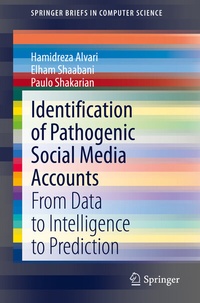
Identification of Pathogenic Social Media Accounts
From Data to Intelligence to Prediction
1st Edition
Published on 4. January 2021
IX, 95 pages
978-3-030-61431-7 (ISBN)
Description

This book sheds light on the challenges facing social media in combating malicious accounts, and aims to introduce current practices to address the challenges. It further provides an in-depth investigation regarding characteristics of "Pathogenic Social Media (PSM),"by focusing on how they differ from other social bots (e.g., trolls, sybils and cyborgs) and normal users as well as how PSMs communicate to achieve their malicious goals. This book leverages sophisticated data mining and machine learning techniques for early identification of PSMs, using the relevant information produced by these bad actors. It also presents proactive intelligence with a multidisciplinary approach that combines machine learning, data mining, causality analysis and social network analysis, providing defenders with the ability to detect these actors that are more likely to form malicious campaigns and spread harmful disinformation.
Over the past years, social media has played a major role in massive dissemination of misinformation online. Political events and public opinion on the Web have been allegedly manipulated by several forms of accounts including "Pathogenic Social Media (PSM)" accounts (e.g., ISIS supporters and fake news writers). PSMs are key users in spreading misinformation on social media - in viral proportions. Early identification of PSMs is thus of utmost importance for social media authorities in an effort toward stopping their propaganda. The burden falls to automatic approaches that can identify these accounts shortly after they began their harmful activities.
Researchers and advanced-level students studying and working in cybersecurity, data mining, machine learning, social network analysis and sociology will find this book useful. Practitioners of proactive cyber threat intelligence and social media authorities will also find this book interesting and insightful, as it presents an important andemerging type of threat intelligence facing social media and the general public.
Over the past years, social media has played a major role in massive dissemination of misinformation online. Political events and public opinion on the Web have been allegedly manipulated by several forms of accounts including "Pathogenic Social Media (PSM)" accounts (e.g., ISIS supporters and fake news writers). PSMs are key users in spreading misinformation on social media - in viral proportions. Early identification of PSMs is thus of utmost importance for social media authorities in an effort toward stopping their propaganda. The burden falls to automatic approaches that can identify these accounts shortly after they began their harmful activities.
Researchers and advanced-level students studying and working in cybersecurity, data mining, machine learning, social network analysis and sociology will find this book useful. Practitioners of proactive cyber threat intelligence and social media authorities will also find this book interesting and insightful, as it presents an important andemerging type of threat intelligence facing social media and the general public.
More details
Series
Language
English
Place of publication
Cham
Switzerland
Publishing group
Springer International Publishing
Target group
Professional and scholarly
Product notice
Reflowable
Illustrations
IX, 95 p. 25 illus., 19 illus. in color.
File size
5,04 MB
ISBN-13
978-3-030-61431-7 (9783030614317)
DOI
10.1007/978-3-030-61431-7
Schweitzer Classification
Other editions
Additional editions
Hamidreza Alvari | Elham Shaabani | Paulo Shakarian
Identification of Pathogenic Social Media Accounts
From Data to Intelligence to Prediction
Book
01/2021
Springer
€53.49
Shipment within 7-9 days
Persons
Hamidreza Alvari
is a Ph.D. candidate in Computer Science at Arizona State University. He is a researcher at the Cyber-Socio Intelligent System (CySIS) Laboratory under Dr. Paulo Shakarian. His research interests lie at the intersection of social network analysis, artificial intelligence and cybersecurity. His works have been published in top conferences and journals including WWW, SDM, CIKM, ASONAM and SNAM. He is a recipient of multiple awards including Best Paper Award, Engineering Grad Fellowship and Travel Awards. He received his masters in Artificial Intelligence from Shiraz University, Shiraz, Iran.
Paulo Shakarian , PhD is the CEO and Co-Founder of Cyber Reconnaissance, Inc., (CYR3CON) which specializes in combining artificial intelligence with information mined from malicious hacker communities to avoid cyberattacks. Shakarian also holds a tenure-track position at Arizona State University as a Fulton Entrepreneurial Professor. He haswritten numerous articles in scientific journals and has authored several books, including Elsevier's Introduction to Cyber-Warfare and Cambridge's Darkweb Cyber Threat Intelligence Mining. He has led research efforts funded by IARPA, DARPA, ONR, AFOSR, and ARO. Shakarian was named a "KDD Rising Star," received the Air Force Young Investigator award, received multiple "best paper" awards and has been featured in major news media outlets such as CNN and The Economist. CYR3CON, Shakarian's company, has received multiple industry accolades including awards from PwC, Cisco, and the DoD. Previously, Paulo was an officer in the U.S. Army where he served two combat tours in Iraq, earning a Bronze Star and the Army Commendation Medal for Valor. He also previously worked as an Assistant Professor at West Point. Paulo holds a Ph.D. and M.S. in computer science from the University of Maryland, College Park, and a B.S. in computer science from West Point (with a Depth of Study in Information Assurance).
Elham Shaabani , Ph.D., is a data scientist at Walmart Labs. She received her PhD in computer science from Arizona State University. Her research interests are artificial intelligence and its applications to the real-world problems. Her work has been published in Springer, KDD, CIKM, ASONAM, SNAM, and WWW. She received the "Best paper award" and "Best poster award" from ICDIS 2019 and ICDIS 2018, respectively. She holds MSc and BSc in computer engineering from Amirkabir University of Technology.
Paulo Shakarian , PhD is the CEO and Co-Founder of Cyber Reconnaissance, Inc., (CYR3CON) which specializes in combining artificial intelligence with information mined from malicious hacker communities to avoid cyberattacks. Shakarian also holds a tenure-track position at Arizona State University as a Fulton Entrepreneurial Professor. He haswritten numerous articles in scientific journals and has authored several books, including Elsevier's Introduction to Cyber-Warfare and Cambridge's Darkweb Cyber Threat Intelligence Mining. He has led research efforts funded by IARPA, DARPA, ONR, AFOSR, and ARO. Shakarian was named a "KDD Rising Star," received the Air Force Young Investigator award, received multiple "best paper" awards and has been featured in major news media outlets such as CNN and The Economist. CYR3CON, Shakarian's company, has received multiple industry accolades including awards from PwC, Cisco, and the DoD. Previously, Paulo was an officer in the U.S. Army where he served two combat tours in Iraq, earning a Bronze Star and the Army Commendation Medal for Valor. He also previously worked as an Assistant Professor at West Point. Paulo holds a Ph.D. and M.S. in computer science from the University of Maryland, College Park, and a B.S. in computer science from West Point (with a Depth of Study in Information Assurance).
Elham Shaabani , Ph.D., is a data scientist at Walmart Labs. She received her PhD in computer science from Arizona State University. Her research interests are artificial intelligence and its applications to the real-world problems. Her work has been published in Springer, KDD, CIKM, ASONAM, SNAM, and WWW. She received the "Best paper award" and "Best poster award" from ICDIS 2019 and ICDIS 2018, respectively. She holds MSc and BSc in computer engineering from Amirkabir University of Technology.
Content
- Intro
- Acknowledgments
- Contents
- 1 Introduction
- References
- 2 Characterizing Pathogenic Social Media Accounts
- 2.1 Introduction
- 2.2 Frameworks
- 2.2.1 Probabilistic Causal Inference
- 2.2.1.1 ISIS-A Dataset
- 2.2.1.2 Causality Analysis
- 2.2.2 Hawkes Processes
- 2.2.2.1 ISIS-B Dataset
- 2.2.2.2 Experimental Results
- 2.3 Conclusion
- References
- 3 Unsupervised Pathogenic Social Media Accounts Detection Without Content or Network Structure
- 3.1 Introduction
- 3.2 Technical Approach
- 3.2.1 Problem Statements
- 3.3 Algorithms
- 3.3.1 Algorithm for Threshold-Based Problems
- 3.3.2 Label Propagation Algorithms
- 3.4 Results and Discussion
- 3.4.1 Existing Method
- 3.4.2 Threshold-Based Selection Approach
- 3.4.3 Label Propagation Selection Approach
- 3.5 Conclusion
- References
- 4 Early Detection of Pathogenic Social Media Accounts
- 4.1 Introduction
- 4.1.1 Decay-Based Causal Measures
- 4.2 The Proposed Framework
- 4.2.1 Leveraging Temporal Aspects of Causality
- 4.2.2 Leveraging Community Structure Aspects of Causality
- 4.3 Experiments
- 4.3.1 Baseline Methods
- 4.3.1.1 Causal 4:Causal2017
- 4.3.1.2 SentiMetrix-Dbscan 4:7490315
- 4.3.1.3 SentiMetrix-RF
- 4.3.2 Identification of PSM Accounts
- 4.3.3 Timeliness of PSM Accounts Identification
- 4.4 Conclusion
- References
- 5 Semi-Supervised Causal Inference for Identifying Pathogenic Social Media Accounts
- 5.1 Introduction
- 5.2 The Proposed Method
- 5.2.1 Final Set of Features
- 5.2.2 Semi-Supervised Causal Inference
- 5.2.3 Computational Complexity
- 5.3 Experiments
- 5.3.1 Baseline Methods
- 5.3.2 Results and Discussion
- 5.4 Conclusion
- References
- 6 Graph-Based Semi-Supervised and Supervised Approaches for Detecting Pathogenic Social Media Accounts
- 6.1 Introduction
- 6.2 Technical Approach
- 6.2.1 Graph-Based Framework
- 6.2.2 Problem Statement
- 6.3 PSM Account Detection Algorithm
- 6.3.1 Supervised Learning Approach
- 6.3.2 Self-Training Semi-Supervised Learning Approach
- 6.4 Results and Discussion
- 6.4.1 Baseline Methods
- 6.4.2 Supervised Learning Approach
- 6.4.3 Self-Training Semi-Supervised Learning Approach
- 6.5 Conclusion
- References
- 7 Feature-Driven Method for Identifying Pathogenic Social Media Accounts
- 7.1 Introduction
- 7.2 Experimental Data
- 7.3 Identifying PSM Users
- 7.3.1 Causal and Account-Level Attributes
- 7.3.1.1 Malicious Signals in Causal Users
- 7.3.1.2 Malicious Signals in Profile Characteristics
- 7.3.2 Source-Level Attributes
- 7.3.2.1 URL Address
- 7.3.2.2 Referenced Website Content
- 7.3.3 Content-Level Attributes
- 7.3.3.1 Malicious Signals in Tweet-Level Information
- 7.3.3.2 Malicious Signals in Suspicious Hashtags
- 7.3.4 Feature-Driven Approach
- 7.4 Experiments
- 7.4.1 Results and Discussion
- 7.4.1.1 Performance Evaluation
- 7.4.1.2 Feature Importance Analysis
- 7.5 Conclusion
- References
- 8 Conclusion
