
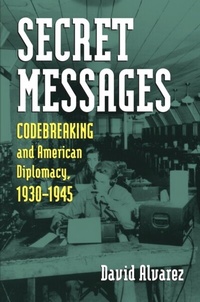
Secret Messages
Description
Alles über E-Books | Antworten auf Fragen rund um E-Books, Kopierschutz und Dateiformate finden Sie in unserem Info- & Hilfebereich.
To defeat your enemies you must know them well. In wartime, however, enemy codemakers make that task much more difficult. If you cannot break their codes and read their messages, you may discover too late the enemy's intentions. That's why codebreakers were considered such a crucial weapon during World War II.
In Secret Messages, David Alvarez provides the first comprehensive analysis of the impact of decoded radio messages (signals intelligence) upon American foreign policy and strategy from 1930 to 1945. He presents the most complete account to date of the U.S. Army's top-secret Signal Intelligence Service (SIS): its creation, its struggles, its rapid wartime growth, and its contributions to the war effort.
Alvarez reveals the inner workings of the SIS (precursor of today's NSA) and the codebreaking process and explains how SIS intercepted, deciphered, and analyzed encoded messages. From its headquarters at Arlington Hall outside Washington, D.C., SIS grew from a staff of four novice codebreakers to more than 10,000 people stationed around the globe, secretly monitoring the communications of not only the Axis powers but dozens of other governments as well and producing a flood of intelligence.
Some of the SIS programs were so clandestine that even the White House?unaware of the agency's existence until 1937?was kept uninformed of them, such as the 1943 creation of a super-secret program to break Soviet codes and ciphers. In addition, Alvarez brings to light such previously classified operations as the interception of Vatican communications and a comprehensive program to decrypt the communications of our wartime allies. He also dispels many of the myths about the SIS's influence on American foreign policy, showing that the impact of special intelligence in the diplomatic sphere was limited by the indifference of the White House, constraints within the program itself, and rivalries with other agencies (like the FBI).
Drawing upon military and intelligence archives, interviews with retired and active cryptanalysts, and over a million pages of cryptologic documents declassified in 1996, Alvarez illuminates this dark corner of intelligence history and expands our understanding of its role in and contributions to the American effort in World War II.
All prices
More details
Other editions
Additional editions
Person
Content
Acknowledgments
List of Abbreviations
Introduction
1. Antecedents
2. Launching a Service
3. Toward Pearl Harbor
4. Marching to War
Photo Section
5. Targets
6. The Russian Problem
7. A Usually Reliable Source
Notes
Bibliography
Index

System requirements
File format: ePUB
Copy protection: Adobe-DRM (Digital Rights Management)
System requirements:
- Computer (Windows; MacOS X; Linux): Install the free reader Adobe Digital Editions prior to download (see eBook Help).
- Tablet/smartphone (Android; iOS): Install the free app Adobe Digital Editions or the app PocketBook before downloading (see eBook Help).
- E-reader: Bookeen, Kobo, Pocketbook, Sony, Tolino and many more (not Kindle).
The file format ePub works well for novels and non-fiction books – i.e., „flowing” text without complex layout. On an e-reader or smartphone, line and page breaks automatically adjust to fit the small displays.
This eBook uses Adobe-DRM, a „hard” copy protection. If the necessary requirements are not met, unfortunately you will not be able to open the eBook. You will therefore need to prepare your reading hardware before downloading.
Please note: We strongly recommend that you authorise using your personal Adobe ID after installation of any reading software.
For more information, see our ebook Help page.
File format: PDF
Copy-Protection: Adobe-DRM (Digital Rights Management)
System requirements:
- Computer (Windows; MacOS X; Linux): Install the free reader Adobe Digital Editions prior to download (see eBook Help).
- Tablet/smartphone (Android; iOS): Install the free app Adobe Digital Editions or the app PocketBook before downloading (see eBook Help).
- E-reader: Bookeen, Kobo, Pocketbook, Sony, Tolino and many more (only limited: Kindle).
The file format PDF always displays a book page identically on any hardware. This makes PDF suitable for complex layouts such as those used in textbooks and reference books (images, tables, columns, footnotes). Unfortunately, on the small screens of e-readers or smartphones, PDFs are rather annoying, requiring too much scrolling.
This eBook uses Adobe-DRM, a „hard” copy protection. If the necessary requirements are not met, unfortunately you will not be able to open the eBook. You will therefore need to prepare your reading hardware before downloading.
Please note: We strongly recommend that you authorise using your personal Adobe ID after installation of any reading software.
For more information, see our eBook Help page.
File format: ePUB
Copy protection: Watermark-DRM (Digital Rights Management)
System requirements:
- Computer (Windows; MacOS X; Linux): Use a reading software that can process the file format ePUB: e.g., Adobe Digital Editions or FBReader – both free (see eBook Help).
- Tablet/Smartphone (Android; iOS): Before downloading, install the free app Adobe Digital Editions (see eBook Help).
- E-reader: Bookeen, Kobo, Pocketbook, Sony, Tolino and many more (not Kindle).
The file format ePUB works well for novels and non-fiction books – i.e., „flowing” text without complex layout. On an e-reader or smartphone, line and page breaks automatically adjust to fit the small displays.
This eBook uses Watermark-DRM, a „soft” copy protection. This means that there are no technical restrictions to prevent illegal distribution. However, there is a personalised watermark embedded in the eBook that can be used to identify the purchaser of the eBook in the event of misuse and to provide evidence for legal purposes.
For more information, see our eBook Help page.
