


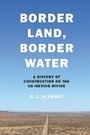
Border Land, Border Water
A History of Construction on the US-Mexico Divide
1st Edition
Published on 22. October 2019
277 pages
978-1-4773-1903-1 (ISBN)
Description

From the boundary surveys of the 1850s to the ever-expanding fences and highway networks of the twenty-first century, Border Land, Border Water examines the history of the construction projects that have shaped the region where the United States and Mexico meet.
Tracing the accretion of ports of entry, boundary markers, transportation networks, fences and barriers, surveillance infrastructure, and dams and other river engineering projects, C. J. Alvarez advances a broad chronological narrative that captures the full life cycle of border building. He explains how initial groundbreaking in the nineteenth century transitioned to unbridled faith in the capacity to control the movement of people, goods, and water through the use of physical structures. By the 1960s, however, the built environment of the border began to display increasingly obvious systemic flaws. More often than not, Alvarez shows, federal agencies in both countries responded with more construction-"compensatory building" designed to mitigate unsustainable policies relating to immigration, black markets, and the natural world. Border Land, Border Water reframes our understanding of how the border has come to look and function as it does and is essential to current debates about the future of the US-Mexico divide.
Tracing the accretion of ports of entry, boundary markers, transportation networks, fences and barriers, surveillance infrastructure, and dams and other river engineering projects, C. J. Alvarez advances a broad chronological narrative that captures the full life cycle of border building. He explains how initial groundbreaking in the nineteenth century transitioned to unbridled faith in the capacity to control the movement of people, goods, and water through the use of physical structures. By the 1960s, however, the built environment of the border began to display increasingly obvious systemic flaws. More often than not, Alvarez shows, federal agencies in both countries responded with more construction-"compensatory building" designed to mitigate unsustainable policies relating to immigration, black markets, and the natural world. Border Land, Border Water reframes our understanding of how the border has come to look and function as it does and is essential to current debates about the future of the US-Mexico divide.
Reviews / Votes
"Border Land, Border Water is a must-read for historians of the US-Mexico divide, environmental historians, and anyone interested in better understanding from a historical perspective current calls [for] construction on the border." (New Books Network: American Studies) "Alvarez bridges borderlands and environmental histories in order to examine how the built world on the border 'functions and for whom.' He achieves this by looking at the border region as multiple spaces that different actors (military, private companies, governments) utilized for their own political motives...Border Land, Border Water not only examines the ways the built environment changed the border region, it also urges people question the history of the land where they grew up." (Not Even Past) "Original, ambitious, and timely...Border Land, Border Water takes on a challenging topic. In the process, it demonstrates the benefits of ignoring the conceptual categories-especially the political boundaries-often used to delimit scholarly inquiry. The result is a welcome reminder that, while borders may originate as imaginary lines on a map, they ultimately become cultural landscapes that shape human lives and the natural world." (Vernacular Architecture Forum) "[A] deeply researched and very timely new book...Spanning the period from the Mexican-American War almost to the present, Alvarez's narrative should be read as a cautionary tale for would-be wall builders, beginning as it does 'amid the breathless ignorance of exploration' and ending 'in the willful ignorance of the overbuilt border of today'...By taking the long view, Alvarez captures the full life cycle of border works. That allows him to illuminate connections and unintended consequences that more near-sighted builders, policymakers, and social scientists rarely perceived." (Journal of Arizona History) "The border between the United States and Mexico has been extensively researched over the past fifty years, but C.J. Alvarez is the first scholar to successfully combine two seemingly discrete fields of inquiry: the history of border surveillance and the history of hydraulic engineering...Scholars have long understood that the [International Boundary and Water Commission] and Border Patrol have overlapping jurisdictions, common purposes, and a symbiotic relationship. Alvarez, however, is the first scholar to show how deeply indebted each is to the other-and, most importantly, how subservient the IBWC has been to the requirements of border control and surveillance." (Southwestern Historical Quarterly) "[An] impressive study...essential reading for borderland courses and for experts and journalists seeking to understand how Mexico and the United States (mostly) cooperated to police, regulate, discourage, or prevent human migration into the United States." (Pacific Historical Review) "[An] illuminating book...Informed by impressive archival research, Border Land, Border Water provides a valuable and highly original perspective on the United States-Mexico borderlands...In helping us to see underneath and beyond the infrastructure that litters the borderlands and that so many take for granted, C.J. Alvarez allows us to see what was lost, and imagine what have could have been. Most importantly, perhaps, he challenges us to bring about a different borderlands, one that embodies 'ecological stewardship, deeper cultural understanding, and peace.'" (North American Congress on Latin America) "This is a thoroughly enthralling work whose title does not fully encapsulate the depth of intersecting topics covered. Scholars interested in borderlands studies, water history, landscape architecture, the Mexican Revolution, political ecology, built landscapes, and the history of policing will find this work particularly useful...Alvarez acts as a guide to the border that we all need. Nothing appears to escape his attention; he weaves the ecological with the economic as deftly as he does the cultural with the political. Border Land, Border Water stands with the best of borderlands histories, by such scholars as Casey Walsh, that demonstrate the importance of transnational development in our globalized economy." (Hispanic American Historical Review) "Centering the state in this story, Alvarez makes a welcome contribution to the historiography of the U.S.-Mexico borderlands...Highlighting the ways in which federal policymakers, law enforcement authorities, and land and water management officials impacted people and the environment, Alvarez reminds us that the state remains an important subject of historical analysis...[Border Land, Border Water] is a timely contribution to our understanding of the U.S.-Mexico divide as the Trump administration moves forward with enhanced border barrier construction." (Western Historical Quarterly)More details
Language
English
Place of publication
Austin, TX
United States
Target group
Professional and scholarly
College/higher education
ISBN-13
978-1-4773-1903-1 (9781477319031)
Copyright in bibliographic data and cover images is held by Nielsen Book Services Limited or by the publishers or by their respective licensors: all rights reserved.
Schweitzer Classification
Other editions
Additional editions
Book
10/2019
University of Texas Press
€64.57
Article exhausted; check different version
Content
Introduction
1. The Border Environment in the Nineteenth Century
2. The Border and the Mexican Revolution
3. Police and Waterworks on the Border: Aspirations to Control through Building
4. Police and Waterworks on the Border: Systemic Flaws
5. Building the Border of Today
Epilogue
Acknowledgments
Notes
Bibliography
Index
1. The Border Environment in the Nineteenth Century
2. The Border and the Mexican Revolution
3. Police and Waterworks on the Border: Aspirations to Control through Building
4. Police and Waterworks on the Border: Systemic Flaws
5. Building the Border of Today
Epilogue
Acknowledgments
Notes
Bibliography
Index
