

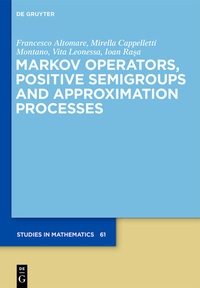
Markov Operators, Positive Semigroups and Approximation Processes
Description

This research monograph gives a detailed account of a theory which is mainly concerned with certain classes of degenerate differential operators, Markov semigroups and approximation processes. These mathematical objects are generated by arbitrary Markov operators acting on spaces of continuous functions defined on compact convex sets; the study of the interrelations between them constitutes one of the distinguishing features of the book.
Among other things, this theory provides useful tools for studying large classes of initial-boundary value evolution problems, the main aim being to obtain a constructive approximation to the associated positive C 0 -semigroups by means of iterates of suitable positive approximating operators. As a consequence, a qualitative analysis of the solutions to the evolution problems can be efficiently developed.
The book is mainly addressed to research mathematicians interested in modern approximation theory by positive linear operators and/or in the theory of positive C
0
-semigroups of operators and evolution equations. It could also serve as a textbook for a graduate level course.
Reviews / Votes
"The authors successfully succeed in demonstrating that the relationship between approximation theory and the theory of C 0 -semigroups of linear operators and evolution equations represents a fascinating and powerful mathematical theory that succeeds in solving problems related to potential theory, partial differential equations, and mathematical physics. [...]The material, forming a perfect integral whole, offers information that puts the reader at the forefront of current research and determines fruitful directions for future advanced studies. The architecture of the monograph also includes substantial motivation and examples for key results. Clarity of the text and rigorous proofs represent other features of this book. We believe that the reader will also appreciate the final section of each chapter named notes and comments. [...] In closing, it is worth mentioning that the monograph may clearly serve as a perfect basis both for researchers and graduate students in pure and applied mathematics who are interested in a modern approach to the theory of positive C 0 -semigroups of operators and their connections with approximation processes." Mathematical Reviews
"This book is a welcome contribution to the topic of approximation theory for solutions of partial differential equations with degenerate coefficients. It is written as - and meant to be - a standard reference for researchers working in this field, and it will certainly become one." Zentralblatt für Mathematik
More details
Other editions
Additional editions
Persons
Content
- Intro
- Preface
- Introduction
- Guide to the reader and interdependence of sections
- Notation
- 1 Positive linear operators and approximation problems
- 1.1 Positive linear functionals and operators
- 1.1.1 Positive Radon measures
- 1.1.2 Choquet boundaries
- 1.1.3 Bauer simplices
- 1.2 Korovkin-type approximation theorems
- 1.3 Further convergence criteria for nets of positive linear operators
- 1.4 Asymptotic behaviour of Lipschitz contracting Markov semigroups
- 1.5 Asymptotic formulae for positive linear operators
- 1.6 Moduli of smoothness and degree of approximation by positive linear operators
- 1.7 Notes and comments
- 2 C0-semigroups of operators and linear evolution equations
- 2.1 C0-semigroups of operators and abstract Cauchy problems
- 2.1.1 C0-semigroups and their generators
- 2.1.2 Generation theorems and abstract Cauchy problems
- 2.2 Approximation of C0-semigroups
- 2.3 Feller and Markov semigroups of operators
- 2.3.1 Basic properties
- 2.3.2 Markov Processes
- 2.3.3 Second-order differential operators on real intervals and Feller theory
- 2.3.4 Multidimensional second-order differential operators and Markov semigroups
- 2.4 Notes and comments
- 3 Bernstein-Schnabl operators associated with Markov operators
- 3.1 Generalities, definitions and examples
- 3.1.1 Bernstein-Schnabl operators on [0,1]
- 3.1.2 Bernstein-Schnabl operators on Bauer simplices
- 3.1.3 Bernstein operators on polytopes
- 3.1.4 Bernstein-Schnabl operators associated with strictly elliptic differential operators
- 3.1.5 Bernstein-Schnabl operators associated with tensor products of Markov operators
- 3.1.6 Bernstein-Schnabl operators associated with convex combinations of Markov operators
- 3.1.7 Bernstein-Schnabl operators associated with convex convolution products of Markov operators
- 3.2 Approximation properties and rate of convergence
- 3.3 Preservation of Hölder continuity
- 3.3.1 Smallest Lipschitz constants and triangles
- 3.3.2 Smallest Lipschitz constants and parallelograms
- 3.4 Bernstein-Schnabl operators and convexity
- 3.5 Monotonicity properties
- 3.6 Notes and comments
- 4 Differential operators and Markov semigroups associated with Markov operators
- 4.1 Asymptotic formulae for Bernstein-Schnabl operators
- 4.2 Differential operators associated with Markov operators
- 4.3 Markov semigroups generated by differential operators associated with Markov operators
- 4.4 Preservation properties and asymptotic behaviour
- 4.5 The special case of the unit interval
- 4.5.1 Degenerate differential operators on [0,1]
- 4.5.2 Approximation properties by means of Bernstein-Schnabl operators
- 4.5.3 Preservation properties and asymptotic behaviour
- 4.5.4 The saturation class of Bernstein-Schnabl operators and the Favard class of their limit semigroups
- 4.6 Notes and comments
- 5 Perturbed differential operators and modified Bernstein-Schnabl operators
- 5.1 Lototsky-Schnabl operators
- 5.2 A modification of Bernstein-Schnabl operators
- 5.3 Approximation properties
- 5.4 Preservation properties
- 5.5 Asymptotic formulae
- 5.6 Modified Bernstein-Schnabl operators and first-order perturbations
- 5.7 The unit interval
- 5.7.1 Complete degenerate second-order differential operators on [0, 1]
- 5.7.2 Approximation properties by means of modified Bernstein-Schnabl operators
- 5.8 The d-dimensional simplex and hypercube
- 5.9 Notes and comments
- Appendices
- A.1 A classification of Markov operators on two dimensional convex compact subsets
- A.2 Rate of convergence for the limit semigroup of Bernstein operators
- Bibliography
- Symbol index
- Index
- Leere Seite
