

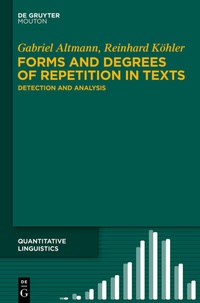
Forms and Degrees of Repetition in Texts
Description

The present volume presents objective methods to detect and analyse various forms of repetitions. Repetition of textual elements is more than a superficial phenomenon. It may even be considered as constitutive for units and relations in a text: on a primary level when no other way exists to establish a unit - as in a musical composition (a motif can be recognised as such only after at least one repetition) - and on a secondary, artistic level, where repetition is a consequence of the transfer of the equivalence principle from the paradigmatic axis to the syntagmatic one as showed by R. Jakobson.
The analysis of repetitive elements and structures in texts with objective mathematical means can serve several practical and theoretical purposes, among them:
Characterisation of texts by means of parameters (measures, indicators) as taken from established mathematical statistics or specifically constructed ones in individual cases.
Comparison of texts on the basis of their quantitative characteristics and classification of the texts by the results.
Research for the laws of text, which control the mechanisms connected to text creation. As a remote aim, the construction of a theory of text consisting of a system of text laws. The final attempt of every possible quantitative text analysis is the construction of a text theory. The book illustrates this on examples of such laws and corresponding empirical tests.
More details
Other editions
Additional editions
Persons
Content
- Intro
- Foreword
- Contents
- 1 Introduction
- 1.1 The universe of discourse
- 1.2 Forms of repetitions
- 1.3 Prolegomena for a future text theory
- 2 Shapeless Repetition
- 2.1 Phonic effects
- 2.2 Two variables
- 2.2.1 The activity index
- 2.2.2 Excursus
- 2.2.3 Comparing activity indices
- 2.3 Global indicators
- 2.3.1 Entropy
- 2.3.2 Comparison of two entropy values
- 2.3.3 The repeat rate
- 2.3.4 Moments of distributions
- 2.4 Modelling using probability distributions
- 2.5 Some text laws
- 2.5.1 The Zipf-Mandelbrot Law
- 2.5.2 The Simon-Herdan Model
- 2.5.3 Hrebícek's Reference Law
- 2.5.4 Type-Token Models
- 2.5.5 Perspectives
- 3 Positional repetition
- 3.1 The rhyme in "Erlkönig"
- 3.2 Open rhymes
- 3.3 The gradual climax
- 3.3.1 The linear climax
- 3.3.2 Reduced climax
- 3.3.3 The exponential climax
- 3.4 Other positional repetitions
- 4 Associative repetition
- 4.1 Associative repetition of two words
- 4.1.1 Short texts
- 4.1.2 Long texts
- 4.2 Presentation
- 4.3 The minimal (acyclic) graph
- 4.4 Vistas
- 5 Iterative repetition
- 5.1 Binary sequences
- 5.2 Large samples
- 5.3 Comparison of runs in two texts
- 5.4 Runs of more than two kinds of elements
- 6 Aggregative repetition
- 6.1 Random distances: binary data
- 6.2 Models of aggregation trends
- 6.3 Brainerd's Markov-chain model
- 6.4 Non-binary data
- 6.5 Similarity aggregation
- 6.6 Vistas
- 7 Repetition in blocks
- 7.1 The Frumkina law
- 7.2 Testing the Frumkina law
- 7.3 Vistas
- 8 Parallel repetitions
- 8.1 Cochran's Q-test
- 8.2 Analysis of variance
- 8.3 The chi-square test
- 9 Cyclic repetition
- 9.1 Fourier analysis
- 10 Summary
- References
- Index
- Foreword
- Contents
- 1 Introduction
- 1.1 The universe of discourse
- 1.2 Forms of repetitions
- 1.3 Prolegomena for a future text theory
- 2 Shapeless Repetition
- 2.1 Phonic effects
- 2.2 Two variables
- 2.2.1 The activity index
- 2.2.2 Excursus
- 2.2.3 Comparing activity indices
- 2.3 Global indicators
- 2.3.1 Entropy
- 2.3.2 Comparison of two entropy values
- 2.3.3 The repeat rate
- 2.3.4 Moments of distributions
- 2.4 Modelling using probability distributions
- 2.5 Some text laws
- 2.5.1 The Zipf-Mandelbrot Law
- 2.5.2 The Simon-Herdan Model
- 2.5.3 Hrebícek's Reference Law
- 2.5.4 Type-Token Models
- 2.5.5 Perspectives
- 3 Positional repetition
- 3.1 The rhyme in "Erlkönig"
- 3.2 Open rhymes
- 3.3 The gradual climax
- 3.3.1 The linear climax
- 3.3.2 Reduced climax
- 3.3.3 The exponential climax
- 3.4 Other positional repetitions
- 4 Associative repetition
- 4.1 Associative repetition of two words
- 4.1.1 Short texts
- 4.1.2 Long texts
- 4.2 Presentation
- 4.3 The minimal (acyclic) graph
- 4.4 Vistas
- 5 Iterative repetition
- 5.1 Binary sequences
- 5.2 Large samples
- 5.3 Comparison of runs in two texts
- 5.4 Runs of more than two kinds of elements
- 6 Aggregative repetition
- 6.1 Random distances: binary data
- 6.2 Models of aggregation trends
- 6.3 Brainerd's Markov-chain model
- 6.4 Non-binary data
- 6.5 Similarity aggregation
- 6.6 Vistas
- 7 Repetition in blocks
- 7.1 The Frumkina law
- 7.2 Testing the Frumkina law
- 7.3 Vistas
- 8 Parallel repetitions
- 8.1 Cochran's Q-test
- 8.2 Analysis of variance
- 8.3 The chi-square test
- 9 Cyclic repetition
- 9.1 Fourier analysis
- 10 Summary
- References
- Index
