

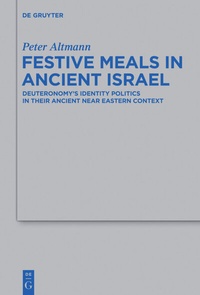
Festive Meals in Ancient Israel
Description

The festive meal texts of Deuteronomy 12-26 depict Israel as a unified people participating in cultic banquets - a powerful and earthy image for both preexilic Judahite and later audiences. Comparison of Deuteronomy 12:13-27, 14:22-29, 16:1-17, and 26:1-15 with pentateuchal texts like Exodus 20-23 is broadened to highlight the rhetorical potential of the Deuteronomic meal texts in relation to the religious and political circumstances in Israel during the Neo-Assyrian and later periods. The texts employ the concrete and rich image of festive banquets, which the monograph investigates in relation to comparative ancient Near Eastern texts and iconography, the zooarchaeological remains of the ancient Levant, and the findings of cultural anthropology with regard to meals.
More details
Other editions
Additional editions
Person
Content
2 - Table of Contents [Seite 8]
3 - Abbreviations [Seite 12]
4 - Introduction [Seite 14]
5 - 1. Overview of the History of Scholarship of Deuteronomy [Seite 18]
5.1 - 1.1. Compositional History [Seite 21]
5.1.1 - 1.1.1. Deuteronomy, Hezekiah, and Josiah [Seite 21]
5.1.2 - 1.1.2. Streams of Scholarly Analysis [Seite 24]
5.2 - 1.2. Methodology for Dating Texts [Seite 28]
5.2.1 - 1.2.1. The Relationship Between the Deuteronomic and the Covenant Codes [Seite 31]
5.2.2 - 1.2.2. The Form of Deuteronomy and the Deuteronomic "Code" [Seite 35]
5.2.3 - 1.2.3. Deuteronomy's Relationship to Assyrian Imperialism? [Seite 44]
6 - 2. Treatment of the Deuteronomic Cultic Meals [Seite 50]
6.1 - 2.1. Methodological Note: Interpretation of the DC Meal Texts as Texts About Meals [Seite 54]
6.2 - 2.2. The Anthropology of Meals [Seite 55]
6.2.1 - 2.2.1. The "Socio-Genetic" Code: Sociological and Anthropological Perspectives [Seite 57]
6.2.1.1 - 2.2.1.1. Goody [Seite 57]
6.2.1.2 - 2.2.1.2. Sutton [Seite 59]
6.2.1.3 - 2.2.1.3. Montanari [Seite 61]
6.2.2 - 2.2.2. The "Psycho-genetic" Code: Biology of Smell and Taste [Seite 63]
6.3 - 2.3. Recent Uses of Anthropology in Ancient Near Eastern and Biblical Studies on Commensality [Seite 67]
6.3.1 - 2.3.1. Schmitt: Das Essen in der Bibel [Seite 67]
6.3.2 - 2.3.2. Belnap: "Filets of Fatling and Goblets of Gold" [Seite 68]
6.3.3 - 2.3.3. Janzen: The Social Meaning of Sacrifice [Seite 69]
6.3.4 - 2.3.4. MacDonald: Not Bread Alone [Seite 70]
6.4 - 2.4. The Use of Ritual Theory [Seite 73]
6.5 - 2.5. Outline of the Work [Seite 79]
7 - 3. Material Culture and the Symbolic Meaning of Meat in Deuteronomy 12 [Seite 85]
7.1 - 3.1. Introduction [Seite 85]
7.2 - 3.2. Importance of Meat as a Symbol in the Biblical Corpus [Seite 87]
7.3 - 3.3. Iconography and Records of Meat and Banquets in the Ancient Near East [Seite 91]
7.4 - 3.4. Diet and Archaeozoology [Seite 112]
7.5 - 3.5. Deuteronomy 12: Compositional History [Seite 120]
7.5.1 - 3.5.1. The Election Formula as a Proposed Key to Relative Dating [Seite 124]
7.5.2 - 3.5.2. Compositional History and Reading of Deut 12:13-27 [Seite 126]
7.6 - 3.6. Conclusion: Significance of Meat From a Socio-Political Background [Seite 141]
8 - 4. The Cultic Meals of the Deuteronomic Cultic Calendar (16:1-17) in Light of Comparative ANE Texts [Seite 146]
8.1 - 4.1. Introduction [Seite 146]
8.2 - 4.2. Ritual Texts [Seite 149]
8.2.1 - 4.2.1. Emar and the zukru Festival Texts [Seite 149]
8.2.2 - 4.2.2. Ugaritic CTU 1.40 (RS 1.002) [Seite 161]
8.3 - 4.3. Narrative Texts [Seite 169]
8.3.1 - 4.3.1. Akkadian Akitu and Enuma Elish [Seite 169]
8.3.2 - 4.3.2. Ugaritic Narratives [Seite 180]
8.3.2.1 - 4.3.2.1. The Rephaim texts (CTU 1.20-22) [Seite 182]
8.3.2.2 - 4.3.2.2. El's Feast (CTU 1.114) [Seite 185]
8.3.2.3 - 4.3.2.4. Baal Cycle [Seite 186]
8.3.2.4 - 4.3.2.5. Conclusions from the Ugaritic Narrative Material [Seite 192]
8.4 - 4.4. Inner-biblical Comparison [Seite 199]
8.4.1 - 4.4.1. Exodus 12:1-13:16 [Seite 199]
8.4.2 - 4.4.2. Exodus 23 and Source-Critical Analysis of Deuteronomy 16 [Seite 203]
8.5 - 4.5. Interpretation of Deuteronomy 16:1-17 [Seite 211]
9 - 5. Deuteronomy 14:22-29 in Light of Ancient Near Eastern Tribute and Modern Anthropology [Seite 224]
9.1 - 5.1. Introduction [Seite 224]
9.2 - 5.2. Deuteronomy 14:22-29: A History of Scholarship [Seite 225]
9.2.1 - 5.2.1. Comparison with Pentateuchal Texts (Num 18:21-32 [Seite 225]
9.2.2 - 5.2.2. Compositional History of Deuteronomy 14:22-29 [Seite 228]
9.3 - 5.3. Ancient Near Eastern and Israelite Background [Seite 234]
9.4 - 5.4. Reading of Deuteronomy 14:22-29 [Seite 240]
9.5 - 5.5. Synthesis of Exegesis, Social Scientific, and Biological Evidence [Seite 251]
10 - 6. Conclusion [Seite 254]
11 - Bibliography [Seite 258]
12 - Index [Seite 300]
