

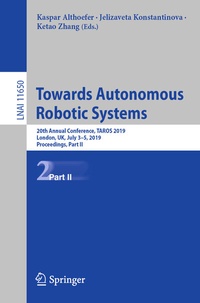
Towards Autonomous Robotic Systems
Description

The two volumes LNAI 11649 and 11650 constitute the refereed proceedings of the 20th Annual Conference "Towards Autonomous Robotics", TAROS 2019, held in London, UK, in July 2019.
The 87 full papers and 12 short papers presented were carefully reviewed and selected from 101 submissions. The papers present and discuss significant findings and advances in autonomous robotics research and applications. They are organized in the following topical sections: robotic grippers and manipulation; soft robotics, sensing and mobile robots; robotic learning, mapping and planning; human-robot interaction; and robotic systems and applications.
More details
Other editions
Additional editions
Content
- Intro
- Preface
- Organization
- Contents - Part II
- Healthcare and Assistive Robotics
- An Augmented Reality Environment to Provide Visual Feedback to Amputees During sEMG Data Acquisitions
- 1 Introduction
- 2 Methods
- 2.1 Device Setup
- 2.2 Myo Software
- 2.3 HoloLens Software
- 2.4 Virtual Hand Control
- 3 Evaluation of the Augmented Reality Environment
- 4 Conclusions
- References
- LibRob: An Autonomous Assistive Librarian*-10pt
- 1 Introduction
- 2 Related Work
- 3 System Description
- 3.1 Hardware Design
- 3.2 Software Components
- 4 Experimental Procedure and Evaluation
- 4.1 Experimental Setup
- 4.2 Results
- 5 Conclusions and Future Work
- References
- Robotic-Assisted Ultrasound for Fetal Imaging: Evolution from Single-Arm to Dual-Arm System
- Abstract
- 1 Introduction
- 2 Design Evolution and Implementation
- 2.1 iFIND Version 1 Robot
- 2.2 iFIND Version 2 Robot
- 2.3 iFIND Version 3 Robot
- 3 Preliminary Healthy Volunteer Study
- 4 Discussion and Conclusions
- Acknowledgements
- References
- Eduardo: A Low Cost Assistive Robot Development Platform, Featuring a Compliant End Effector
- Abstract
- 1 Introduction
- 2 Related Work
- 3 Design
- 3.1 Physical Robot Design
- 3.2 Software
- 4 Experiments
- 4.1 Testing for Thickness of the Flex Plates
- 4.2 Flex Sensor Voltage Response Test
- 4.3 Combing
- 5 Conclusion
- References
- GarmNet: Improving Global with Local Perception for Robotic Laundry Folding
- 1 Introduction
- 2 Related Work
- 3 Network Architecture
- 4 Experiments
- 4.1 Dataset
- 4.2 Landmark Detection Anchors
- 4.3 Loss Functions
- 4.4 One Landmark Class per Sample, Constraint
- 4.5 Using Landmarks Within Garment Localization
- 4.6 Final Optimization with Augmented Data
- 5 Conclusion
- A Appendix
- References
- Soft Robotics and Sensing
- Soft Particles for Granular Jamming
- Abstract
- 1 Introduction
- 1.1 Granular Jamming
- 2 Design and Fabrication
- 3 Experimental Study and Results
- 4 Conclusions and Future Work
- References
- A K-Nearest Neighbours Based Inverse Sensor Model for Occupancy Mapping
- 1 Introduction
- 2 Related Work
- 3 Methodology
- 3.1 Background of OctoMap
- 3.2 Update Normal Distribution
- 3.3 Mapping with k-NN Based Inverse Sensor Model
- 4 Experimental Results
- 4.1 Experiment Setup
- 4.2 Experiment Results
- 4.3 Discussion
- 5 Conclusion
- References
- Elastomer-Based Touch Sensor: Visualization of Tactile Pressure Distribution
- Abstract
- 1 Introduction
- 2 Sensor Design
- 2.1 Design and Fabrication of the Elastomer
- 2.2 Illumination and Image Capture
- 3 Prototype Sensor Performance
- 3.1 Working Principle of Tactile Sensor
- 3.2 Visualization of Tactile Information
- 4 Conclusions
- Acknowledgments
- References
- Modelling of a Soft Sensor for Exteroception and Proprioception in a Pneumatically Actuated Soft Robot
- Abstract
- 1 Introduction
- 2 Methodology
- 2.1 Finite Element Modeling
- 2.2 Model Validation
- 3 Results and Discussion
- 4 Conclusions
- Acknowledgements
- References
- Robotic Mapping, Navigation and Planning
- Online Human In-Hand Manipulation Skill Recognition and Learning
- 1 Introduction
- 2 Related Work
- 2.1 In-Hand Motion Capturing
- 2.2 Motion Skill Representation and Learning
- 3 The Incremental Learning Framework for Gaussian Mixture Model
- 3.1 Batch Learning of GMM Using Standard EM Algorithm
- 3.2 Incremental Parameter Learning of GMMs
- 3.3 In-Hand Manipulation Recognition
- 4 Experiments and Discussions
- 4.1 Experiment Settings
- 5 Conclusion and Future Work
- References
- Mapping of Ultra-Wide Band Positional Variance for Indoor Environments
- 1 Introduction
- 2 Related Works
- 3 Methodology
- 4 Results and Analysis
- 5 Conclusion
- References
- MoDSeM: Towards Semantic Mapping with Distributed Robots*-12pt
- 1 Introduction
- 2 Related Work, Novelty and Contributions
- 3 MoDSeM Overview
- 3.1 Perception Modules
- 3.2 Semantic Map
- 3.3 History and Memory
- 3.4 ModSeM for Multi-robot Perception
- 4 Preliminary Experiments
- 4.1 Experimental Scenario
- 4.2 Results
- 4.3 Discussion
- 5 Conclusion
- References
- Towards Long-Term Autonomy Based on Temporal Planning
- 1 Introduction
- 2 Domain Definition
- 3 Multi-vehicle Implementation
- 4 Performance Evaluation
- 5 Conclusions
- References
- An Optimal Approach to Anytime Task and Path Planning for Autonomous Mobile Robots in Dynamic Environments
- 1 Introduction
- 2 Problem Definition
- 3 The DA-TPP Approach
- 3.1 Anytime Extension
- 3.2 Dynamic Anytime Extension
- 4 Path Planning
- 4.1 Local Path Correction
- 4.2 Global Re-Planning
- 5 Experimental Evaluation
- 5.1 Base Planner Comparison
- 5.2 Anytime Evaluation
- 5.3 Dynamic Anytime Evaluation
- 6 Conclusion
- References
- A Self-organizing Network with Varying Density Structure for Characterizing Sensorimotor Transformations in Robotic Systems*-12pt
- 1 Introduction
- 2 Methods
- 2.1 A Biologically-Inspired Sensorimotor Model
- 2.2 Modeling Sensory and Motor Spaces
- 2.3 Formation of Sensorimotor Mapping
- 2.4 Varying Density Structure
- 2.5 Adaptation to Changes in the Sensorimotor Model
- 3 Results
- 3.1 Setup
- 3.2 Enhanced Accuracy
- 3.3 Adaptation to Changes in Morphology
- 4 Conclusions
- References
- Watchman Routes for Robot Inspection
- 1 Introduction
- 2 Background Theories
- 3 Framework Design
- 4 Experiments
- 5 Conclusion and Discussion
- References
- Semantic Path Planning for Indoor Navigation and Household Tasks
- 1 Introduction
- 2 Semantic Path Planning
- 3 Proposed Method
- 4 Numerical Evaluation
- 4.1 Clear a Region of Objects
- 4.2 Moving Objects to Another Region
- 4.3 Move to a Region or an Object
- 5 Discussion
- 6 Conclusion
- References
- A Vision-Based Assistance Key Differenciator for Helicopters Automonous Scalable Missions*-12pt
- 1 Introduction
- 2 Vision-Based Piloting Assistance
- 3 SLAM for Autopilot Support
- 3.1 History
- 3.2 Visual SLAM
- 3.3 Vision-Based Navigation
- 4 Discussion and Positioning
- References
- Random Walk Exploration for Swarm Mapping
- 1 Introduction
- 2 Related Work
- 3 Swarm Mapping Method
- 3.1 Random Walk Exploration
- 3.2 Individual Mapping
- 3.3 Global Mapping
- 4 Experimental Setup
- 4.1 Robot
- 4.2 Protocol
- 5 Results
- 6 Conclusions
- References
- Visual and Thermal Data for Pedestrian and Cyclist Detection
- 1 Introduction
- 2 Pedestrian and Cyclist Detection
- 3 Detection Systems for Autonomous Vehicles
- 4 Sensors
- 4.1 Visible Light Sensors
- 4.2 Thermal Infrared Sensors
- 4.3 Dual Sensor System
- 5 Sensor Fusion
- 6 Conclusions
- References
- Robot Path Planning Using Imprecise and Sporadic Advisory Information from Humans
- 1 Introduction
- 2 Related Work
- 3 Problem Scenario: Description and Challenges
- 4 Map Representation Using Imprecise Probabilities
- 5 Map Updating with On-Board Sensors and Human Inputs
- 6 Survivable Path Planning
- 7 Implementation, Results, and Discussion
- 8 Conclusions
- References
- Collision-Free Optimal Trajectory for a Controlled Floating Space Robot
- 1 Introduction
- 2 Optimal Path Planning
- 3 Contribution
- 4 Path Optimization Using Genetic Algorithm
- 4.1 The Cost Functions
- 4.2 The Optimization Constraints
- 4.3 Shortcomings of the Equality Constraints
- 4.4 The Resultant Trajectory Optimization Algorithm
- 5 Simulations and Results
- 5.1 Motion of CFSR
- 5.2 Obstacle Avoidance
- 5.3 Singularity Avoidance
- 6 Conclusion
- References
- A Cross-Landscape Evaluation of Multi-robot Team Performance in Static Task-Allocation Domains
- 1 Introduction
- 2 Related Work
- 3 Approach
- 3.1 Metrics
- 4 Experiments
- 5 Results
- 5.1 Distance Travelled
- 5.2 Time
- 5.3 Efficiency
- 6 Summary
- References
- Mobile Robot Trajectory Analysis with the Help of Vision System
- 1 Introduction
- 2 Motion Tracking and Analysis
- 3 Experimental Setup
- 4 Results
- References
- Novel Robotic Systems and Applications
- Intuitive Bare-Hand Teleoperation of a Robotic Manipulator Using Virtual Reality and Leap Motion
- 1 Introduction
- 2 Related Work
- 3 The Proposed System
- 3.1 System Architecture
- 3.2 How Bare Hands Control the Robotic Manipulator?
- 4 Demonstration and Discussion
- 5 Conclusion
- References
- A Robust Polyurethane Depositing System for Overcoming Obstacles in Disaster Scenario Robotics
- 1 Introduction
- 1.1 Background
- 1.2 Polyurethane Foam
- 1.3 Related Work
- 2 Design
- 2.1 Deposit System
- 2.2 Robotic Platform
- 2.3 Object Overcoming System
- 3 Results
- 3.1 Small Frontal Object Test
- 3.2 Large Frontal Object Test
- 3.3 Chasm Test
- 3.4 Summary of Experimental Results
- 4 Conclusion
- References
- Omni-Pi-tent: An Omnidirectional Modular Robot With Genderless Docking
- 1 Introduction
- 1.1 Self-repair During Continuous Motion
- 2 Design Requirements
- 3 Design Features
- 4 Constructing the Omni-Pi-tent Prototype
- 5 Testing the Prototype
- 5.1 Testing Infrared Docking Guidance
- 5.2 Testing the Docking System
- 5.3 Testing the Hinge
- 6 Conclusion and Future Work
- References
- Evaluating ToRCH Structure for Characterizing Robots
- 1 Introduction
- 2 Method
- 3 Results
- 3.1 Evaluating the Accuracy of ToRCH
- 3.2 Evaluating the Richness of ToRCH
- 4 Discussion
- 5 Limitations
- 6 Conclusions
- References
- Optimal Manoeuver Trajectory Synthesis for Autonomous Space and Aerial Vehicles and Robots
- Abstract
- 1 Introduction
- 2 Optimal Attitude Orientation Acquisition Trajectory Synthesis
- 3 Optimal Translational Trajectory Synthesis
- 4 Translational Kinematics of an Aerospace Robotic Platform
- 5 Translational Kinetics of an Aerospace Robotic Platform
- 6 Optimal Translational Trajectory Synthesis for an Aerospace Robotic Platform
- 7 Extension to an on-Board Robot Manipulator
- 8 Typical Simulation Examples
- 9 Discussion and Conclusions
- References
- MRComm: Multi-Robot Communication Testbed
- 1 Introduction
- 2 Related Work
- 3 Approach
- 3.1 MRComm Testbed
- 4 Experiments
- 5 Results and Discussion
- 6 Summary
- References
- Autonomous Air-Hockey Playing Cobot Using Optimal Control and Vision-Based Bayesian Tracking
- 1 Introduction
- 2 Tactical Layer: Determination of Cobot Actions
- 2.1 Computer Vision: Kalman Filtering-Based Predictive Approach
- 2.2 Strategy-Making: AHP-Based Probabilistic Behavior
- 3 Active Layer: Implementation of Cobot Actions
- 3.1 Software Implementation: Translation of PD Commands into Joint Velocities
- 3.2 Hardware Implementation: Universal-Joint Based Striker
- 4 Experimentation Results and Analysis
- 4.1 Strategy Making: Evolution of Skillset Usage with Game State
- 4.2 Active Layer: Preparation of Joint Velocity
- 5 Conclusion
- References
- Development and Evaluation of a Novel Robotic System for Search and Rescue
- Abstract
- 1 Introduction
- 2 Related Works
- 3 Design of the Search and Rescue Robot System
- 3.1 Proposed Overall Design
- 3.2 Robot Body Design
- 3.3 Multi-hop Networking
- 4 Development of the Robot
- 5 Experiments and Evaluation
- 5.1 Free Standing, Small Obstacles Test
- 5.2 Slope Test
- 5.3 Obstacle Test: Loose Rubble/Outdoor Environment
- 5.4 Obstacle Test: Staircase
- 5.5 Testing the Multi-hop Network
- 5.6 Power Consumption of the Robot
- 6 Conclusions
- References
- Payload Capabilities and Operational Limits of Eversion Robots
- Abstract
- 1 Introduction
- 2 Analytical Modelling
- 2.1 Force Equilibrium
- 2.2 Longitudinal and Circumferential Stresses
- 3 Results
- 3.1 Failure Due to Yielding
- 3.2 Failure Due to Buckling
- 3.3 Lateral Collapse Force
- 3.4 Operational Limits
- 4 Conclusions
- Acknowledgements
- References
- The Impact of the Robot's Morphology in the Collective Transport
- 1 Introduction
- 2 Research Setup
- 2.1 Robots: E-pucks
- 2.2 Simulation: Webots
- 2.3 Scenario: Collective Transport
- 2.4 Genetic Algorithm
- 3 Experiments
- 3.1 Controllers
- 3.2 Results
- 4 Conclusions
- 5 Future Work
- References
- System Design and Control of a Di-Wheel Rover
- Abstract
- 1 Introduction
- 2 Chassis Design of Di-Wheel Rover
- 3 Experimental Analysis and Results
- 3.1 Structural Analysis
- 3.2 Controller Type
- 3.3 Ground Surfaces
- 3.4 Electrical Characteristics
- 4 Conclusions
- Acknowledgements
- References
- An Auto-Correction Teleoperation Method for a Mobile Manipulator Using Gaze Tracking and Hand Motion Detection
- 1 Introduction
- 2 System Description
- 2.1 Gaze Control with Smart Eye
- 2.2 Hand Detection with Leap Motion
- 2.3 Youbot
- 3 Method
- 3.1 Impact of Gaze Commands
- 3.2 Adaptive Speed Control
- 4 Experiments
- 5 Conclusion
- References
- A Novel Wireless Measurement While Drilling System for the Detection of Deeply Buried Unexploded Bombs (UXBs)
- Abstract
- 1 Threat of UXO
- 2 Deeply Buried UXO
- 3 Deeply Buried UXO Survey Methods
- 3.1 Pushed Method (Cone Penetration Test-CPT)
- 3.2 Predrilled Borehole Method
- 3.3 The Role of Geology in Selecting a Suitable Detection Technique
- 4 Proposed Real Time Measurement While Drilling System
- 4.1 Auger - The Selected Drilling Method
- 4.2 Existing Wireless Telemetry Systems Used in the Oil and Gas Industry
- 4.3 The Infrared (IR) Option
- 4.4 The Auger as a Waveguide
- 4.5 Concept Demonstration
- 5 Implementations and Field Testing
- 6 Conclusion
- Acknowledgment
- References
- Short Papers
- Making the Case for Human-Aware Navigation in Warehouses*-12pt
- 1 Introduction
- 2 Problem Statement and Analysis
- 3 Proposed Approach and Conclusion
- References
- The Third Hand, Cobots Assisted Precise Assembly
- 1 Methodology
- 2 Demonstration
- References
- Towards a Swarm Robotic System for Autonomous Cereal Harvesting
- 1 Introduction
- 2 Autonomous Multi-vehicle Cereal Harvesting
- 3 A More Flexible Swarm Robotic System
- References
- Boundary Detection in a Swarm of Kilobots
- References
- Towards Generating Simulated Walking Motion Using Position Based Deep Reinforcement Learning
- 1 Introduction
- 2 Deep Reinforcement Learning
- 2.1 Definition
- 2.2 Learning Algorithm
- 3 Experimental Setup
- 3.1 Simulation Environment
- 4 Current Result
- 4.1 Future Work
- References
- Improved Safety with a Distributed Routing Strategy for UAVs
- 1 Introduction
- 2 Methods
- 3 Simulation Procedure
- 4 Results
- References
- Exploration: Do We Need a Map?
- 1 Introduction
- 2 Methodology
- 2.1 Exploration Strategies
- 2.2 Environmental Setup
- 3 Results
- 4 Conclusions
- References
- The Downsizing of a Free-Flying Space Robot
- 1 Introduction
- 2 Manipulator Design
- 3 Conclusion and Further Work
- References
- Preliminary Investigation on Visual Finger-Counting with the iCub Robot Cameras and Hands
- Abstract
- 1 Introduction
- 2 Materials and Methods
- 2.1 Setup
- 2.2 Image Data Collection
- 2.3 Extracting the Hand Silhouettes
- 2.4 A Deep Neural Network Model for Fingers Detection
- 3 Results
- Acknowledgments
- References
- Modular, Underactuated Anthropomorphic Robot Hand with Flexible Fingers and Twisted String Actuators
- 1 Introduction
- 2 Design Considerations
- 3 Grasping and Load Test
- 4 Conclusion
- References
- A Quest Towards Safe Human Robot Collaboration
- 1 Methodology
- 2 Tests and Results
- References
- Wheelchair Navigation: Automatically Adapting to Evolving Environments
- 1 Introduction
- 2 Background and Motivation
- 2.1 Shared Control and User Intentions
- 2.2 Global Navigation
- 3 Proposed System
- 3.1 Object Segmentation and Recognition
- 3.2 Localisation and Path Planning
- 4 Conclusions
- References
- Correction to: Random Walk Exploration for Swarm Mapping
- Correction to: Chapter "Random Walk Exploration for Swarm Mapping" in: K. Althoefer et al. (Eds.): Towards Autonomous Robotic Systems, LNAI 11650, https://doi.org/10.1007/978-3-030-25332-5_19
- Author Index
