

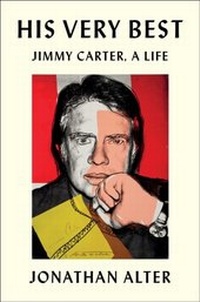
His Very Best
Jimmy Carter, a Life
1st Edition
Published on 29. September 2020
800 pages
978-1-5011-2555-3 (ISBN)
Description

From one of America's most respected journalists and modern historians comes the highly acclaimed, "splendid" (The Washington Post) biography of Jimmy Carter, the thirty-ninth president of the United States and Nobel Prize?winning humanitarian.
Jonathan Alter tells the epic story of an enigmatic man of faith and his improbable journey from barefoot boy to global icon. Alter paints an intimate and surprising portrait of the only president since Thomas Jefferson who can fairly be called a Renaissance Man, a complex figure?ridiculed and later revered?with a piercing intelligence, prickly intensity, and biting wit beneath the patented smile. Here is a moral exemplar for our times, a flawed but underrated president of decency and vision who was committed to telling the truth to the American people.
Growing up in one of the meanest counties in the Jim Crow South, Carter is the only American president who essentially lived in three centuries: his early life on the farm in the 1920s without electricity or running water might as well have been in the nineteenth; his presidency put him at the center of major events in the twentieth; and his efforts on conflict resolution and global health set him on the cutting edge of the challenges of the twenty-first.
"One of the best in a celebrated genre of presidential biography," (The Washington Post), His Very Best traces how Carter evolved from a timid, bookish child?raised mostly by a Black woman farmhand?into an ambitious naval nuclear engineer writing passionate, never-before-published love letters from sea to his wife and full partner, Rosalynn; a peanut farmer and civic leader whose guilt over staying silent during the civil rights movement and not confronting the white terrorism around him helped power his quest for racial justice at home and abroad; an obscure, born-again governor whose brilliant 1976 campaign demolished the racist wing of the Democratic Party and took him from zero percent to the presidency; a stubborn outsider who failed politically amid the bad economy of the 1970s and the seizure of American hostages in Iran but succeeded in engineering peace between Israel and Egypt, amassing a historic environmental record, moving the government from tokenism to diversity, setting a new global standard for human rights and normalizing relations with China among other unheralded and far-sighted achievements. After leaving office, Carter eradicated diseases, built houses for the poor, and taught Sunday school into his mid-nineties.
This "important, fair-minded, highly readable contribution" (The New York Times Book Review) will change our understanding of perhaps the most misunderstood president in American history.
Jonathan Alter tells the epic story of an enigmatic man of faith and his improbable journey from barefoot boy to global icon. Alter paints an intimate and surprising portrait of the only president since Thomas Jefferson who can fairly be called a Renaissance Man, a complex figure?ridiculed and later revered?with a piercing intelligence, prickly intensity, and biting wit beneath the patented smile. Here is a moral exemplar for our times, a flawed but underrated president of decency and vision who was committed to telling the truth to the American people.
Growing up in one of the meanest counties in the Jim Crow South, Carter is the only American president who essentially lived in three centuries: his early life on the farm in the 1920s without electricity or running water might as well have been in the nineteenth; his presidency put him at the center of major events in the twentieth; and his efforts on conflict resolution and global health set him on the cutting edge of the challenges of the twenty-first.
"One of the best in a celebrated genre of presidential biography," (The Washington Post), His Very Best traces how Carter evolved from a timid, bookish child?raised mostly by a Black woman farmhand?into an ambitious naval nuclear engineer writing passionate, never-before-published love letters from sea to his wife and full partner, Rosalynn; a peanut farmer and civic leader whose guilt over staying silent during the civil rights movement and not confronting the white terrorism around him helped power his quest for racial justice at home and abroad; an obscure, born-again governor whose brilliant 1976 campaign demolished the racist wing of the Democratic Party and took him from zero percent to the presidency; a stubborn outsider who failed politically amid the bad economy of the 1970s and the seizure of American hostages in Iran but succeeded in engineering peace between Israel and Egypt, amassing a historic environmental record, moving the government from tokenism to diversity, setting a new global standard for human rights and normalizing relations with China among other unheralded and far-sighted achievements. After leaving office, Carter eradicated diseases, built houses for the poor, and taught Sunday school into his mid-nineties.
This "important, fair-minded, highly readable contribution" (The New York Times Book Review) will change our understanding of perhaps the most misunderstood president in American history.
More details
Other editions
Additional editions
Book
03/2022
Simon & Schuster
€21.00
Article not available at the moment
Book
11/2020
Simon & Schuster
€44.80
Article exhausted; check different version
Person
Jonathan Alter
Content
- Intro
- Title Page
- Dedication
- Preface
- Author's Note
- Prologue: June 1979
- Part One: Sources of Strength
- Chapter 1: Daddy and Hot
- Chapter 2: The Carters and the Gordys
- Chapter 3: Miss Julia
- Chapter 4: Annapolis
- Chapter 5: Rosalynn
- Chapter 6: The Rickover Way
- Part Two: Georgia on His Mind
- Chapter 7: The Joiner
- Chapter 8: "There's Nothing I Can Do"
- Chapter 9: Senator Carter
- Chapter 10: The Greasy Pole
- Chapter 11: Born Again
- Chapter 12: The Code Word Campaign
- Chapter 13: "He Said Whaaat?"
- Chapter 14: Jungle Jimmy
- Part Three: Dark Horse
- Chapter 15: Jimmy Who?
- Chapter 16: The Long March
- Chapter 17: Front-Runner
- Chapter 18: Grits and Fritz
- Chapter 19: "Lust in My Heart"
- Part Four: Outsider President
- Chapter 20: "Let's Go!"
- Chapter 21: The Moral Equivalent of War
- Chapter 22: The Steel Magnolia
- Chapter 23: His Inner Engineer
- Chapter 24: "Bert, I'm Proud of You"
- Part Five: Peacemaker
- Chapter 25: Human Rights
- Chapter 26: Panama Canal Squeaker
- Chapter 27: Camp David
- Chapter 28: Recognizing China
- Part Six: Swamped
- Chapter 29: The Fall of the Shah
- Chapter 30: The "Malaise" Speech
- Chapter 31: Touching Bottom
- Chapter 32: Ready for Teddy?
- Chapter 33: America Held Hostage
- Chapter 34: Reheating the Cold War
- Chapter 35: Disaster at Desert One
- Chapter 36: Are You Better Off?
- Chapter 37: Inaugural Drama
- Part Seven: Global Citizen
- Chapter 38: Exile
- Chapter 39: The Carter Center
- Chapter 40: Freelance Secretary of State
- Chapter 41: Sunday School Teacher
- Photographs
- Acknowledgments
- About the Author
- Notes
- Select Bibliography
- Photo Credits
- Index
- Copyright
