

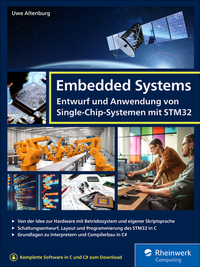
Embedded Systems
Description

Vom Hardwareentwurf bis hin zur eigenen Programmiersprache - unmöglich? Aber nein! Mit diesem Buch entwerfen Sie zunächst eine eigene Hardware auf der Basis der bekannten ARM-Microcontroller der STM32-Familie. Sie lernen, wie Sie dafür einen portablen Bootloader programmierein und schließlich sogar ein kleines Betriebssystem. Und damit nicht genug: Am Ende erstellen Sie eine eigene Skriptsprache samt Interpreter in C.
Automatisierte Tests, Treibererstellung, Qualitätssicherung für verschiedene Zielplattformen? Auch daran ist gedacht!
Mit seinem praktischen Ansatz ist das Buch ideal sowohl für die Lehre als auch für das Selbststudium . Mit erprobten Lösungen, umfangreicher Software und Best Practices von Embedded-Systems-Profi Uwe Altenburg bauen Sie wertvolle Kenntnisse auf.
Aus dem Inhalt:
- Einführung in Embedded Systems
- Entwicklungstools und Testumgebung
- Schaltungsentwurf und Leiterplattenlayout
- Bootloader-Funktion implementieren
- Betriebssystem mit Multitasking
- Eine Skriptsprache implementieren
- Interpreter und Laufzeitsystem
- Lexikalische und syntaktische Analyse
- Code-Generierung
More details
Other editions
Additional editions
Person
ISNI:
Content
1. Einleitung ... 13
1.1 ... Embedded Systems ... 13
1.2 ... Was bietet das Buch ... 14
1.3 ... Die Software zum Buch ... 15
1.4 ... Verwendete Entwicklungstools ... 18
2. Hardware ... 19
2.1 ... Single-Chip ... 19
2.2 ... Mikrocontroller ... 21
2.3 ... Breakout-Board ... 25
2.4 ... Schaltungsentwurf ... 30
2.5 ... Leiterplattenlayout ... 54
3. Bootloader ... 69
3.1 ... System-Startup ... 70
3.2 ... Betriebssystem-Updates ... 76
4. Betriebssystem ... 93
4.1 ... Initialisierung ... 94
4.2 ... Abstraktionen ... 114
4.3 ... Multithreading ... 143
4.4 ... Grafik-Display ... 151
4.5 ... Modbus-Protokoll ... 160
5. Embedded BASIC ... 177
5.1 ... Ansatz ... 177
5.2 ... Sprache ... 183
5.3 ... Anwendungen ... 210
6. Interpreter ... 227
6.1 ... Laufzeitsystem ... 228
6.2 ... Multitasking ... 292
6.3 ... Hardwarezugriff ... 302
6.4 ... Emulation am PC ... 313
7. bersetzer ... 327
7.1 ... Lexikalische Analyse ... 327
7.2 ... Syntaktische Pr fung ... 341
7.3 ... Semantische Analyse ... 359
7.4 ... Code-Generator ... 372
8. Zusammenfassung ... 377
8.1 ... Themengebiete ... 378
8.2 ... Ausblick ... 379
Anhang ... 383
A. Schaltplan ... 385
B. Leiterplatte ... 387
C. Grundlagen von Embedded BASIC ... 389
C.1 ... Grammatik ... 389
C.2 ... Token-Liste ... 392
D. Literaturverzeichnis ... 399
Index ... 401
