

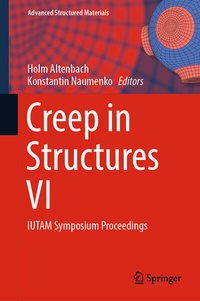
Creep in Structures VI
Description

This book offers a current state of the art in analysis and modeling of creep phenomena with applications to the structural mechanics. It presents the some presentations from the IUTAM-Symposium series "Creep in Structures", which held in Magdeburg (Germany) in September 2023, and it discusses many advances and new results in the field. These are for example: interlinks of mechanics with materials science in multi-scale analysis of deformation and damage mechanisms over a wide range of stresses and temperature; development and analysis of new alloys for (ultra)high-temperature applications; formulation and calibration of advanced constitutive models of inelastic behavior under transient loading and temperature conditions; development of efficient procedures and machine learning techniques for identification of material parameters in advanced constitutive laws; introduction of gradient-enhanced and non-local theories to account for damage and fracture processes; and applicationof new experimental methods, such as digital image correlation, for the analysis of inelastic deformation under multi-axial stress state.
More details
Other editions
Additional editions
Content
Chapter 1: Phase-Field Damage Modeling in Generalized Mechanics by using a Mixed Finite Element Method (FEM).- Chapter 2: Creep-Damage Processes in Cyclic Loaded Double Walled Structures.- Chapter 3: Creep Mechanics - Some Historical Remarks and New Trends.- Chapter 4: Various State-of-the-Art Methods for Creep Evaluation of Power Plant Components in a Wide Load and Temperature Range.- Chapter 5: Creep and Irradiation Effects in Reactor Vessel Internals.- Chapter 6: Analysis of Damage and Fracture in Anisotropic Sheet Metals Based on Biaxial Experiments.- Chapter 7: Effect of Physical Aging on the Flexural Creep in 3D Printed Thermoplastic.- Chapter 8: Development of a Microstructure-Based Finite Element Model of Thermomechanical Response of a Fully Metallic Composite Phase Change Material.- Chapter 9: The Effect of Dynamic Loads on the Creep of Geomaterials.- Chapter 10: A Novel Simulation Method for Phase Transition of Single Crystal Ni based Superalloys in Elevated Temperature Creep Regions via Discrete Cosine Transform and Maximum Entropy Method.- Chapter 11: Anisotropic Creep Analysis of Fiber Reinforced Load Point Support Structures for Thermoplastic Sandwich Panels.- Chapter 12: Time-Swelling Superposition Principle for the Linear Viscoelastic Properties of Polyacrylamide Hydrogels.- Chapter 13: Application of Nonlinear Viscoelastic Material Models for the Shrinkage and Warpage Analysis of Blow Molded Parts.- Chapter 14: Modeling Solid Materials in DEM Using the Micropolar Theory.- Chapter 15: The Development of a Cavitation-Based Model for Creep Lifetime Prediction Using Cu-40Zn-2Pb Material.- Chapter 16: Self-heating Analysis with Respect to Holding Times of an Additive Manufactured Aluminium Alloy.- Chapter 17: Creep Under High Temperature Thermal Cycling and Low Mechanical Loadings.- Chapter 18: The Development and Application of Optimisation Technique for the Calibrating of Creep Cavitation Model Based on Cavity Histogram.- Chapter 19: A Temperature-Dependent Viscoelastic Approach to the Constitutive Behavior of Semi-Crystalline Thermoplastics at Finite Deformations.
