

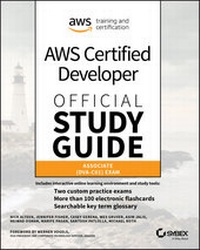
AWS Certified Developer Official Study Guide, Associate Exam
Description

Foreword by Werner Vogels, Vice President and Corporate Technology Officer, Amazon The AWS exam has been updated. Your study guide should be, too.
The AWS Certified Developer Official Study Guide-Associate Exam is your ultimate preparation resource for the latest exam! Covering all exam objectives, this invaluable resource puts a team of AWS experts at your side with expert guidance, clear explanations, and the wisdom of experience with AWS best practices. You'll master core services and basic architecture, and equip yourself to develop, deploy, and debug cloud-based applications using AWS.
The AWS Developer certification is earned by those who demonstrate the technical knowledge and skill associated with best practices for building secure, reliable cloud-based applications using AWS technology. This book is your official exam prep companion, providing everything you need to know to pass with flying colors.
- Study the AWS Certified Developer Exam objectives
- Gain expert insight on core AWS services and best practices
- Test your understanding of key concepts with challenging chapter questions
- Access online study tools including electronic flashcards, a searchable glossary, practice exams, and more
Cloud computing offers businesses the opportunity to replace up-front capital infrastructure expenses with low, variable costs that scale as they grow. This customized responsiveness has negated the need for far-future infrastructure planning, putting thousands of servers at their disposal as needed-and businesses have responded, propelling AWS to the number-one spot among cloud service providers. Now these businesses need qualified AWS developers, and the AWS certification validates the exact skills and knowledge they're looking for. When you're ready to get serious about your cloud credentials, the AWS Certified Developer Official Study Guide-Associate Exam is the resource you need to pass the exam with flying colors. NOTE: As of October 7, 2019, the accompanying code for hands-on exercises in the book is available for downloading from the secure Resources area in the online test bank. You'll find code for Chapters 1, 2, 11, and 12.
More details
Other editions
Additional editions
Persons
ABOUT THE AUTHORS
The AWS Certified Developer Official Study Guide ¿ Associate (DVA-C01) Exam is written by a team of leading AWS subject-matter experts. AWS offers a broad set of global compute, storage, database, analytics, application, and deployment products and services. These offerings help businesses scale and build sophisticated applications with increased flexibility, scalability, and reliability.
Content
Introduction xxix
Assessment Test xxxv
Chapter 1 Introduction to AWS Cloud API 1
Introduction to AWS 2
Calling an AWS Cloud Service 5
Working with Regions 9
API Credentials and AWS Identity and Access Management 14
Summary 24
Exam Essentials 24
Resources to Review 25
Exercises 26
Review Questions 33
Chapter 2 Introduction to Compute and Networking 37
Amazon Elastic Compute Cloud 38
Running Applications on Instances 44
Customizing the Network 51
Managing Your Resources 64
Developer Tools 66
Summary 66
Exam Essentials 67
Resources to Review 68
Exercises 69
Review Questions 80
Chapter 3 Hello, Storage 85
Introduction to AWS Storage 86
Storage Fundamentals 87
AWS Block Storage Services 92
AWS Object Storage Services 99
AWS File Storage Services 136
Storage Comparisons 142
Cloud Data Migration 145
Summary 154
Exam Essentials 154
Resources to Review 159
Exercises 162
Review Questions 170
Chapter 4 Hello, Databases 175
Introduction to Databases 176
Relational Databases 178
Nonrelational Databases 195
Data Warehouse 217
In-Memory Data Stores 226
Graph Databases 230
Cloud Database Migration 232
Running Your Own Database on Amazon Elastic Compliance and Security 236
Summary 237
Exam Essentials 237
Resources to Review 239
Exercises 242
Review Questions 256
Chapter 5 Encryption on AWS 259
Introduction to Encryption 260
AWS Key Management Service 260
AWS CloudHSM 262
Controlling the Access Keys 263
Summary 273
Exam Essentials 273
Resources to Review 274
Exercises 275
Review Questions 279
Chapter 6 Deployment Strategies 281
Deployments on the AWS Cloud 282
AWS Elastic Beanstalk 290
Deployment Strategies 299
Monitoring and Troubleshooting 303
Summary 307
Exam Essentials 307
Resources to Review 308
Exercises 309
Review Questions 313
Chapter 7 Deployment as Code 317
Introduction to AWS Code Services 318
Using AWS CodePipeline to Automate Deployments 320
Using AWS CodeCommit as a Source Repository 332
Using AWS CodeBuild to Create Build Artifacts 344
Using AWS CodeDeploy to Deploy Applications 352
Summary 371
Exam Essentials 372
Resources to Review 373
Exercises 374
Review Questions 377
Chapter 8 Infrastructure as Code 381
Introduction to Infrastructure as Code 382
Infrastructure as Code 382
Using AWS CloudFormation to Deploy Infrastructure 383
Summary 432
Exam Essentials 434
Resources to Review 436
Exercises 437
Review Questions 440
Chapter 9 Configuration as Code 445
Introduction to Configuration as Code 446
Using AWS OpsWorks Stacks to Deploy Applications 447
Using Amazon Elastic Container Service to Deploy Containers 471
Summary 483
Exam Essentials 485
Resources to Review 487
Exercises 488
Review Questions 491
Chapter 10 Authentication and Authorization 495
Introduction to Authentication and Authorization 496
Summary 508
Exam Essentials 509
Resources to Review 509
Exercises 510
Review Questions 517
Chapter 11 Refactor to Microservices 519
Introduction to Refactor to Microservices 521
Amazon Simple Queue Service 523
Amazon Simple Notification Service 534
Amazon Kinesis Data Streams 540
Amazon Kinesis Data Firehose 543
Amazon Kinesis Data Analytics 544
Amazon Kinesis Video Streams 545
Amazon DynamoDB Streams 546
AWS IoT Device Management 547
Amazon MQ 550
AWS Step Functions 551
Summary 568
Exam Essentials 569
Resources to Review 570
Exercises 573
Review Questions 582
Chapter 12 Serverless Compute 585
Introduction to Serverless Compute 586
AWS Lambda 586
AWS Lambda Functions 588
Inside the AWS Lambda Function 593
Configuring the AWS Lambda Function 596
Invoking AWS Lambda Functions 601
Monitoring AWS Lambda Functions 602
Summary 605
Exam Essentials 605
Resources to Review 606
Exercises 607
Review Questions 618
Chapter 13 Serverless Applications 621
Introduction to Serverless Applications 622
Web Server with Amazon Simple Storage Service (Presentation Tier) 622
Dynamic Data with Amazon API Gateway (Logic or App Tier) 627
User Authentication with Amazon Cognito 634
Standard Three-Tier vs. the Serverless Stack 640
Amazon Aurora Serverless 642
AWS Serverless Application Model 643
AWS SAM CLI 645
AWS Serverless Application Repository 647
Serverless Application Use Cases 647
Summary 647
Exam Essentials 649
Resources to Review 650
Exercises 651
Review Questions 660
Chapter 14 Stateless Application Patterns 663
Introduction to the Stateless Application Pattern 664
Amazon DynamoDB 664
Amazon ElastiCache 739
Amazon Simple Storage Service 747
Amazon Elastic File System 773
Summary 781
Exam Essentials 782
Resources to Review 785
Exercises 786
Review Questions 793
Chapter 15 Monitoring and Troubleshooting 797
Introduction to Monitoring and Troubleshooting 798
Amazon CloudWatch 800
AWS CloudTrail 818
AWS X-Ray 820
Summary 823
Exam Essentials 823
Resources to Review 825
Exercises 826
Review Questions 829
Chapter 16 Optimization 833
Introduction to Optimization 834
Cost Optimization: Everyone's Responsibility 834
Right Sizing 838
Using Instance Reservations 840
Using Spot Instances 843
Using AWS Auto Scaling 845
Using Containers 849
Using Serverless Approaches 850
Optimizing Storage 851
Optimizing Data Transfer 858
Relational Databases and Amazon DynamoDB 859
Monitoring Costs 864
Monitoring Performance 868
Summary 869
Exam Essentials 871
Resources to Review 874
Exercises 876
Review Questions 881
Appendix Answers to Review Questions 885
Index 917
Assessment Test
-
You have an application running on Amazon Elastic Compute Cloud (Amazon EC2) that needs read-only access to several AWS services. What is the best way to grant that application permissions only to a specific set of resources within your account?
- Use API credentials derived based on the AWS account.
- Launch the EC2 instance into an AWS Identity and Access Management (IAM) role and attach the ReadOnlyAccess IAM-managed policy.
- Declare the necessary permissions as statements in the AWS SDK configuration file on the EC2 instance.
- Launch the EC2 instance into an IAM role with custom IAM policies for the permissions.
-
You have deployed a new application in the US West (Oregon) Region. However, you have accidentally deployed an Amazon Polly lexicon needed for your application in EU (London). How can you use your lexicon to synthesize speech while minimizing the changes to your application code and reducing cost?
- Point your SDK client to the EU (London) for all requests to Amazon Polly, but to US West (Oregon) for all other API calls.
- No action needed; the data is automatically available from all Regions.
- Upload a copy of the lexicon to US West (Oregon).
- Move the rest of the application resources to EU (London).
-
When you're placing subnets for a specific Amazon Virtual Private Cloud (Amazon VPC), you can place the subnets in which of the following?
- In any Availability Zone within the Region for the Amazon VPC
- In any Availability Zone in any Region
- In any AWS edge location
- In any specific AWS data center
-
You have identified two Amazon Elastic Compute Cloud (Amazon EC2) instances in your account that appear to have the same private IP address. What could be the cause?
- These instances are in different Amazon Virtual Private Cloud (Amazon VPCs).
- The instances are in different subnets.
- The instances have different network ACLs.
- The instances have different security groups.
-
You have a workload that requires 15,000 consistent IOPS for data that must be durable. What combination of the following do you need? (Select TWO.)
- Use an Amazon Elastic Block Store (Amazon EBS) optimized instance.
- Use an instance store.
- Use a Provisioned IOPS SSD volume.
- Use a previous-generation EBS volume.
-
Your company stores critical documents in Amazon Simple Storage Service (Amazon S3), but it wants to minimize cost. Most documents are used actively for only about one month and then used much less frequently after that. However, all data needs to be available within minutes when requested. How can you meet these requirements?
- Migrate the data to Amazon S3 Reduced Redundancy Storage (RRS) after 30 days.
- Migrate the data to Amazon S3 Glacier after 30 days.
- Migrate the data to Amazon S3 Standard - Infrequent Access (IA) after 30 days.
- Turn on versioning and then migrate the older version to Amazon S3 Glacier.
-
You are migrating your company's applications and data from on-premises to the AWS Cloud. You have performed a data inventory and discovered that you will need to transfer about 2 PB of data to AWS. Which migration option will be the best choice for your company with minimal cost and shortest time?
- AWS Snowball
- AWS Snowmobile
- Upload files directly to AWS over the internet using Amazon Simple Storage Service (Amazon S3) Transfer Acceleration.
- Amazon Kinesis Data Firehose
-
You are changing your application to take advantage of the elasticity and cost benefits provided by AWS Auto Scaling. To do this, you must move session state information from the individual Amazon Elastic Compute Cloud (Amazon EC2) instances. Which of the following AWS Cloud services is best suited as an alternative for storing session state information?
- Amazon DynamoDB
- Amazon Redshift
- AWS Storage Gateway
- Amazon Kinesis
-
Your company's senior management wants to query several data stores to obtain a "big picture" view of the business. The amount of data contained within the data stores is at least 2 TB in size. Which of the following is the best AWS service to deliver results to senior management?
- Amazon Elastic Block Store (Amazon EBS)
- Amazon Simple Storage Service (Amazon S3)
- Amazon Relational Database Service (Amazon RDS)
- Amazon Redshift
-
Your ecommerce application provides daily and ad hoc reporting to various business units on customer purchases. These operations result in a high level of read traffic to your MySQL Amazon Relational Database Service (Amazon RDS) instance. What can you do to scale up read traffic without impacting your database's performance?
- Increase the allocated storage for the Amazon RDS instance.
- Modify the Amazon RDS instance to be a Multi-AZ deployment.
- Create a read replica for an Amazon RDS instance.
- Change the Amazon RDS instance DB engine version.
-
Your company has refactored their application to use NoSQL instead of SQL. They would like to use a managed service for running the new NoSQL database. Which AWS service should you recommend?
- Amazon Relational Database Service (Amazon RDS)
- Amazon Elastic Compute Cloud (Amazon EC2)
- Amazon DynamoDB
- Amazon Redshift
-
A company is currently using Amazon Relational Database Service (Amazon RDS); however, they are retiring a database that is currently running. They have automatic backups enabled on the database. They want to make sure that they retain the last backup before deleting the Amazon RDS database. As the lead developer on the project, what should you do?
- Delete the database. Amazon RDS automatic backups are already enabled.
- Create a manual snapshot before deleting the database.
- Use the AWS Database Migration Service (AWS DMS) to back up the database.
- SSH into the Amazon RDS database and perform a SQL dump.
-
When using Amazon Redshift, which node do you use to run your SQL queries?
- Compute node
- Cluster node
- Master node
- Leader node
-
Your company is building a recommendation feature for their application. They would like to use an AWS managed graph database. Which service should you recommend?
- Amazon Relational Database Service (Amazon RDS)
- Amazon Neptune
- Amazon ElastiCache
- Amazon Redshift
-
You have an Amazon DynamoDB table that has a partition key and a sort key. However, a business analyst on your team wants to be able to query the DynamoDB table with a different partition key. What should you do?
- Create a local secondary index.
- Create a global secondary index.
- Create a new DynamoDB table.
- Advise the business analyst that this is not possible.
-
An application is using Amazon DynamoDB. Recently, a developer on your team has noticed that occasionally the application does not return the most up-to-date data after a read from the database. How can you solve this issue?
- Increase the number of read capacity units (RCUs) for the table.
- Increase the number of write capacity units (WCUs) for the table.
- Refactor the application to use a SQL database.
- Configure the application to perform a strongly consistent read.
-
A developer on your team would like to test a new idea and requires a NoSQL database. Your current applications are using Amazon DynamoDB. What should you recommend?
- Create a new table inside DynamoDB.
- Use DynamoDB Local.
- Use another NoSQL database on-premises.
- Create an Amazon Elastic Compute Cloud (Amazon EC2) instance, and install a NoSQL database.
-
The AWS Encryption SDK provides an encryption library that integrates with AWS Key Management Service (AWS KMS) as a master key provider. Which of the following operations does the AWS Encryption SDK perform to build on the AWS SDKs?
- Generates, encrypts, and decrypts data keys
- Uses the data keys to encrypt and decrypt your raw data
- Stores the encrypted data keys with the corresponding encrypted data in a single object
- All of the above
-
Of all the cryptographic algorithms that the AWS Encryption SDK supports, which one is the default algorithm?
- AES-256
- AES-192
- AES-128
- SSH-256
-
Amazon Elastic Block Store (Amazon EBS) volumes are encrypted by default.
- True
- False
-
Which of the following cannot be retained when deleting an AWS Elastic Beanstalk environment?
- Source code from the Git repository
- Data from the automatic backups of an Amazon Relational Database Service (Amazon RDS) instance
- Packaged code from the source bundle stored in an Amazon Simple Storage...
