

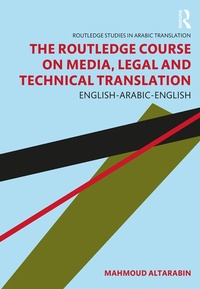
The Routledge Course on Media, Legal and Technical Translation
English-Arabic-English
1st Edition
Published on 26. October 2020
262 pages
978-1-000-19777-8 (ISBN)
Description

The Routledge Course on Media, Legal and Technical Translation: English-Arabic-English is an indispensable and engaging coursebook for university students wishing to develop their English-Arabic-English translation skills in these three text types. Taking a practical approach, the book introduces Arab translation students to common translation strategies in addition to the linguistic, syntactic, and stylistic features of media, legal, and technical texts. This book features texts carefully selected for their technical relevance. The key features include:
* comprehensive four chapters covering media, legal, and technical texts, which are of immense importance to Arab translation students;
* detailed and clear explanations of the lexical, syntactic, and stylistic features of English and Arabic media, legal, and technical texts;
* up-to-date and practical translation examples in both directions offering students actual experiences of professional translators;
* authentic texts extracted from various sources to promote students' familiarity with language features and use;
* extensive range of exercises following each section of the book to enable students to test and practice the knowledge and skills they developed from reading previous sections;
* glossaries following most exercises containing the translation of difficult words;
and
* a list of recommended readings following each chapter.
The easy, practical, and comprehensive approach adopted in the book makes it a must-have coursebook for intermediate and advanced students studying translation between English and Arabic. University instructors and professional translators working on translation between English and Arabic will find this book particularly useful.
* comprehensive four chapters covering media, legal, and technical texts, which are of immense importance to Arab translation students;
* detailed and clear explanations of the lexical, syntactic, and stylistic features of English and Arabic media, legal, and technical texts;
* up-to-date and practical translation examples in both directions offering students actual experiences of professional translators;
* authentic texts extracted from various sources to promote students' familiarity with language features and use;
* extensive range of exercises following each section of the book to enable students to test and practice the knowledge and skills they developed from reading previous sections;
* glossaries following most exercises containing the translation of difficult words;
and
* a list of recommended readings following each chapter.
The easy, practical, and comprehensive approach adopted in the book makes it a must-have coursebook for intermediate and advanced students studying translation between English and Arabic. University instructors and professional translators working on translation between English and Arabic will find this book particularly useful.
More details
Series
Edition
1. Auflage
Language
English
Place of publication
London
United Kingdom
Publishing group
Taylor & Francis Ltd
Target group
College/higher education
Product notice
Reflowable
Illustrations
20 Tables, black and white; 10 Line drawings, black and white; 10 Illustrations, black and white
ISBN-13
978-1-000-19777-8 (9781000197778)
Copyright in bibliographic data and cover images is held by Nielsen Book Services Limited or by the publishers or by their respective licensors: all rights reserved.
Schweitzer Classification
Other editions
Additional editions
Mahmoud Altarabin
The Routledge Course on Media, Legal and Technical Translation
English-Arabic-English
Book
10/2020
1st Edition
Routledge
€207.20
Shipment within 15-20 days
Mahmoud Altarabin
The Routledge Course on Media, Legal and Technical Translation
English-Arabic-English
Book
10/2020
1st Edition
Routledge
€61.40
Shipment within 15-20 days
Mahmoud Altarabin
The Routledge Course on Media, Legal and Technical Translation
English-Arabic-English
Book
09/2020
Routledge
Unfortunately, price unknown
Available (delivery time upon request)
Person
Mahmoud Altarabin is an assistant professor of translation and linguistics at the Department of English, Islamic University of Gaza. He designs and teaches translation courses for undergraduates and postgraduates.
Content
Contents
List of figures
List of tables
Foreword
Acknowledgments
Introduction
1 Translation: Basic Concepts and Definitions
1.1 What is translation?
1.2 Equivalence: An Illusion
1.3 Translation Strategies
1.4 Language variation
1.5 Translation quality
1.6 Decision making
1.7 Translators tools
Exercises
Suggestions for further reading
2 Translating News
2.1 News Translation: Issues
2.1.1 Translation as rewriting
2.1.2 Ideology and Media
2.1.3 Ideology and Translation
2.1.4 Transediting
2.1.5 Translators in conflict zones
2.2 The Newspaper
2.3 Features of English News Headlines
2.3.1 Headlines style
2.3.2 Syntactic features
2.3.3 Lexical features
2.3.4 News impact factors
2.4 Features of Arabic News Headlines
2.4.1 Syntactic features
2.4.2 Lexical features
2.4.3 News impact factors
2.5 Newspapers Sections
2.5.1 Lead stories/leads
2.5.2 Editorial & Opinion
2.5.3 Sports
2.5.4 Economy and Business
2.6 Exercises page
2.6.1 Arabic into English
2.6.2 English into Arabic
Suggestions for further reading
3 Translating Legal Texts
3.1 Introduction
3.2 Legal translation: sources of difficulty
3.2.1 Different languages and legal systems
3.2.2 Intra-system differences
3.2.3 Familiarity with legal terminology
3.3 Features of English Legalese
3.3.1 Lexical features
3.3.2 Syntactic features
3.4 Features of Arabic Legalese
3.4.1 Lexical features
3.4.2 Syntactic features
3.5 Classification of legal texts
3.6 Classification of legal translation
3.7 Legal translators
3.8 Translating legal documents:
3.9 Translating legal phrases & sentences
3.10 Important notes
3.11 General exercises
3.12 English legal documents
3.13 Arabic legal and Sharia documents
Suggestions for further reading
4 Technical and Scientific Translation
4.1 Introduction
4.2 Lexical issues and text features
4.3 Translation strategies
4.4 Finance and business texts
4.5 Agriculture texts
4.6 Medical texts
4.7 Environment
4.8 Technology and Industry Texts
Suggestions for further reading
References
Index
List of figures
List of tables
Foreword
Acknowledgments
Introduction
1 Translation: Basic Concepts and Definitions
1.1 What is translation?
1.2 Equivalence: An Illusion
1.3 Translation Strategies
1.4 Language variation
1.5 Translation quality
1.6 Decision making
1.7 Translators tools
Exercises
Suggestions for further reading
2 Translating News
2.1 News Translation: Issues
2.1.1 Translation as rewriting
2.1.2 Ideology and Media
2.1.3 Ideology and Translation
2.1.4 Transediting
2.1.5 Translators in conflict zones
2.2 The Newspaper
2.3 Features of English News Headlines
2.3.1 Headlines style
2.3.2 Syntactic features
2.3.3 Lexical features
2.3.4 News impact factors
2.4 Features of Arabic News Headlines
2.4.1 Syntactic features
2.4.2 Lexical features
2.4.3 News impact factors
2.5 Newspapers Sections
2.5.1 Lead stories/leads
2.5.2 Editorial & Opinion
2.5.3 Sports
2.5.4 Economy and Business
2.6 Exercises page
2.6.1 Arabic into English
2.6.2 English into Arabic
Suggestions for further reading
3 Translating Legal Texts
3.1 Introduction
3.2 Legal translation: sources of difficulty
3.2.1 Different languages and legal systems
3.2.2 Intra-system differences
3.2.3 Familiarity with legal terminology
3.3 Features of English Legalese
3.3.1 Lexical features
3.3.2 Syntactic features
3.4 Features of Arabic Legalese
3.4.1 Lexical features
3.4.2 Syntactic features
3.5 Classification of legal texts
3.6 Classification of legal translation
3.7 Legal translators
3.8 Translating legal documents:
3.9 Translating legal phrases & sentences
3.10 Important notes
3.11 General exercises
3.12 English legal documents
3.13 Arabic legal and Sharia documents
Suggestions for further reading
4 Technical and Scientific Translation
4.1 Introduction
4.2 Lexical issues and text features
4.3 Translation strategies
4.4 Finance and business texts
4.5 Agriculture texts
4.6 Medical texts
4.7 Environment
4.8 Technology and Industry Texts
Suggestions for further reading
References
Index
