

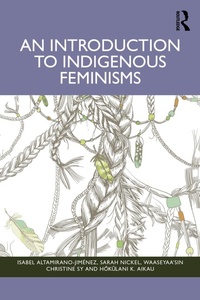
An Introduction to Indigenous Feminisms
1st Edition
Published on 30. May 2025
278 pages
978-1-040-34355-5 (ISBN)
Description

An Introduction to Indigenous Feminisms introduces important concepts and approaches for understanding what Indigenous feminisms are, why we use the term in plural, and why Indigenous feminisms are not just for academics.
This engaging and accessible textbook, the first of its kind in this subject, provides instructors and students with the historical contexts, analytical tools, and the practice-driven possibilities for creative and epistemic engagement with Indigenous feminist knowledge. Besides including useful pedagogical features, the volume explores:
How Indigenous feminist conversations have evolved
What political practices have developed over time
Stories, theories, and histories about Indigenous women's experiences
An Introduction to Indigenous Feminisms provides students with ways to practice Indigenous ways of thinking, learning, especially those studying Gender Studies, Social and Cultural History, Sociology and Politics.
This engaging and accessible textbook, the first of its kind in this subject, provides instructors and students with the historical contexts, analytical tools, and the practice-driven possibilities for creative and epistemic engagement with Indigenous feminist knowledge. Besides including useful pedagogical features, the volume explores:
How Indigenous feminist conversations have evolved
What political practices have developed over time
Stories, theories, and histories about Indigenous women's experiences
An Introduction to Indigenous Feminisms provides students with ways to practice Indigenous ways of thinking, learning, especially those studying Gender Studies, Social and Cultural History, Sociology and Politics.
More details
Edition
1. Auflage
Language
English
Place of publication
London
United Kingdom
Publishing group
Taylor & Francis Ltd
Target group
College/higher education
Illustrations
10 Halftones, black and white; 10 Illustrations, black and white
File size
9,64 MB
ISBN-13
978-1-040-34355-5 (9781040343555)
Copyright in bibliographic data and cover images is held by Nielsen Book Services Limited or by the publishers or by their respective licensors: all rights reserved.
Schweitzer Classification
Other editions
Additional editions
Isabel Altamirano-Jimenez | Sarah Nickel | waaseyaa'sin Christine Sy
An Introduction to Indigenous Feminisms
Book
05/2025
1st Edition
Routledge
€63.90
Shipment within 10-20 days
Isabel Altamirano-Jimenez | Sarah Nickel | waaseyaa'sin Christine Sy
An Introduction to Indigenous Feminisms
Book
05/2025
1st Edition
Routledge
€205.80
Shipment within 10-20 days
Persons
Isabel Altamirano-Jimenez is Professor and Canada Research Chair in Comparative Indigenous Feminist Studies at the University of Alberta.
Sarah Nickel is Associate Professor and Canada Research Chair in Indigenous Politics and Gender at the University of Alberta.
waaseyaa'sin Christine Sy is Associate Professor in Gender Studies at the University of Victoria.
Hokulani K. Aikau is Professor in the School of Indigenous Governance at the University of Victoria.
Sarah Nickel is Associate Professor and Canada Research Chair in Indigenous Politics and Gender at the University of Alberta.
waaseyaa'sin Christine Sy is Associate Professor in Gender Studies at the University of Victoria.
Hokulani K. Aikau is Professor in the School of Indigenous Governance at the University of Victoria.
Content
Introduction
PART I: Indigenous Ontologies: Epistemologies and Feminisms
1. What Are Indigenous Feminisms?
2. Indigenous Feminist Theories and Methodologies
3. A "Kin"ealogy of Indigenous Feminisms: Stories of Indigenous Feminisms
PART II: The Race-Patriarchy-Colonialism-Capitalism Connection
4. Colonialism, Land, Bodies, and Indigeneity
5. Gender Violence and State Formation
6. Indigenous Sexuality and Relationality
PART III: Indigenous Women's Resistance and Indigenous Feminist Futures
7. Resistance and Refusal
8. Relations with Lands and Waters
9. Visioning Indigenous Feminist Futures
Appendix: The Indigenous Feminist Collective Reading List @indigenousfeminisms
PART I: Indigenous Ontologies: Epistemologies and Feminisms
1. What Are Indigenous Feminisms?
2. Indigenous Feminist Theories and Methodologies
3. A "Kin"ealogy of Indigenous Feminisms: Stories of Indigenous Feminisms
PART II: The Race-Patriarchy-Colonialism-Capitalism Connection
4. Colonialism, Land, Bodies, and Indigeneity
5. Gender Violence and State Formation
6. Indigenous Sexuality and Relationality
PART III: Indigenous Women's Resistance and Indigenous Feminist Futures
7. Resistance and Refusal
8. Relations with Lands and Waters
9. Visioning Indigenous Feminist Futures
Appendix: The Indigenous Feminist Collective Reading List @indigenousfeminisms
