

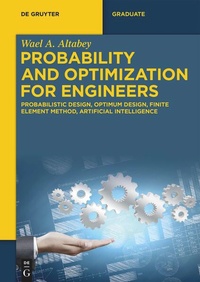
Probability and Optimization for Engineers
Description

Probability and Optimization for Engineers covers the fundamentals of probabilistic design and optimum design and methods for high performance design. It presents the principle of finite element method in probabilistic and optimum design with solved specific interactive problems of finite element analysis using ANSYS. It explains artificial intelligence for optimum design using AI algorithms including machine learning, deep learning, artificial neural networks, Bayesian optimum design, Bayesian machine learning optimization, and genetic algorithms.
- Probabilistic and optimum design course with easy, visual, and applied methods.
- Solved examples, assignments, problems and tutorials.
- Educational resource for engineering students and for practicing engineers.
More details
Other editions
Additional editions
Person
Dr. Wael A. Altabey is a full professor at department of Mechanical Engineering, Alexandria University, Alexandria, Egypt. Before that he was a research associate professor between 2018 to 2024 at International Institute for Urban Systems Engineering (IIUSE), Southeast University, Nanjing, China, and National and Local Joint Engineering Research Center for Basalt Fiber Production and Application Technology, Southeast University, Nanjing, Jiangsu, China, after completing a postdoctoral research fellowship for two years (2016-2018).
Since 2016 his researches have focused on the utilization of Artificial Intelligence (AI) based schemes for structural health monitoring (SHM) and Non-Destructive Testing (NDT) for damage classification, detection, diagnosis, prediction, dynamic response analysis, and Reliability evaluation in composite, and steel Structures (such as aircraft, wind turbines, pipes, bridges and industrial machines) at National and Local Joint Engineering Research Center for Basalt Fiber Production and Application Technology, Southeast University, Nanjing, Jiangsu, China. This is the only national R&D platform awarded by the National Development and Reform Commission in this industry with more than 30 national authorized patents. The center's international and national awards indicators have reached international and local leading levels and filling many technical gaps in China.
He participated in several research activities, which achieved from NSFC and private sectors. He listed in Stanford List of World's Top 2% Scientists from 2020, until now. He serves on various technical committees in several international conferences and workshops, guest editor of special Issues in several international scientific journals and on the editorial board of several international scientific journals in the field of artificial intelligence, mechanical, materials, and civil engineering. He is a peer reviewer of more than 160 international scientific journals. He is an author and co-author of more than 130 high impact journal papers, 60 scientific conference papers and 60 chapters, 10 academic and research books, patent, and delivered over 60 invited talks.
His research interests: Smart and Nanomaterials; Composite Structures; Structural Health Monitoring (SHM); Artificial Intelligence (AI); Non-Destructive Testing (NDT); Digital Twins Model of Structural Behavior, System Identification; Damage Detection: Vibration-Based Techniques; Fiber Optical Sensing Technique, Structural Control; Structural Resilience and Reliability, Hysteretic Systems, Micro/Nano Electro Mechanical Systems (MEMS/ NEMS), and Energy Harvesting Model for Self-Powered Sensors.
Content
- Preface
- Contents
- Chapter 1 The probability methods
- 1.1 Introduction
- 1.2 Traditional (deterministic) versus probabilistic design analysis methods
- 1.3 Reliability and quality issues
- 1.4 Probabilistic design terminology
- 1.5 Steps for probabilistic design analysis using ANSYS
- Chapter 2 Probability distributions
- 2.1 Introduction
- 2.2 Gallery of common continuous distributions
- 2.3 Normal distribution
- 2.3.1 Probability density function
- 2.4 Uniform distribution
- 2.4.1 Probability density function
- 2.5 Lognormal distribution
- 2.6 Weibull distribution
- 2.6.1 Probability density function
- Chapter 3 Choosing a distribution for a random variable
- 3.1 Introduction
- 3.2 Measured data
- 3.3 Mean values, standard deviation, and exceedance values
- 3.4 No data
- 3.4.1 Geometric tolerances
- 3.4.2 Material data
- 3.4.3 Load data
- 3.5 Choosing random output parameters
- Chapter 4 Probabilistic design techniques
- 4.1 Introduction
- 4.2 Direct sampling
- 4.3 Latin hypercube sampling
- 4.4 Postprocessing probabilistic analysis results
- 4.4.1 Statistical postprocessing
- 4.4.1.1 Sample history
- 4.4.1.2 Histogram
- 4.4.1.3 Cumulative distribution function
- 4.4.1.4 Print probabilities
- 4.4.1.5 Print inverse probabilities
- 4.4.2 Trend postprocessing
- 4.4.2.1 Sensitivities
- 4.4.2.2 Scatter plots
- 4.4.2.3 Correlation matrix
- 4.5 The basic concepts in structural reliability evaluation
- 4.5.1 Response surface method
- 4.5.2 JC method
- 4.5.3 Monte Carlo simulation
- Chapter 5 Tutorial: probabilistic design analysis of circular plate bending
- 5.1 Introduction
- 5.2 Approach and assumptions
- 5.3 Summary of steps
- 5.4 Step-by-step analysis
- 5.4.1 Enter PDS and specify analysis file
- 5.4.2 Specify analysis file
- 5.4.3 Define input variables
- 5.4.4 Define output parameters
- 5.4.5 Execute Monte Carlo simulations to obtain solution
- 5.4.6 Perform statistical postprocessing
- 5.4.6.1 Sample history
- 5.4.6.2 Histogram
- 5.4.6.3 Cumulative DF and probabilities
- 5.4.6.4 Inverse problem
- 5.4.7 Perform trend postprocessing
- 5.4.8 Generate HTML report and exit
- Chapter 6 Tutorial: probabilistic design analysis of a laminate composite plate under distributed pressure
- 6.1 Introduction
- 6.2 Geometrical model
- 6.3 Stress analysis
- 6.4 Reliability analysis using ANSYS
- 6.4.1 Relative frequency
- 6.4.2 Cumulative density function
- 6.4.3 Simulation sample
- 6.4.4 Sensitivity analysis
- 6.4.5 Determination of performance function
- 6.5 Reliability evaluation using a hybrid response surface method
- 6.5.1 Artificial neural network
- 6.5.2 Fuzzy random theory
- Chapter 7 The optimization methods
- 7.1 Introduction
- 7.2 Optimum design
- 7.2.1 Optimum design fundamentals
- 7.2.2 Applications and examples
- 7.2.3 Types of optimization
- 7.3 Graphical method
- 7.3.1 Linear system
- 7.3.2 Nonlinear system
- 7.4 Analytical method
- 7.4.1 Unconstrained optimization
- 7.4.1.1 Differential calculus method
- 7.4.1.2 The solution for one variable
- 7.4.1.3 The solution for multivariable
- 7.4.2 Constrained optimization
- 7.4.2.1 Lagrangian multipliers and necessary conditions
- 7.4.2.2 Lagrangian multipliers' solution for equality constraints
- 7.4.2.3 Lagrangian multipliers' solution for inequality constraint by using slack variables
- The properties of the slack variable(S)
- 7.4.2.4 The check for constrained optimization (sufficient condition)
- 7.5 Numerical method
- 7.5.1 Descent condition
- 7.5.2 MATLAB built-in algorithm
- 7.6 Optimum design using ANSYS
- 7.6.1 Design optimization terminology and information flow
- 7.6.2 Optimization methods
- 7.6.2.1 Subproblem approximation method
- 7.6.2.2 First-order method
- 7.6.3 Optimization design tools
- 7.6.3.1 Single-loop analysis tool
- 7.6.3.2 Random tool
- 7.6.3.3 Sweep tool
- 7.6.3.4 Factorial tool
- 7.6.3.5 Gradient tool
- 7.6.4 General process for design optimization
- 7.6.4.1 Create the analysis file
- 7.6.4.2 Build the model parametrically
- 7.6.4.3 Obtain the solution
- 7.6.4.4 Retrieve results parametrically
- 7.6.5 Guidelines for performing optimization analysis
- 7.6.5.1 Choosing design variables
- 7.6.5.2 Choosing state variables
- 7.6.5.3 Choosing the objective function
- 7.6.5.4 Restarting an optimization analysis
- 7.6.5.5 Sample optimization analysis
- Chapter 8 Tutorial: optimization of heat transfer rate from the rod of a cylindrical pin fin
- 8.1 Introduction
- 8.2 Approach and assumptions
- 8.3 Input file using a log file
- 8.4 Step-by-step analysis using GUI method
- 8.4.1 Test analysis file
- 8.4.2 Enter the optimizer and identify the analysis file
- 8.4.3 Identify the optimization variables
- 8.4.4 Run the optimization
- 8.4.5 Review the results
- 8.4.6 Restore the best design and exit
- Chapter 9 The optimum design using artificial intelligence
- 9.1 Introduction
- 9.2 Artificial intelligence (AI)
- 9.3 Machine learning (ML)
- 9.4 Deep learning (DL)
- 9.5 Artificial neural networks (ANNs)
- 9.5.1 ANN architecture
- 9.5.1.1 Input layer
- 9.5.1.2 Output layer
- 9.5.1.3 Hidden layers
- 9.5.2 Types of artificial neural networks
- 9.5.2.1 Multilayer perceptrons (MLPs)
- 9.5.2.2 Radial basis function networks
- 9.5.2.3 Multilayer feedforward neural networks
- 9.5.2.4 The backpropagation ANN
- 9.5.3 ANN parameters
- 9.5.3.1 Learning rate
- 9.5.3.2 Momentum
- 9.5.3.3 Input noise
- 9.5.3.4 Training and testing tolerances
- 9.5.4 Learning process and algorithms
- 9.5.4.1 Supervised learning
- 9.5.4.2 Unsupervised learning
- 9.5.5 Bayesian optimum design
- 9.5.5.1 Problem definition
- 9.5.6 Gaussian process (GP)
- 9.5.7 Acquisition function
- 9.6 Bayesian machine learning optimization
- 9.6.1 Bayesian machine learning optimization code
- 9.7 Genetic algorithms (GAs)
- 9.7.1 Genetic algorithm code
- About the author
- Index
