

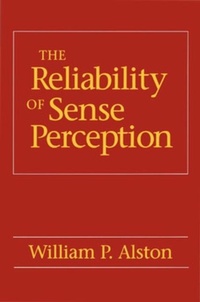
The Reliability of Sense Perception
1st Edition
Published on 5. July 2018
168 pages
978-1-5017-2054-3 (ISBN)
Description

Why suppose that sense perception is an accurate source of information about the physcial environment? More generally, is it possible to demonstrate that our basic ways of forming beliefs are reliable? In this book, a leading analytic philosopher confronts this classic problem through detailed investigation of sense perception, the source of beliefs in which we place the most confidence. Carefully assessing the available arguments, William P. Alston concludes that it is not possible to show in any noncircular way that sense perception is a reliable source of beliefs.
More details
Language
English
Place of publication
NY
United States
Target group
College/higher education
Professional and scholarly
Edition type
Digital original
ISBN-13
978-1-5017-2054-3 (9781501720543)
Copyright in bibliographic data and cover images is held by Nielsen Book Services Limited or by the publishers or by their respective licensors: all rights reserved.
Schweitzer Classification
Other editions
Additional editions
William P. Alston
The Reliability of Sense Perception
Book
01/1996
Cornell University Press
€38.38
Shipment within 10-20 days
William P. Alston
The Reliability of Sense Perception
Book
05/1993
Cornell University Press
€66.85
Shipment within 10-20 days
Person
AlstonWilliam P.:
The late William P. Alston was Professor of Philosophy Emeritus at Syracuse University. His books include A Realist Conception of Truth, Illocutionary Acts and Sentence Meanings, The Reliability of Sense Perception, and Perceiving God: The Epistemology of Religious Experience, all from Cornell.
The late William P. Alston was Professor of Philosophy Emeritus at Syracuse University. His books include A Realist Conception of Truth, Illocutionary Acts and Sentence Meanings, The Reliability of Sense Perception, and Perceiving God: The Epistemology of Religious Experience, all from Cornell.
Content
- Cover
- THE RELIABILITY OF SENSE PERCEPTION
- Title
- Copyright
- Dedication
- CONTENTS
- Preface
- Chapter 1 Introduction
- i. The Problem
- ii. Significance of the Problem
- iii. Ways of Belief Formation
- iv. Doxastic Practices
- v. Reliability
- Chapter 2 Track Record and Other Simple Empirical Arguments for Reliability
- i. A Track Record Argument for the Reliability of Sense Perceptual Practice (SP)
- ii. Epistemic Circularity
- iii. A Piecemeal Approach
- iv. Back to SP as a Whole
- v. Pragmatic Arguments: Validation by Fruits
- vi. The Road Ahead
- Chapter 3 A Priori Arguments
- i. Theological Arguments
- ii. Verificationism
- iii. Criteria of Physical Object Concepts
- iv. Paradigm Case Arguments
- v. The Private Language Argument
- vi. Transcendental Arguments
- Chapter 4 Empirical Arguments for the Reliability of SP
- i. The Explanation of Sensory Experience
- ii. The Explanation of Patterns in Sense Experience
- iii. Attempts to Support the Standard Explanation
- iv. Explanations of Our Success in Predicting Our Experience
- v. Problems with the Argument
- vi. How Widespread Is the Circularity Problem?
- Chapter 5 Where Do We Go from Here?
- i. The Problem
- ii. A Practical Argument for the Rationality of SP
- iii. Practical Rationality and Reliability
- iv. Overriders of Prima Facie Rationality
- v. Significant Self-Support
- Bibliography
- Index
