

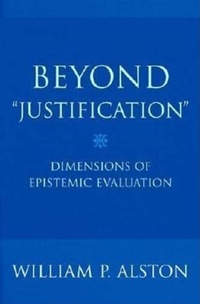
Beyond "Justification"
Dimensions of Epistemic Evaluation
1st Edition
Published on 5. July 2018
274 pages
978-1-5017-2057-4 (ISBN)
Description

Much of the writing in Anglo-American epistemology in the twentieth century focused on the conditions for beliefs being "justified." In a book that seeks to shift the ground of debate within theory of knowledge, William P. Alston finds that the century-long search for a correct account of the nature and conditions of epistemic justification misses the point. Alston calls for that search to be suspended and for talk of epistemic justification to cease. He proposes instead an approach to the epistemology of belief that focuses on the evaluation of various "epistemic desiderata" that may be satisfied by beliefs.Alston finds that features of belief that are desirable for the goals of cognition include having an adequate basis, being formed in a reliable way, and coherence within bodies of belief. In Alston's view, a belief's being based on an adequate ground and its being formed in a reliable way, though often treated as competing accounts of justification, are virtually identical. Beyond "Justification" also contains discussions of fundamental questions about the epistemic status of principles and beliefs and appropriate responses to various kinds of skepticism.
More details
Language
English
Place of publication
NY
United States
Edition type
Digital original
ISBN-13
978-1-5017-2057-4 (9781501720574)
Copyright in bibliographic data and cover images is held by Nielsen Book Services Limited or by the publishers or by their respective licensors: all rights reserved.
Schweitzer Classification
Other editions
Additional editions
Book
10/2006
Cornell University Press
€42.09
Shipment within 10-20 days
Book
12/2004
Cornell University Press
€64.38
Shipment within 10-20 days
Person
AlstonWilliam P.:
The late William P. Alston was Professor of Philosophy Emeritus at Syracuse University. His books include A Realist Conception of Truth, Illocutionary Acts and Sentence Meanings, The Reliability of Sense Perception, and Perceiving God: The Epistemology of Religious Experience, all from Cornell.
The late William P. Alston was Professor of Philosophy Emeritus at Syracuse University. His books include A Realist Conception of Truth, Illocutionary Acts and Sentence Meanings, The Reliability of Sense Perception, and Perceiving God: The Epistemology of Religious Experience, all from Cornell.
Content
- Cover
- BEYOND "JUSTIFICATION
- Title
- Copyright
- Dedication
- CONTENTS
- Preface
- List of Abbreviations
- INTRODUCTION
- i. What Counts as Epistemology?
- ii. Concentration on the Epistemology of Belief
- iii. Basic Organization of the Book
- Part I. The Naturalistic Approach
- CHAPTER 1. DISPENSING WITH "JUSTIFICATION
- i. Conceptions of Epistemic Justification
- ii. Comments on These Conceptions
- iii. Conditions for the Justification of a Belief
- iv. Attempts to Identify Epistemic Justification
- CHAPTER 2. THE EPISTEMIC POINT OF VIEW
- i. True Belief as the Basic Goal of Cognition
- ii. Truth and Other Goals of Cognition
- iii. Objects of Epistemic Evaluation
- CHAPTER 3. THE EPISTEMIC DESIDERATA APPROACH
- i. A List of Epistemic Desiderata
- ii. An Outline of the Epistemic Desiderata Approach
- iii. Interrelations of Desiderata
- iv. Internalism and Externalism
- v. Internalism and Externalism on Justificationism and on the Epistemic Desiderata Approach
- CHAPTER 4. DEONTOLOGICAL DESIDERATA
- i. Preliminaries
- ii. Basic Voluntary Control of Believing
- iii. Other Modes of Voluntary Control of Believing
- iv. Indirect Voluntary Influence on Believing
- CHAPTER 5. ADEQUACY OF GROUNDS OF BELlEF
- i. Grounds and the Basing Relation
- ii. Having Evidence and Basing a Belief on It
- iii. Adequacy of Grounds and Truth
- iv. Adequacy of Grounds-Preliminaries
- v. Adequacy of Grounds and Epistemic Probability
- vi. The Logical Construal of Episternic Probability
- vii. A Frequency Construal of Epistemic Probability
- CHAPTER 6. RELIABILITY AND OTHER TRUTH-CONDUCIVE DESIDERATA
- i. The Problem of Generality
- ii. Belief-Forming Processes
- iii. Belief-Forming Mechanisms as Psychologically Realized Functions
- iv. The Problem of Generality Solved
- v. Identity of Adequacy of Ground and Reliability of Process
- vi. Objections and Complications
- vii. Some More Serious Complications
- viii. Proper Functioning of Cognitive Faculties
- ix. Intellectual Virtues: Sosa and Goldman
- x. Intellectual Virtues: Zagzebski
- xi. Conclusion on Intellectual Virtue
- CHAPTER 7. ADDITIONAL EPISTEMIC DESIDERATA
- i. Group III Desiderata
- ii. Group V Desiderata
- CHAPTER 8. WHERE PARTICULAR DESIDERATA ARE OF SPECIAL IMPORTANCE
- i. Introduction
- ii. Reliability
- iii. Group III Desiderata
- iv. Deontological Desiderata
- v. General Philosophical Assessment of Beliefs
- vi. Assessment of Perceptual Beliefs: Preliminaries
- vii. The Nature of Perception
- viii. The Truth Conducivity of Grounds of Perceptual Beliefs
- Part II. Ultimate Questions: The Epistemology of Epistemology
- CHAPTER 9. CRITICAL QUESTIONS ABOUT EPISTEMOLOGICAL METHODOLOGY
- i. The Demand for a Final Settlement
- ii. The Inevitability of a Regress
- iii. Attempts to Avoid the Regress: Doxastic Practices
- iv. Epistemic Circularity
- v. Avoiding Epistemic Circularity
- vi. The Pervasiveness of Epistemic Circularity
- CHAPTER 10. SKEPTICISM
- i. Types of Skepticism
- ii. Disarming the Pyrrhonian Skeptic
- iii. Humean Skepticism
- iv. Skepticism Concerning Various Epistemic Desiderata
- CHAPTER 11. THE EPISTEMIC DESIDERATA APPROACH AND THE OVERALL EPISTEMIC ORGANIZATION OF BELIEF
- i. Types of Foundationalism
- ii. Coherentism and Contextualism
- iii. Does the Epistemic Desiderata Approach Make a Difference?
- iv. Are We Committed to Contextualism?
- Envoi
- Bibliography
- Index
