

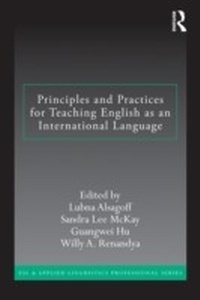
Principles and Practices for Teaching English as an International Language
1st Edition
Published on 23. April 2012
376 pages
978-1-136-74117-3 (ISBN)
Description

What general principles should inform a socioculturally sensitive pedagogy for teaching English as an International Language and what practices would be consistent with these principles?
This text explores the pedagogical implications of the continuing spread of English and its role as an international language, highlighting the importance of socially sensitive pedagogy in contexts outside inner circle English-speaking countries. It provides comprehensive coverage of topics traditionally included in second language methodology courses (such as the teaching of oral skills and grammar), as well as newer fields (such as corpora in language teaching and multimodality); features balanced treatment of theory and practice; and encourages teachers to apply the pedagogical practices to their own classrooms and to reflect on the effects of such practices. Designed for pre-service and in-service teachers of English around the world, Principles and Practices for Teaching English as an International Language fills a critical need in the field.
This text explores the pedagogical implications of the continuing spread of English and its role as an international language, highlighting the importance of socially sensitive pedagogy in contexts outside inner circle English-speaking countries. It provides comprehensive coverage of topics traditionally included in second language methodology courses (such as the teaching of oral skills and grammar), as well as newer fields (such as corpora in language teaching and multimodality); features balanced treatment of theory and practice; and encourages teachers to apply the pedagogical practices to their own classrooms and to reflect on the effects of such practices. Designed for pre-service and in-service teachers of English around the world, Principles and Practices for Teaching English as an International Language fills a critical need in the field.
More details
Series
Language
English
Place of publication
London
United Kingdom
Publishing group
Taylor & Francis Ltd
Target group
College/higher education
Illustrations
6 s/w Tabellen
6 Tables, black and white
File size
2,09 MB
ISBN-13
978-1-136-74117-3 (9781136741173)
Copyright in bibliographic data and cover images is held by Nielsen Book Services Limited or by the publishers or by their respective licensors: all rights reserved.
Schweitzer Classification
Other editions
Additional editions
Lubna Alsagoff | Sandra Lee Mckay | Guangwei Hu
Principles and Practices for Teaching English as an International Language
Book
03/2012
1st Edition
Routledge
€232.60
Shipment within 15-20 days
Lubna Alsagoff | Sandra Lee Mckay | Guangwei Hu
Principles and Practices for Teaching English as an International Language
Book
03/2012
1st Edition
Routledge
€83.40
Shipment within 15-20 days
Persons
Lubna Alsagoff is Associate Professor and Head of English Language and Literature at the National Institute of Education, Nanyang Technological University, Singapore.
Sandra Lee McKay is Professor Emeritus of English at San Francisco State University.
Guangwei Hu is Associate Professor in the English Language and Literature department of the National Institute of Education, Nanyang Technological University, Singapore.
Willy A. Renandya is Senior Lecturer at the English Language and Literature department of the National Institute of Education, Nanyang Technological University, Singapore.
Sandra Lee McKay is Professor Emeritus of English at San Francisco State University.
Guangwei Hu is Associate Professor in the English Language and Literature department of the National Institute of Education, Nanyang Technological University, Singapore.
Willy A. Renandya is Senior Lecturer at the English Language and Literature department of the National Institute of Education, Nanyang Technological University, Singapore.
Content
Preface
Part I: WHY ANOTHER BOOK ON EIL
1. Another Book about EIL? Heralding the Need for New Ways of Thinking, Doing, and BeingLubna Alsagoff
Part II: CALLING FOR CHANGE
2. Individual Identity, Cultural Globalization, and Teaching English as an International Language: The Case for an Epistemic BreakB. Kumaravadivelu
3. Principles of Teaching English as an International LanguageSandra Lee McKay
4. Language Teaching and Learning in the Postlinguistic Condition?Mark Evan Nelson & Richard Kern
5. The Use of Digital Media in Teaching English as an International LanguagePaige Ware, Meei-Ling Liaw & Mark Warschauer
6. Linking EIL and Literacy: Theory and PracticeConstant Leung & Brian V Street
7. Identity and the EIL LearnerLubna Alsagoff
8. Assessing English as an International LanguageGuangwei Hu
Part III: IMPLEMENTING CHANGE
9. EIL Curriculum DevelopmentJames Dean Brown
10. Teaching Materials in EILAya Matsuda
11. Teaching Oral Skills in English as a Lingua FrancaJuliane House
12. Lexical Innovation in English as an International Language: Implications for English TeachingWendy D. Bokhorst-Heng
13. Corpora in Language Teaching from the Perspective of English as an International LanguageJohn Flowerdew
14. Grammar Teaching and StandardsAnthea Fraser Gupta
15. Principles and Practices for Teaching English as an International Language: Teaching Critical ReadingCatherine Wallace
16. Controversy and Change in How We View L2 Writing in International ContextsChristine Pearson Casanave
17. Literature in Language TeachingAlan Maley
18. Language Learning Strategies: An EIL PerspectiveYongqi Gu
Part IV: FORGING AHEAD
19. English as an International Language: A Time for ChangeSandra Lee McKay
About the Contributors
Index
Part I: WHY ANOTHER BOOK ON EIL
1. Another Book about EIL? Heralding the Need for New Ways of Thinking, Doing, and BeingLubna Alsagoff
Part II: CALLING FOR CHANGE
2. Individual Identity, Cultural Globalization, and Teaching English as an International Language: The Case for an Epistemic BreakB. Kumaravadivelu
3. Principles of Teaching English as an International LanguageSandra Lee McKay
4. Language Teaching and Learning in the Postlinguistic Condition?Mark Evan Nelson & Richard Kern
5. The Use of Digital Media in Teaching English as an International LanguagePaige Ware, Meei-Ling Liaw & Mark Warschauer
6. Linking EIL and Literacy: Theory and PracticeConstant Leung & Brian V Street
7. Identity and the EIL LearnerLubna Alsagoff
8. Assessing English as an International LanguageGuangwei Hu
Part III: IMPLEMENTING CHANGE
9. EIL Curriculum DevelopmentJames Dean Brown
10. Teaching Materials in EILAya Matsuda
11. Teaching Oral Skills in English as a Lingua FrancaJuliane House
12. Lexical Innovation in English as an International Language: Implications for English TeachingWendy D. Bokhorst-Heng
13. Corpora in Language Teaching from the Perspective of English as an International LanguageJohn Flowerdew
14. Grammar Teaching and StandardsAnthea Fraser Gupta
15. Principles and Practices for Teaching English as an International Language: Teaching Critical ReadingCatherine Wallace
16. Controversy and Change in How We View L2 Writing in International ContextsChristine Pearson Casanave
17. Literature in Language TeachingAlan Maley
18. Language Learning Strategies: An EIL PerspectiveYongqi Gu
Part IV: FORGING AHEAD
19. English as an International Language: A Time for ChangeSandra Lee McKay
About the Contributors
Index
