

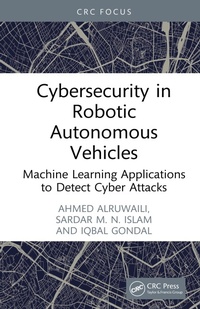
Cybersecurity in Robotic Autonomous Vehicles
Machine Learning Applications to Detect Cyber Attacks
1st Edition
Published on 21. March 2025
106 pages
978-1-040-35870-2 (ISBN)
Description

Cybersecurity in Robotic Autonomous Vehicles introduces a novel intrusion detection system (IDS) specifically designed for AVs, which leverages data prioritisation in CAN IDs to enhance threat detection and mitigation. It offers a pioneering intrusion detection model for AVs that uses machine and deep learning algorithms.
Presenting a new method for improving vehicle security, the book demonstrates how the IDS has incorporated machine learning and deep learning frameworks to analyse CAN bus traffic and identify the presence of any malicious activities in real time with high level of accuracy. It provides a comprehensive examination of the cybersecurity risks faced by AVs with a particular emphasis on CAN vulnerabilities and the innovative use of data prioritisation within CAN IDs.
The book will interest researchers and advanced undergraduate students taking courses in cybersecurity, automotive engineering, and data science. Automotive industry and robotics professionals focusing on Internet of Vehicles and cybersecurity will also benefit from the contents.
Presenting a new method for improving vehicle security, the book demonstrates how the IDS has incorporated machine learning and deep learning frameworks to analyse CAN bus traffic and identify the presence of any malicious activities in real time with high level of accuracy. It provides a comprehensive examination of the cybersecurity risks faced by AVs with a particular emphasis on CAN vulnerabilities and the innovative use of data prioritisation within CAN IDs.
The book will interest researchers and advanced undergraduate students taking courses in cybersecurity, automotive engineering, and data science. Automotive industry and robotics professionals focusing on Internet of Vehicles and cybersecurity will also benefit from the contents.
More details
Edition
1. Auflage
Language
English
Place of publication
London
United Kingdom
Publishing group
Taylor & Francis Ltd
Target group
College/higher education
Professional and scholarly
Illustrations
5 Tables, black and white; 22 Line drawings, black and white; 1 Halftones, black and white; 23 Illustrations, black and white
File size
1,55 MB
ISBN-13
978-1-040-35870-2 (9781040358702)
Copyright in bibliographic data and cover images is held by Nielsen Book Services Limited or by the publishers or by their respective licensors: all rights reserved.
Schweitzer Classification
Other editions
Additional editions
Ahmed Alruwaili | Sardar M. N. Islam | Iqbal Gondal
Cybersecurity in Robotic Autonomous Vehicles
Machine Learning Applications to Detect Cyber Attacks
Book
approx. 06/2026
1st Edition
Taylor & Francis
€31.00
Not yet published
Ahmed Alruwaili | Sardar M. N. Islam | Iqbal Gondal
Cybersecurity in Robotic Autonomous Vehicles
Machine Learning Applications to Detect Cyber Attacks
Book
03/2025
1st Edition
CRC Press
€78.10
Shipment within 15-20 days
Persons
Mr. Ahmed Alruwaili is a researcher specialising in cyber security, artificial intelligence, and quantum computing. He received his Bachelor of Computer Science in computer science and information from Aljouf University, Saudi Arabia, in 2013, and a Master of Information Technology with a focus on cyber security from Deakin University, Australia, in 2019. Currently, he is pursuing his PhD at Victoria University, Australia, where he focuses on enhancing security frameworks for the Internet of Vehicles. His research bridges theoretical concepts and practical applications in areas such as cyber security, artificial intelligence, game theory, distributed systems security, machine autonomy, and quantum computing. An active member of the Institute for Systems and Technologies of Information, Control and Communication (INSTICC), and the Australian Information Security Association (AISA), Mr. Alruwaili is committed to contributing to the academic community and staying at the forefront of developments in his field.
Dr. Sardar M. N. Islam (Naz) is currently a professor at Victoria University, Australia. He is also a distinguished visiting professor of artificial intelligence at UnSri and a distinguished visiting professor of quantum technologies and computing at BIT; adjunct professor of IT and business at Armstrong Institute, Melbourne; and editor-in-chief of International Transactions on Artificial Intelligence. Professor Islam adopts a global and humanistic approach in his research and academic works. He has published 31 scholarly authored academic books and 4 edited books with prestigious international publishers in different disciplines, including computer science. Professor Islam has also published approx. 250 articles, including some of the leading international journal articles in his specialised research areas.
Dr. Iqbal Gondal is Associate Dean in Cloud, Systems and Security, and Deputy Director (cybersecurity) Sir Lawrence Wackett Defence & Aerospace Centre (SLWDAC) in Royal Melbourne Institute of Technology (RMIT), Australia. He has worked in industry and academia for 25 years in both Singapore and Australia. He was the director of Internet Commerce Security Lab (ICSL) for seven years to conduct translational research in cybersecurity. Previously, he was the director of ICT strategy for the faculty of IT in Monash, India. He is a fellow of Institute of Engineers Australia, member of IEEE USA, and graduate member of Australian Institute of Company Directors (GAICD). Dr. Gondal worked as a research fellow and a senior software systems engineer for seven years in Singapore and Australia with Delphi (GM), Singapore Manufacturing Technology (SimTech) centre, and other industries working on design and development, project management, system design and integration, SCADA, intelligent techniques, adaptive systems, and wireless switches for financial services. He has published over 219-refereed conference and journal papers, and he is a an experienced HDR supervisor. Dr. Gondal was a member of the University Governing Council & Engineering Advisory Committee, Non-Exec Director of Oceania Cyber Security Centre, and University engagement for the Defence Science Institute.
Dr. Sardar M. N. Islam (Naz) is currently a professor at Victoria University, Australia. He is also a distinguished visiting professor of artificial intelligence at UnSri and a distinguished visiting professor of quantum technologies and computing at BIT; adjunct professor of IT and business at Armstrong Institute, Melbourne; and editor-in-chief of International Transactions on Artificial Intelligence. Professor Islam adopts a global and humanistic approach in his research and academic works. He has published 31 scholarly authored academic books and 4 edited books with prestigious international publishers in different disciplines, including computer science. Professor Islam has also published approx. 250 articles, including some of the leading international journal articles in his specialised research areas.
Dr. Iqbal Gondal is Associate Dean in Cloud, Systems and Security, and Deputy Director (cybersecurity) Sir Lawrence Wackett Defence & Aerospace Centre (SLWDAC) in Royal Melbourne Institute of Technology (RMIT), Australia. He has worked in industry and academia for 25 years in both Singapore and Australia. He was the director of Internet Commerce Security Lab (ICSL) for seven years to conduct translational research in cybersecurity. Previously, he was the director of ICT strategy for the faculty of IT in Monash, India. He is a fellow of Institute of Engineers Australia, member of IEEE USA, and graduate member of Australian Institute of Company Directors (GAICD). Dr. Gondal worked as a research fellow and a senior software systems engineer for seven years in Singapore and Australia with Delphi (GM), Singapore Manufacturing Technology (SimTech) centre, and other industries working on design and development, project management, system design and integration, SCADA, intelligent techniques, adaptive systems, and wireless switches for financial services. He has published over 219-refereed conference and journal papers, and he is a an experienced HDR supervisor. Dr. Gondal was a member of the University Governing Council & Engineering Advisory Committee, Non-Exec Director of Oceania Cyber Security Centre, and University engagement for the Defence Science Institute.
Content
1. Introduction. 2. Theoretical Lens. 3. Exploring CAN Bus Security: Insights and Analysis. 4. Research Design. 5. Results and Discussion. 6. Conclusions and Future Research.
