

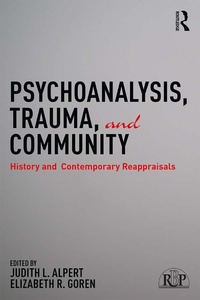
Psychoanalysis, Trauma, and Community
History and Contemporary Reappraisals
Published on 18. November 2016
282 pages
978-1-317-40169-8 (ISBN)
Description

Trauma is one of the hottest contemporary topics within psychoanalysis, whilst many psychoanalysts are increasingly interested in applying their skills outside the traditional setting of the consulting room, especially in response to disasters, wars and serious social issues. Psychoanalysis, Trauma, and Community seeks to correct the misconceptions of what analysts do and how they do it and debunk the stereotype of psychoanalysts stuck in their offices plying their wares on the worried well.
Bringing together a group of eminent contributors, this volume considers how psychoanalysis may best be expanded to help in social and community settings, to understand these wider issues from a psychoanalytic perspective, and provide clear clinical guidance and clinical examples of how best to work in a wide variety of non-traditional ways. The innovative work featured includes taking testimony, in-situ interviewing, documentary film-making, social activism, ethnic and political conflict mediation, on-site workshops as well as direct clinical interventions. The reader is taken from the Holocaust, Hiroshima and the Vietnam War to the Balkan Wars and Palestinian-Israeli conflict, from the political violence of the disappeared in Argentina to the devastation wrought by Hurricane Katrina, and from chronic conditions of poverty in India to racism in the post-Jim Crow South.
Psychoanalysis, Trauma, and Community will appeal to psychoanalysts, psychoanalytic psychotherapists and anyone studying on the increasing number of trauma courses being given today in universities. Lay readers with an interest in the traumatic fallout as a result of chronic conditions or the myriad disasters that occur globally will find this book illuminating. For the non-specialist mental health professional, including non-analytic psychotherapists, social workers and others who work in the community, this book offers concrete advice on dealing with intervention issues such as entry and integration, as well as on management of multiple and complex trauma in a non-clinical setting.
Bringing together a group of eminent contributors, this volume considers how psychoanalysis may best be expanded to help in social and community settings, to understand these wider issues from a psychoanalytic perspective, and provide clear clinical guidance and clinical examples of how best to work in a wide variety of non-traditional ways. The innovative work featured includes taking testimony, in-situ interviewing, documentary film-making, social activism, ethnic and political conflict mediation, on-site workshops as well as direct clinical interventions. The reader is taken from the Holocaust, Hiroshima and the Vietnam War to the Balkan Wars and Palestinian-Israeli conflict, from the political violence of the disappeared in Argentina to the devastation wrought by Hurricane Katrina, and from chronic conditions of poverty in India to racism in the post-Jim Crow South.
Psychoanalysis, Trauma, and Community will appeal to psychoanalysts, psychoanalytic psychotherapists and anyone studying on the increasing number of trauma courses being given today in universities. Lay readers with an interest in the traumatic fallout as a result of chronic conditions or the myriad disasters that occur globally will find this book illuminating. For the non-specialist mental health professional, including non-analytic psychotherapists, social workers and others who work in the community, this book offers concrete advice on dealing with intervention issues such as entry and integration, as well as on management of multiple and complex trauma in a non-clinical setting.
Reviews / Votes
"The essays here expand the boundaries of psychoanalysis, applying its principles to social problems and intelligent activism while aptly demonstrating the profound applicability of our field to the socio-cultural milieu. A broad spectrum of mass trauma-including but not limited to the Holocaust, Hurricane Katrina, and September 11th-is attended to by courageous analysts who understand that their vocation must move them beyond the office walls. In the alternative tradition of Harry Stack Sullivan and Robert J. Lifton, this powerful and highly recommended volume importantly reminds us that psychoanalytic principles and practice can and should reach far outside the usual clinical frame."-Danielle Knafo, Author, Living with Terror, Working with Trauma: A Clinician's Handbook."Psychoanalysis, Trauma and Community is essential reading for all citizen-psychoanalysts, as we meet a critical juncture in history. Confronting the effects of global violence, hatred, poverty, and oppression, we are being called by social justice. How do we apply analytic premises outside the office? The authors in this volume re-frame analytic theory, offering us a compelling guide and source of inspiration and hope."-Sue Grand, NYU Postdoctoral Program in Psychotherapy and psychoanalysis; faculty, National Institute for the Psychotherapies; faculty, the Mitchell Center for Relational Psychoanalysis and visiting scholar, the Psychoanalytic Institute of Northern California. "The essays here expand the boundaries of psychoanalysis, applying its principles to social problems and intelligent activism while aptly demonstrating the profound applicability of our field to the socio-cultural milieu. A broad spectrum of mass trauma-including but not limited to the Holocaust, Hurricane Katrina, and September 11th-is attended to by courageous analysts who understand that their vocation must move them beyond the office walls. In the alternative tradition of Harry Stack Sullivan and Robert J. Lifton, this powerful and highly recommended volume importantly reminds us that psychoanalytic principles and practice can and should reach far outside the usual clinical frame."-Danielle Knafo, Author, Living with Terror, Working with Trauma: A Clinician's Handbook.
"Psychoanalysis, Trauma and Community is essential reading for all citizen-psychoanalysts, as we meet a critical juncture in history. Confronting the effects of global violence, hatred, poverty, and oppression, we are being called by social justice. How do we apply analytic premises outside the office? The authors in this volume re-frame analytic theory, offering us a compelling guide and source of inspiration and hope."-Sue Grand, NYU Postdoctoral Program in Psychotherapy and psychoanalysis; faculty, National Institute for the Psychotherapies; faculty, the Mitchell Center for Relational Psychoanalysis and visiting scholar, the Psychoanalytic Institute of Northern California.
More details
Series
Language
English
Place of publication
London
United Kingdom
Publishing group
Taylor & Francis Ltd
Target group
Professional and scholarly
College/higher education
Illustrations
1 Halftones, black and white
File size
1,59 MB
ISBN-13
978-1-317-40169-8 (9781317401698)
Copyright in bibliographic data and cover images is held by Nielsen Book Services Limited or by the publishers or by their respective licensors: all rights reserved.
Schweitzer Classification
Other editions
Additional editions
Judith L. Alpert | Elizabeth R. Goren
Psychoanalysis, Trauma, and Community
History and Contemporary Reappraisals
Book
11/2016
1st Edition
Routledge
€72.70
Shipment within 10-20 days
Judith L. Alpert | Elizabeth R. Goren
Psychoanalysis, Trauma, and Community
History and Contemporary Reappraisals
Book
11/2016
1st Edition
Routledge
€247.20
Shipment within 10-20 days
Persons
Judith L. Alpert, Ph.D., is Professor and Clinical Consultant at New York University's Postdoctoral Program in psychotherapy and psychoanalysis. She is also Professor of Applied Psychology and former Co-Director of the Trauma and Violence Transdisciplinary Studies Program at NYU, as well as maintaining private practice in New York.
Elizabeth Goren Ph.D., is Adjunct Clinical Professor at New York University and Clinical Consultant in NYU's Postdoctoral Program in Psychotherapy & Psychoanalysis and Pace University. She is also in private practice in New York.
Elizabeth Goren Ph.D., is Adjunct Clinical Professor at New York University and Clinical Consultant in NYU's Postdoctoral Program in Psychotherapy & Psychoanalysis and Pace University. She is also in private practice in New York.
Content
Foreword Nina K. Thomas
Introduction: Expanding our Analytic Identity: The Inclusion of a Larger Social Perspective Judith L. Alpert, Elizabeth R. Goren, & Andrea Rihm
Part I. Receiving Testimony
Reestablishing the internal "Thou" in testimony of trauma Dori Laub
Dwelling at the Thresholds: Witnesses to Historical Trauma Across Concentric Fields Judy Roth
Part II. Therapeutic Encounters Outside the Frame
The multiple traumas of Hurricane Katrina as witnessed by a psychoanalytic first responder Laurel Bass Wagner
Some Dark Reality: A community develops skills to cope with shared trauma Ghislaine Boulanger
Psychoanalysis in and out of the office Neil Altman
Part III. Facilitating Collective Mourning
Intervention strategies for addressing collective trauma: Healing communities ravaged by racial strife Ricardo C. Ainslie
Beyond "Thank You for Your Service": The Creation of Post-War Veteran/Non-Veteran Collaborative Mourning Spaces Donna Bassin
Large-Group Identity and Massive Trauma Vamik D. Volkan
Part IV. Psychoanalytic Scholarship and Activism
The analyst as witness, historian and activist: A conversation with Robert Jay Lifton Elizabeth R. Goren & Judith L. Alpert
My Fulbright Journey Mary-Joan Gerson
Social trauma, politics and psychoanalysis: A personal narrative Nancy Caro Hollander
Institutional Betrayal and the Case of the American Psychological Association: The Role of Psychoanalysts and Psychoanalysis in Challenging It Elizabeth Hegeman
Robert Jay Lifton: A Witness and Prophet Who Feels Deeply and Assaults our Minds Lewis Aron
Conclusion: Psychoanalysis, Trauma & Community: Lessons Learned Alison Lake, Elizabeth R. Goren, & Judith L. Alpert
Introduction: Expanding our Analytic Identity: The Inclusion of a Larger Social Perspective Judith L. Alpert, Elizabeth R. Goren, & Andrea Rihm
Part I. Receiving Testimony
Reestablishing the internal "Thou" in testimony of trauma Dori Laub
Dwelling at the Thresholds: Witnesses to Historical Trauma Across Concentric Fields Judy Roth
Part II. Therapeutic Encounters Outside the Frame
The multiple traumas of Hurricane Katrina as witnessed by a psychoanalytic first responder Laurel Bass Wagner
Some Dark Reality: A community develops skills to cope with shared trauma Ghislaine Boulanger
Psychoanalysis in and out of the office Neil Altman
Part III. Facilitating Collective Mourning
Intervention strategies for addressing collective trauma: Healing communities ravaged by racial strife Ricardo C. Ainslie
Beyond "Thank You for Your Service": The Creation of Post-War Veteran/Non-Veteran Collaborative Mourning Spaces Donna Bassin
Large-Group Identity and Massive Trauma Vamik D. Volkan
Part IV. Psychoanalytic Scholarship and Activism
The analyst as witness, historian and activist: A conversation with Robert Jay Lifton Elizabeth R. Goren & Judith L. Alpert
My Fulbright Journey Mary-Joan Gerson
Social trauma, politics and psychoanalysis: A personal narrative Nancy Caro Hollander
Institutional Betrayal and the Case of the American Psychological Association: The Role of Psychoanalysts and Psychoanalysis in Challenging It Elizabeth Hegeman
Robert Jay Lifton: A Witness and Prophet Who Feels Deeply and Assaults our Minds Lewis Aron
Conclusion: Psychoanalysis, Trauma & Community: Lessons Learned Alison Lake, Elizabeth R. Goren, & Judith L. Alpert
