

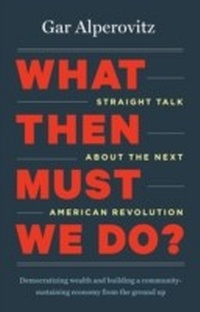
What Then Must We Do?
Description

Never before have so many Americans been more frustrated with our economic system, more fearful that it is failing, or more open to fresh ideas about a new one. The seeds of a new movement demanding change are forming.
But just what is this thing called a new economy, and how might it take shape in America? In What Then Must We Do? Gar Alperovitz speaks directly to the reader about where we find ourselves in history, why the time is right for a new-economy movement to coalesce, what it means to build a new system to replace the crumbling one, and how we might begin. He also suggests what the next system might look like-and where we can see its outlines, like an image slowly emerging in the developing trays of a photographer's darkroom, already taking shape.
He proposes a possible next system that is not corporate capitalism, not state socialism, but something else entirely-and something entirely American.
Alperovitz calls for an evolution, not a revolution, out of the old system and into the new. That new system would democratize the ownership of wealth, strengthen communities in diverse ways, and be governed by policies and institutions sophisticated enough to manage a large-scale, powerful economy.
For the growing group of Americans pacing at the edge of confidence in the old system, or already among its detractors, What Then Must We Do? offers an elegant solution for moving from anger to strategy.
More details
Other editions
Additional editions
Person
Content
- Intro
- Praise
- Title Page
- Copyright Page
- Dedication
- Contents
- A Note About What Can Be Talked About, and in What Ways
- Introduction
- Part I: The System Problem
- 1. How to Detect a System Problem Without Really Trying
- 2. But Hasn't What We Normally Call Politics Done What Needs to Be Done in the Past?
- 3. Flies Number Two and Three in the Traditional Theory of Politics
- 4. The Fading Power of Traditional Politics
- Part II: Systems Old and New: Evolutionary Reconstruction
- 5. A Note About Systems and History and Prehistory And Also About Just Plain Useful Change
- 6. An Initial Way to Think About System Change
- 7. Quiet Democratization Everywhere
- 8. Worker Ownership Redux
- 9. Cultural and Ideological Hegemony, Utopia-and Us
- Part III: "Checkerboard": Emergent Municipal and State Possibilities
- 10. How the Conservatives Buried Adam Smith And What It Might Mean for Us
- 11. Everyday Socialism, All the Time, American-Style
- 12. Checkerboard Strategies, and Beyond
- Part IV: Hot Spots: Banking, Health Care, and Crisis Transformations
- 13. Banking
- 14. Health Care
- 15. Beyond Countervailing Power
- 16. Bigger Possibilities and Precedents
- Part V: Narrow-Minded Efficiency, Public Enterprise, and All That
- 17. Public Enterprise Redux I
- 18. Public Enterprise Redux II
- Part VI: The Emerging Historical Era
- 19. The Emerging Historical Context
- 20. Two Dogs That Are Unlikely to Bark Again
- 21. Stagnation and Punctuated Stagnation
- 22. The Logic of Our Time in History
- Part VII: Conclusion
- 23. The Prehistory of the Next American Revolution
- Afterword
- Acknowledgments
- Notes
- About the Author
