

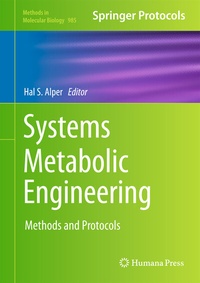
Systems Metabolic Engineering
Description

With the ultimate goal of systematically and robustly defining the specific perturbations necessary to alter a cellular phenotype, systems metabolic engineering has the potential to lead to a complete cell model capable of simulating cell and metabolic function as well as predicting phenotypic response to changes in media, gene knockouts/overexpressions, or the incorporation of heterologous pathways. In Systems Metabolic Engineering: Methods and Protocols , experts in the field describe the methodologies and approaches in the area of systems metabolic engineering and provide a step-by-step guide for their implementation. Four major tenants of this approach are addressed, including modeling and simulation, multiplexed genome engineering, 'omics technologies, and large data-set incorporation and synthesis, all elucidated through the use of model host organisms. Written in the highly successful Methods in Molecular BiologyT series format, chapters include introductions on their respective topics, lists of the necessary materials and reagents, step-by-step, readily reproducible laboratory protocols, and tips on troubleshooting and avoiding known pitfalls.
Comprehensive and cutting-edge, Systems Metabolic Engineering: Methods and Protocols serves as an ideal guide for metabolic engineers, molecular biologists, and microbiologists aiming to implement the most recent approaches available in the field.
More details
Other editions
Additional editions
Content
Genome-Scale Model Management and Comparison.- Automated Genome Annotation and Metabolic Model Reconstruction in the SEED and Model SEED.- Metabolic Model Refinement Using Phenotypic Microarray Data.- Linking Genome-Scale Metabolic Modeling and Genome Annotation.- Resolving Cell Composition through Simple Measurements, Genome-Scale Modeling, and a Genetic Algorithm.- A Guide to Integrating Transcriptional Regulatory and Metabolic Networks Using PROM (Probabilistic Regulation of Metabolism).- Kinetic Modeling of Metabolic Pathways: Application to Serine Biosynthesis.- Computational Tools for Guided Discovery and Engineering of Metabolic Pathways.- Retrosynthetic Design of Heterologous Pathways.- Customized Optimization of Metabolic Pathways by Combinatorial Transcriptional Engineering.- Adaptive Laboratory Evolution for Strain Engineering.- Trackable Multiplex Recombineering for Gene-Trait Mapping in E. coli.- Identification of Mutations in Evolved Bacterial Genomes.- Discovery of Post-Transcriptional Regulatory RNAs Using Next Generation Sequencing Technologies.- 13 C-based Metabolic Flux Analysis: Fundamentals and Practice.- Nuclear Magnetic Resonance Methods for Metabolic Fluxomics.- Using Multiple Tracers for 13 C Metabolic Flux Analysis.- Isotopically Nonstationary 13 C Metabolic Flux Analysis.- Sample Preparation and Biostatistics for Integrated Genomics Approaches.- Targeted Metabolic Engineering Guided by Computational Analysis of Single Nucleotide Polymorphisms (SNPs).- Linking RNA Measurements and Proteomics with Genome-Scale Models.- Comparative Transcriptome Analysis for Metabolic Engineering.- Merging Multiple Omics Datasets In Silico: Statistical Analyses and Data Interpretation.
