

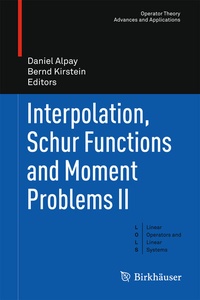
Interpolation, Schur Functions and Moment Problems II
Description

The origins of Schur analysis lie in a 1917 article by Issai Schur in which he constructed a numerical sequence to correspond to a holomorphic contractive function on the unit disk. These sequences are now known as Schur parameter sequences. Schur analysis has grown significantly since its beginnings in the early twentieth century and now encompasses a wide variety of problems related to several classes of holomorphic functions and their matricial generalizations. These problems include interpolation and moment problems as well as Schur parametrization of particular classes of contractive or nonnegative Hermitian block matrices.
This book is primarily devoted to topics related to matrix versions of classical interpolation and moment problems. The major themes include Schur analysis of nonnegative Hermitian block Hankel matrices and the construction of Schur-type algorithms. This book also covers a number of recent developments in orthogonal rational matrix functions, matrix-valued Carathéodory functions and maximal weight solutions for particular matricial moment problems on the unit circle.
Reviews / Votes
From the reviews:
"The contributors of this volume are very productive and they have published a large number of papers in many journals and books. . It may take a while for the reader to get used to it, but once familiar with these habits and the constructs involved, it is good reading. It will be of high interest to anyone who is involved from far or near with Schur analysis and the whole universe of related topics that I sketched in the beginning." (A. Bultheel, The European Mathematical Society, September, 2012)
More details
Other editions
Additional editions
Content
- Intro
- Interpolation, Schur Functions and Moment Problems II
- Contents
- Editorial Introduction
- References
- On the Concept of Invertibility for Sequences of Complex p × q-matrices and its Application to Holomorphic p × q-matrix-valued Functions
- 0. Introduction
- 1. Some notation
- 2. A first look at invertible sequences in Cp×q
- 3. The arithmetic of invertible sequences
- 4. Constructing the inverse sequence
- 5. A closer look at the set Dp×q,? and reciprocal sequences
- 6. Further observations on invertible sequences
- 7. Some considerations on EP sequences
- 8. Moore-Penrose pseudoinverses of holomorphic matrix-malued functions
- Appendix A. The Moore-Penrose inverse of a complex matrix
- References
- On Reciprocal Sequences of Matricial Carathéodory Sequences and Associated Matrix Functions
- 0. Introduction
- 1. Reciprocal sequences
- 2. Matricial Toeplitz non-negative definite sequences
- 3. Matricial Carathéodory sequences
- 4. Reciprocal sequences of matricial Carathéodory sequences
- 5. Matricial Toeplitz non-negative definite sequences generated by reciprocation
- 6. Matricial Carathéodory functions
- 7. Moore-Penrose Inverses of Matricial Carathéodory Functions
- 8. An approach to constructing the reciprocal of a non-negative Hermitian q × q measure
- 9. Matricial R-functions in the open upper half-plane
- Appendix A. Some facts from matrix theory
- Acknowledgement
- References
- On a Schur-type Algorithm for Sequences of Complex p × q-matrices and its Interrelations with the Canonical Hankel Parametrization
- 1. Introduction
- 2. The canonical Hankel parametrization of sequences of p × q-Matrices
- 3. Some observations on finite and infinite sequences of matrices with particular Hankel-properties
- 4. Reciprocal sequences
- 5. Some identities for block Hankel matrices associated with Cauchy products
- 6. Some identities for block Hankel matrices formed by a sequence and its reciprocal
- 7.The shortened negative reciprocal sequence corresponding to a sequence from Dp ×q,?
- 8. The first Schur transform of a sequence of p × q-matrices
- 9. A Schur-type algorithm for sequences of complex p x q-matrices
- 10. Recovering the original sequence from the first Schur transform and first two matrices
- Appendix A. The Moore-Penrose inverse of a complex matrix
- Appendix B. On two particular multiplicative groups of triangular block matrices
- References
- Multiplicative Structure of the Resolvent Matrix for the Truncated Hausdorff Matrix Moment Problem
- 1. Introduction
- 2. Notation and preliminaries
- 2.1. Hausdorff matrix moment problem and the resolvent matrix
- 2.2. The resolvent matrix of the HMM problem
- 3. Main algebraic identities
- 4. The Blaschke-Potapov factors
- Appendix A. Blaschke-Potapov representation of the resolvent matrix, the case of an even number of moments
- Acknowledgment
- References
- On a Special Parametrization of Matricial a-Stieltjes One-sided Non-negative Definite Sequences
- 1. Introduction
- 2. Some facts on the classes of a-Stieltjes one-sided non-negative definite sequences and some of its subclasses
- 3. Canonical Hankel parametrization
- 4. One-sided a-Stieltjes parametrizations
- 5. Completely degenerate a-Stieltjes non-negative definite sequences
- 6. Connection between a-Stieltjes and canonical Hankel parametrization
- 7. Connection between right a- and right ß-Stieltjes parametrizations
- Appendix A. Moore-Penrose inverse
- Appendix B. Some considerations on non-negative Hermitian measures
- References
- On Maximal Weight Solutions of a Moment Problem for Rational Matrix-valued Functions
- 0. Introduction
- 1. Preliminaries
- 2. Some basics on canonical solutions of Problem (R)
- 3. A special family of solutions of Problem (R)
- 4. Characterizations of F(a)n,u in the set of canonical solutions
- 5. An extremal property of F(a)n,u in the solution set of Problem (R)
- 6. Some conclusions from Theorem 5.5
- References
